Other ways to say for your information include for your awareness, please note, I wanted to let you know, for your reference, and just so you know. The best alternative depends on your audience, message, and purpose.
In professional communication, FYI (for your information) shares updates, highlights relevant details, or provides helpful context. However, some situations call for more specific wording. A client notification, a quick coworker message, and a formal business announcement may need different expressions. Understanding the difference between professional email phrases, formal synonyms, polite alternatives, and reference-related expressions helps you communicate clearly without sounding abrupt or overly formal.
Quick Answers
| Question | Answer |
| What is another way to say for your information? | For your awareness, please note, or I wanted to let you know. |
| How do you professionally say for your information in an email? | Use phrases such as “I wanted to bring this to your attention” or “For your awareness.” |
| What does for your information mean? | It introduces information that someone may find useful, relevant, or necessary to know. |
| What is the short form of for your information? | FYI is the standard abbreviation. |
| What is the difference between for your information and for your reference? | FYI shares information, while for your reference usually points to material someone can consult later. |
What Does For Your Information Mean?
For your information means that someone is sharing information they believe another person should know or may find useful. People commonly use the phrase in emails, workplace conversations, notices, and messages. It does not automatically require the recipient to respond or take action.
For example:
“For your information, the client has approved the revised proposal.”
This sentence communicates an update. It tells the recipient about the approval without asking them to do anything.
For Your Information Meaning in Everyday Communication
The phrase introduces information for someone’s knowledge. Its meaning can change slightly depending on context and tone.
People commonly use it to:
- Share updates: For your information, the office will close early tomorrow.
- Provide context: For your information, we discussed this issue last week.
- Highlight relevant details: For your information, the revised figures appear on page three.
- Correct a misunderstanding: For your information, the deadline was moved to Friday.
The final example can sound confrontational, especially during a disagreement. When you want to correct someone politely, explain the fact directly instead.
For example:
Instead of: “For your information, I already sent the report.”
Write: “I sent the report yesterday, and I’ve attached it again here for convenience.”
The second version provides the same information without suggesting frustration.
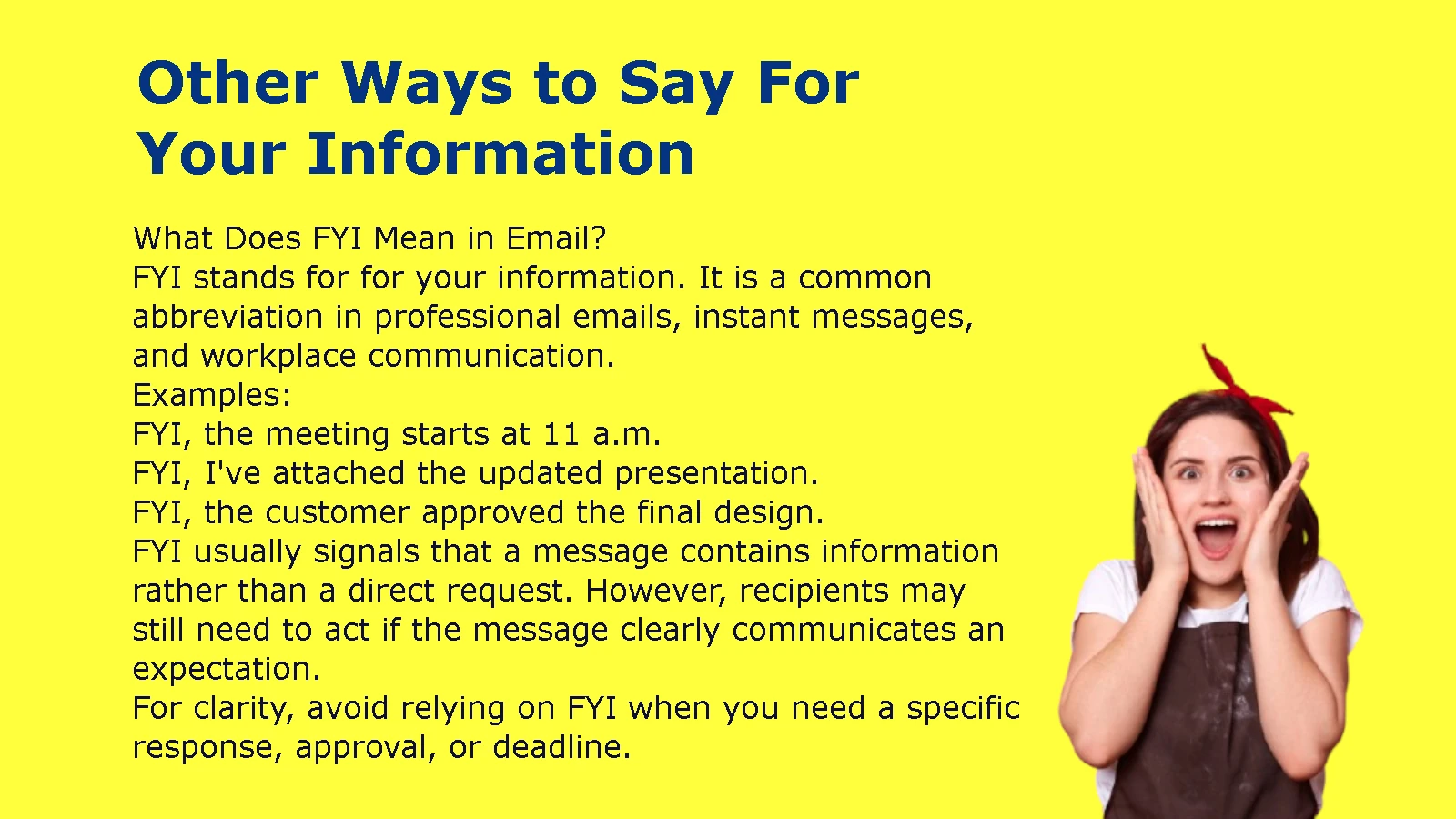
What Does FYI Mean in Email?
FYI stands for for your information. It is a common abbreviation in professional emails, instant messages, and workplace communication.
Examples:
- FYI, the meeting starts at 11 a.m.
- FYI, I’ve attached the updated presentation.
- FYI, the customer approved the final design.
FYI usually signals that a message contains information rather than a direct request. However, recipients may still need to act if the message clearly communicates an expectation.
For clarity, avoid relying on FYI when you need a specific response, approval, or deadline.
Is For Your Information Polite or Rude?
“For your information” is not inherently rude. It can sound neutral, helpful, formal, or irritated depending on how you use it.
Consider these examples:
Neutral: “For your information, the new schedule is attached.”
Helpful: “I wanted to let you know that the team has finished the review.”
Potentially confrontational: “For your information, I was never responsible for that task.”
The phrase becomes more likely to sound dismissive when someone uses it to correct, challenge, or embarrass another person.
When communicating with clients, managers, or colleagues, focus on the information itself. A short explanation often works better than a formal introductory phrase.
Other Ways to Say For Your Information
The best alternatives to for your information communicate your purpose without adding unnecessary words. Some phrases introduce updates, others highlight important details, and a few direct readers toward documents or supporting resources.
Professional Alternatives to For Your Information
Use these expressions in business emails, workplace announcements, and professional messages.
Please note
Use this phrase when you want someone to notice an important detail.
Example: “Please note that the submission deadline is November 12.”
For your awareness
Use this expression when sharing a relevant development without necessarily requesting action.
Example: “For your awareness, the marketing team has revised its launch timeline.”
I wanted to let you know
This sounds natural, polite, and personal. It works well for updates and notifications.
Example: “I wanted to let you know that your application has moved to the next stage.”
I’d like to bring to your attention
Choose this phrase when a particular issue, development, or detail deserves attention.
Example: “I’d like to bring to your attention a discrepancy in the latest invoice.”
Kindly note
This phrase appears in professional correspondence, particularly in some international business settings. Depending on the audience, it may sound formal or slightly directive.
Example: “Kindly note that the office will remain closed on Monday.”
For your consideration
Use this when presenting an idea, proposal, or option for someone to evaluate.
Example: “I’ve attached the revised budget for your consideration.”
Please be advised
This expression suits formal notifications, policies, and official correspondence. It can sound stiff in everyday workplace emails.
Example: “Please be advised that maintenance will begin at 8 p.m.”
Polite and Friendly Alternatives
These phrases work well when you want to keep your communication approachable.
- Just so you know: Just so you know, the team meeting has moved to Thursday.
- Thought you might like to know: Thought you might like to know that the client loved your presentation.
- I wanted to share: I wanted to share the latest project update with you.
- In case it’s helpful: In case it’s helpful, I’ve included the template we used last quarter.
- As a quick heads-up: As a quick heads-up, the office entrance will be temporarily closed.
- I thought I’d keep you informed: I thought I’d keep you informed about the hiring process.
- Wanted to make you aware: Wanted to make you aware of a minor change to the schedule.
These alternatives often feel warmer than traditional business wording. Use them when the relationship allows a conversational tone.
Formal Alternatives for Business Communication
Formal expressions can suit legal notices, corporate announcements, policy updates, and official correspondence. Choose them carefully because excessive formality can make simple messages harder to read.
| Alternative | Best use | Example |
| I am writing to inform you | Official notifications | I am writing to inform you of the revised policy. |
| This is to inform you that | Formal announcements | This is to inform you that registration closes Friday. |
| We would like to notify you | Customer communication | We would like to notify you of an upcoming service interruption. |
| Please take note of | Important instructions | Please take note of the updated requirements. |
| We wish to bring to your attention | Significant matters | We wish to bring to your attention an issue with the submitted documents. |
| Please be informed | Formal notices | Please be informed that the office will reopen Tuesday. |
Writing tip: Formal wording does not automatically make an email more professional. Clear and respectful language usually creates a better impression than complicated phrasing.
Short and Simple Alternatives to FYI
Sometimes, the most effective alternative is a short expression.
- Note: Note: The revised file is attached.
- Heads-up: Heads-up: The deadline has changed.
- For context: For context, the original proposal included three options.
- Just a note: Just a note that the meeting room has changed.
- Worth noting: Worth noting: The latest figures exclude refunds.
- Sharing for visibility: Sharing for visibility: The project timeline is now updated.
Use these expressions in internal chats, brief emails, and team updates.
Keep in mind that “heads-up” usually introduces advance notice, while “for context” provides background information. These phrases overlap with FYI, but they are not exact substitutes in every situation.
Alternatives When Sharing Documents or Resources
When you attach a document, link, report, or reference material, choose wording that explains why the recipient should open it.
For your reference
“I’ve attached the onboarding guide for your reference.”
For your review
“Please find the revised proposal attached for your review.”
This wording suggests that you want the recipient to examine the material.
For your records
“I’m sending a copy of the signed agreement for your records.”
This phrase indicates that the recipient may want to keep the document.
For your convenience
“For your convenience, I’ve included the payment instructions below.”
This highlights an effort to make something easier.
As background information
“As background information, the previous project used a different reporting format.”
This helps someone understand the circumstances surrounding a topic.
Attached for your reference
“Attached for your reference is the latest project schedule.”
This works well when providing a supporting document.
Be precise about the implied action. “For your review” can suggest an expected task, whereas “for your reference” generally indicates that the material is available to consult.
How to Professionally Say For Your Information in Email
To professionally say for your information in an email, select wording that reflects the message’s purpose. Use “I wanted to let you know” for a simple update, “please note” for an important detail, and “for your reference” when sharing supporting material.
Professional communication becomes easier when you explain what happened, why it matters, and what the recipient needs to do next.
Professional Email Examples Using Alternatives to FYI
Sharing a project update
Subject: Project Timeline Update
Hi Sarah,
I wanted to let you know that we’ve completed the first stage of the project. The team expects to finish the next stage by Friday.
Best,
Daniel
Informing a manager about a change
Subject: Revised Meeting Schedule
Hi Alex,
For your awareness, the client meeting has moved from Wednesday to Thursday at 2 p.m.
I’ve updated the calendar invitation as well.
Best,
Morgan
Notifying a client about a deadline
Subject: Updated Submission Deadline
Hello Jordan,
Please note that the submission deadline is now November 12. This change gives your team two additional business days to prepare the documents.
Please let me know if you have any questions.
Best regards,
Taylor
Sharing a document with a colleague
Subject: Updated Project Brief
Hi Chris,
I’ve attached the latest project brief for your reference. It includes the revised objectives and updated delivery dates.
Best,
Jamie
Communicating a policy update
Subject: Updated Remote Work Policy
Hello Team,
I am writing to inform you that our remote work policy will change beginning November 16.
Please review the updated guidelines in the employee handbook.
Thank you,
Human Resources
Copy-and-Paste Email Templates
Use these templates as starting points. Replace the details with accurate information before sending.
Quick informational email
Subject: Quick Update
Hi [Name],
I wanted to let you know that [brief update].
Please reach out if you need any additional details.
Best,
[Your Name]
Formal business update
Subject: [Topic] Update
Dear [Name],
I am writing to inform you that [specific development].
Please review the details below and contact me if you have any questions.
Sincerely,
[Your Name]
Polite follow-up
Subject: Following Up on [Topic]
Hi [Name],
I wanted to share a quick update regarding [topic]. [Explain the latest development.]
Please let me know if you need anything else.
Best,
[Your Name]
Client-facing notification
Subject: Important Update Regarding [Service/Project]
Hello [Name],
I wanted to make you aware of [specific change].
The change will take effect on [date]. [Briefly explain how it affects the client.]
Please contact us if you have questions.
Kind regards,
[Your Name]
Email with an attachment
Subject: [Document Name]
Hi [Name],
I’ve attached [document name] for your reference.
It includes [brief description of its contents]. Please let me know if you’d like any additional information.
Best,
[Your Name]
How to Use FYI in an Email Subject Line
You can use FYI in a subject line when you want to signal that a message contains an informational update.
Examples:
- FYI: Updated Project Timeline
- FYI: New Office Schedule
- FYI: Client Feedback Received
However, a descriptive subject line often provides more value.
Compare:
“FYI”
with:
“Updated Project Timeline: Final Delivery Moved to Friday”
The second subject immediately tells the recipient what changed. It also makes the email easier to find later.
Use FYI in subject lines when your workplace commonly uses the abbreviation and the topic remains clear.
How to Say For Your Information Without Sounding Rude
Professional wording should communicate respect, not just formality.
Use these techniques:
- Explain the reason: “I’m sharing this because it affects Friday’s deadline.”
- Keep corrections neutral: “The deadline in the latest schedule is Friday.”
- Avoid unnecessary emphasis: Excessive capitalization or exclamation marks can make an update feel aggressive.
- Provide useful context: Mention what changed and why it matters.
- State the next step: If someone needs to respond, make the request clear.
For example:
Instead of: “FYI, you used the wrong figures.”
Write: “I noticed a discrepancy in the figures on page two. Could you review them before we finalize the report?”
The revised message identifies the problem and offers a clear next step without blaming the recipient.
Which Alternative to For Your Information Should You Use?
Choose an alternative based on your purpose, audience, and desired tone. “For your awareness” suits relevant updates, “for your reference” introduces supporting material, and “please note” highlights details that deserve attention.
The right phrase makes your intention clear before the reader even reaches the main message.
Comparison Table of Professional FYI Alternatives
| Phrase | Tone | Best use | Example |
| For your awareness | Professional | Relevant updates | For your awareness, the schedule has changed. |
| For your reference | Neutral | Documents and resources | I’ve attached the guide for your reference. |
| Please note | Direct | Important details | Please note that the deadline is Friday. |
| Just so you know | Casual | Friendly updates | Just so you know, the meeting starts at 10. |
| I wanted to let you know | Polite | Personal updates | I wanted to let you know that the report is ready. |
| Please be advised | Formal | Official notifications | Please be advised that the office will close early. |
| For context | Neutral | Background information | For context, we revised the proposal last week. |
Best Alternatives for Different Audiences
When emailing your manager
Use concise and direct wording.
Example: “I wanted to let you know that the revised figures are ready.”
This communicates progress without making the message sound unnecessarily formal.
When emailing a client
Choose a courteous phrase that explains the impact.
Example: “I wanted to make you aware of a change to the delivery schedule.”
If the change requires client approval, request it explicitly.
When messaging a coworker
Friendly alternatives usually work well.
Example: “Just a heads-up, the conference room is booked until noon.”
When emailing a professor or instructor
Use respectful wording that fits the relationship.
Example: “I wanted to let you know that I’ve submitted the revised assignment.”
When contacting a friend
Keep it natural.
Example: “Just so you know, we’re meeting at the usual place.”
Best Alternatives for Sensitive or Important Information
Some situations require more than a generic FYI.
Delivering corrections
“I noticed one detail that needs updating.”
This focuses on the issue rather than the person’s mistake.
Explaining delays
“I wanted to let you know that the delivery date has moved to Monday.”
Add the reason if it helps the recipient plan.
Sharing unexpected changes
“Please note that the venue has changed.”
Follow this with the new location and any necessary instructions.
Communicating policy or compliance updates
“Please review the updated policy, which takes effect on November 16.”
When the recipient must comply, explain the requirement, deadline, and applicable action. Avoid using FYI as a substitute for a clear instruction.
For Your Information vs. For Your Reference
For your information introduces information that someone may need to know, while for your reference usually introduces material someone can consult later. Both phrases appear in professional emails, but they communicate different intentions.
Understanding this distinction helps you avoid vague or misleading messages.
For Your Information vs. For Your Reference Examples
Consider these situations.
Sharing an announcement
“For your information, the office will close at 3 p.m. on Friday.”
The recipient needs to know about a change.
Sharing a document
“I’ve attached the office holiday calendar for your reference.”
The recipient receives material they can check later.
Sharing both information and a resource
“The office will close at 3 p.m. on Friday. I’ve attached the updated holiday calendar for your reference.”
This message communicates the immediate update and provides a useful document.
When Should You Use For Your Reference?
Use “for your reference” when sharing information that supports a current or future task.
Common examples include:
- Contracts and agreements
- Meeting notes
- Reports and spreadsheets
- Project schedules
- Policy documents
- Previous email conversations
- Research materials
For example:
“I’ve included last month’s performance report for your reference as you prepare the new forecast.”
This sentence explains why the resource may be useful.
If you expect the recipient to study or evaluate the material, consider “for your review” instead.
Is For Your Reference More Professional Than FYI?
Neither phrase is automatically more professional. Each serves a different purpose.
“For your reference” suits documents, records, and resources.
“FYI” suits quick updates and information-sharing.
A professional email uses the phrase that accurately describes the message. Choosing a longer expression simply to sound formal can make communication less efficient.
For Your Information Short Form and Abbreviations
The standard short form of for your information is FYI. People use it in workplace emails, messaging apps, and online conversations to introduce information. The abbreviation is widely recognized, but spelling out the phrase can provide a more formal or personal tone.
What Is the Short Form of For Your Information?
FYI = For Your Information
Examples:
- FYI, the updated report is ready.
- FYI, the office will be closed tomorrow.
- FYI, the client requested a new proposal.
FYI generally introduces information rather than a question or instruction.
You can place it at the beginning of a sentence or in a subject line.
Example:
“FYI: The revised presentation is available in the shared folder.”
Use punctuation that makes the message easy to read.
Although FYI is common in professional environments, consider your audience. A full phrase may be clearer when communicating with someone unfamiliar with workplace abbreviations.
What Is the Short Form of For My Information?
There is no widely standardized abbreviation specifically for for my information.
FYI normally stands for “for your information,” not “for my information.”
If you want to express that you are collecting information for yourself, use clear wording instead.
Examples:
- “I’m gathering this information for my records.”
- “I’m collecting these details for my reference.”
- “I’d like to understand this better.”
- “I’m keeping this information for future use.”
Do not assume that FYI means “for my information” simply because the person sending or receiving the message wants to learn something.
Common FYI Email Examples
Here are practical ways to use FYI in workplace messages.
Sharing a document
“FYI, I’ve uploaded the final report to the shared folder.”
Announcing a meeting change
“FYI, tomorrow’s meeting will begin at 9:30 a.m.”
Providing background
“FYI, the client requested these changes during our last call.”
Sharing an internal update
“FYI, the design team has approved the revised mockup.”
Each example communicates information without explicitly requesting a response.
Should You Use FYI in Formal Emails?
FYI can work in formal workplaces, but its suitability depends on company culture, recipient expectations, and message sensitivity.
Use FYI when:
- You are sharing a routine update.
- The recipient understands the abbreviation.
- The message does not require extensive explanation.
- Your workplace commonly uses concise communication.
Spell out the phrase or use a more specific alternative when:
- You are contacting an unfamiliar client.
- The message concerns a sensitive issue.
- The information requires careful explanation.
- The abbreviation could make the message seem abrupt.
For instance, “I wanted to let you know that your appointment has changed” may sound more considerate than “FYI, your appointment has changed.”
Common Mistakes to Avoid When Using FYI and Its Alternatives
The most common mistake is choosing a phrase without considering what the recipient should understand or do. FYI works well for information-sharing, but it can create confusion when the message requires a decision, response, or action.
Using FYI When You Actually Need Action
FYI does not clearly communicate a deadline or responsibility.
Weak example:
“FYI, the contract needs approval.”
Better example:
“Could you approve the contract by Thursday at 3 p.m.?”
The revised version identifies the action and deadline.
If you want to share context and request action, combine both:
“For your awareness, the client has revised the contract. Please review the updated terms and send your approval by Thursday.”
This message makes the purpose clear.
Confusing For Your Information With For Your Reference
These expressions serve related but different functions.
Incorrectly vague:
“For your reference, the meeting has been canceled.”
This is not necessarily wrong, but it may not be the clearest choice if the cancellation is the main point.
Clearer:
“Please note that today’s meeting has been canceled.”
You can then add:
“I’ve attached the revised meeting schedule for your reference.”
The first sentence communicates the news. The second introduces the resource.
Overusing Formal Phrases
Long introductions can bury the main message.
Wordy:
“I am writing this email to bring to your kind attention the fact that our scheduled meeting has been moved.”
Clearer:
“Please note that our meeting has moved to Thursday.”
Professional communication values clarity. Use a longer introduction only when it adds useful context or an appropriate personal touch.
Sending FYI Messages Without Context
A message that contains only “FYI” may leave the recipient wondering why they received it.
Weak example:
“FYI: Attached.”
Better example:
“I’ve attached the revised budget for your reference. It includes the updated vendor estimates.”
The extra sentence explains the attachment’s value.
Practical rule: Before sending an FYI message, ask yourself: “Why does this person need to know this?”
If you cannot answer that question, consider whether the message is necessary.
Frequently Asked Questions
What Is Another Way to Say For Your Information?
You can say “for your awareness,” “please note,” “I wanted to let you know,” “just so you know,” or “for your reference.” Choose the phrase based on your purpose. Use “please note” for important details and “for your reference” when sharing supporting materials.
How Do You Professionally Say For Your Information?
Use a clear, respectful phrase such as “I wanted to bring this to your attention,” “For your awareness,” or “I wanted to let you know.” For example: “I wanted to let you know that the project deadline has moved to Friday.”
How Do You Say For Your Information in an Email?
You can write, “For your awareness, the meeting has moved to Thursday,” or “I wanted to let you know that the report is ready.” If you attach a document, “I’ve attached the report for your reference” is often more precise.
What Does FYI Mean in a Text or Email?
FYI stands for “for your information.” It introduces information that the recipient may find useful or relevant. People commonly use it in emails, text messages, and workplace chats to share updates without necessarily requesting a response.
Is FYI Considered Rude or Unprofessional?
FYI is not inherently rude or unprofessional. It works well for routine updates, but it can sound abrupt when used to correct someone or deliver sensitive information. A complete sentence with helpful context often creates a more respectful tone.
What Is the Difference Between FYI and For Your Reference?
FYI usually introduces information someone should know, while “for your reference” typically introduces a document or resource someone can consult later. For example, share a schedule change as an FYI and attach the updated schedule for reference.
Conclusion: Choose the Right Alternative to For Your Information
The best alternative to for your information depends on what you want your reader to understand.
Use for your awareness for professional updates, please note for important details, I wanted to let you know for polite communication, and for your reference when sharing supporting materials.
If you need a quick message, FYI remains a useful abbreviation. However, a clear sentence often works better when the topic is sensitive, the recipient is unfamiliar with you, or the message requires action.