Saying “Have a good day” is a simple and friendly way to wish someone a pleasant, enjoyable, or successful day. If you’re looking for other ways to say “Have a good day,” there are plenty of alternatives that can sound more warm, casual, professional, cheerful, or personal depending on who you’re speaking to and the situation.
The phrase “Have a good day” is commonly used when ending a conversation, leaving a workplace, finishing a customer interaction, or saying goodbye to someone. However, expressions such as “Enjoy your day,” “Have a great day,” “Take care,” “Have a wonderful day,” “Hope you have a good one,” and “Wishing you a pleasant day” can add a different tone while expressing a similar idea.
In this guide, you’ll learn what to say instead of “Have a good day,” which alternatives work in casual and professional situations, and how to choose the right expression for friends, coworkers, customers, clients, and other people. You’ll also see natural examples to help you use each phrase correctly.
By the end, you’ll have a useful collection of natural ways to say “Have a good day” without sounding repetitive, overly formal, or unnatural.
Best Alternatives to “Have a Good Day”
Here are 27 natural expressions you can use instead.
1. Have a Great Day
Meaning: You hope the person has a particularly enjoyable or successful day.
Best for: Almost any everyday situation.
Tone: Friendly and positive.
Example:
“Thanks for your help today. Have a great day!”
This is probably the easiest replacement for “have a good day.” It works with friends, coworkers, customers, acquaintances, and people you don’t know well.
Because “great” sounds slightly more enthusiastic than “good,” it can make a routine farewell feel a little warmer.
2. Have a Wonderful Day
Meaning: You wish someone a very pleasant and enjoyable day.
Best for: Personal messages, customer service, thoughtful conversations, and friendly emails.
Tone: Warm and positive.
Example:
“Thank you for taking the time to speak with me. Have a wonderful day!”
“Wonderful” adds warmth without making the expression overly emotional. It’s a useful choice when you want to sound especially courteous.
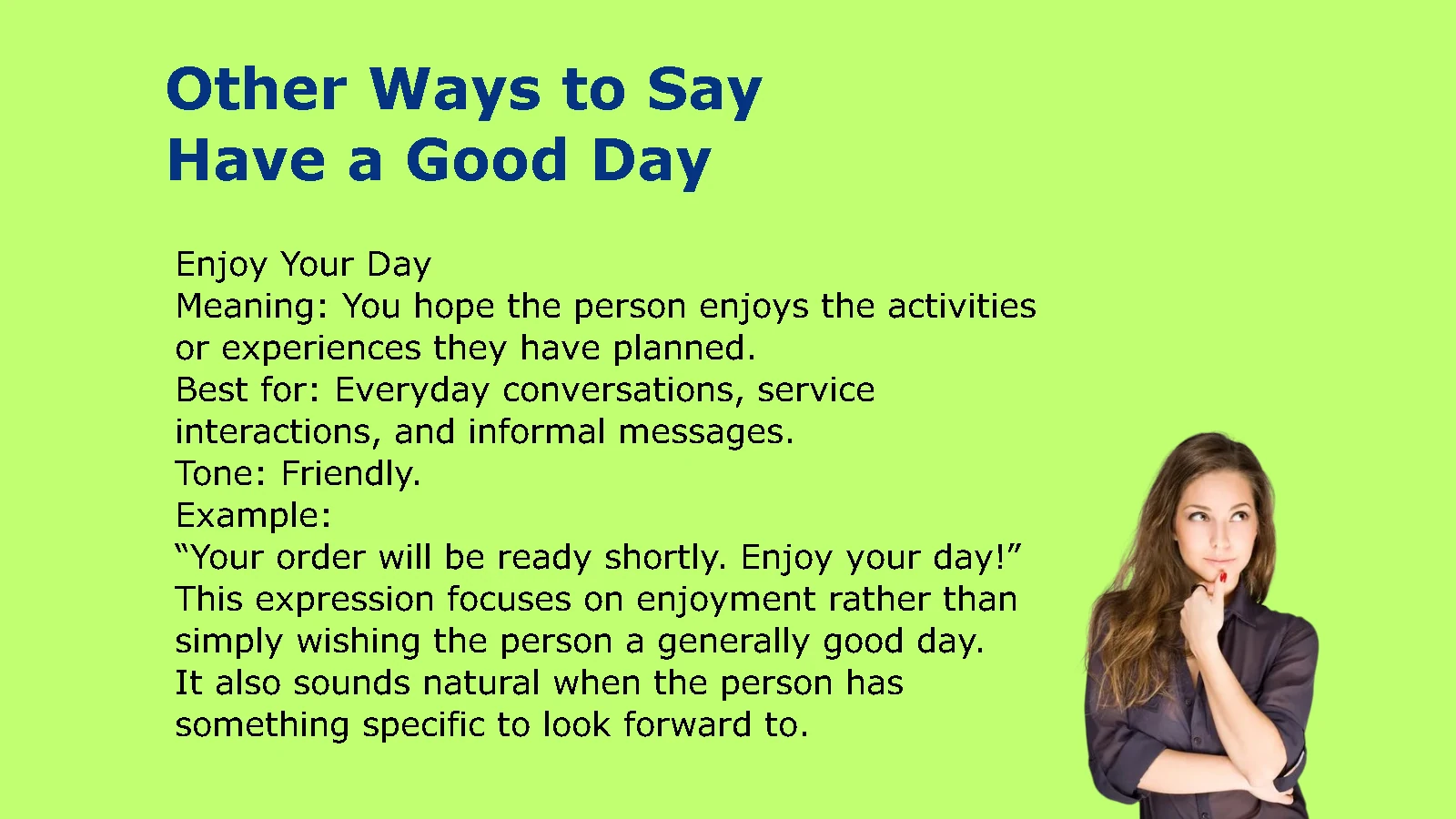
3. Enjoy Your Day
Meaning: You hope the person enjoys the activities or experiences they have planned.
Best for: Everyday conversations, service interactions, and informal messages.
Tone: Friendly.
Example:
“Your order will be ready shortly. Enjoy your day!”
This expression focuses on enjoyment rather than simply wishing the person a generally good day.
It also sounds natural when the person has something specific to look forward to.
4. Have a Nice Day
Meaning: You wish someone a pleasant day.
Best for: General conversations, customer interactions, and everyday farewells.
Tone: Neutral and polite.
Example:
“Here’s your receipt. Have a nice day!”
“Have a nice day” is very close in meaning to “have a good day.” If you’re simply looking for a straightforward alternative, this is one of the safest choices.
5. Have a Lovely Day
Meaning: You hope someone has a pleasant, enjoyable, or especially pleasant day.
Best for: Friendly conversations, personal messages, and warm customer interactions.
Tone: Warm.
Example:
“Thanks again for coming by. Have a lovely day!”
This sounds a little more personal and expressive than “have a nice day.” It’s especially useful when you want your farewell to feel warm rather than routine.
6. Have a Fantastic Day
Meaning: You wish someone an exceptionally enjoyable day.
Best for: Friends, enthusiastic conversations, and upbeat messages.
Tone: Cheerful and enthusiastic.
Example:
“Good luck with your presentation. Have a fantastic day!”
The word “fantastic” makes this more energetic than “have a good day.” It works best when the surrounding conversation is already positive.
7. Have an Amazing Day
Meaning: You hope someone has a particularly enjoyable or memorable day.
Best for: Friends, family, social media messages, and upbeat conversations.
Tone: Enthusiastic.
Example:
“Enjoy the concert tonight, and have an amazing day!”
This is a natural choice when you’re genuinely excited about something the other person is doing.
For a formal business email, however, “I hope you have a great day” may sound more restrained.
8. Have a Beautiful Day
Meaning: You wish someone a particularly pleasant or peaceful day.
Best for: Personal messages and warm conversations.
Tone: Warm and affectionate.
Example:
“Thanks for talking with me this morning. Have a beautiful day!”
“Beautiful” can sound more personal than “good” or “nice,” so consider your relationship with the person before using it in a formal workplace setting.
9. Enjoy the Rest of Your Day
Meaning: You hope the remaining part of the person’s day goes well.
Best for: Conversations that happen after the day has already started.
Tone: Polite and friendly.
Example:
“I’m glad we could resolve the issue. Enjoy the rest of your day!”
This is one of the most useful alternatives when it’s already morning or afternoon.
Instead of wishing someone an entire good day when part of it has passed, you acknowledge the time naturally.
10. Have a Good One
Meaning: A casual way to wish someone a good experience or day.
Best for: Friends, coworkers, casual customer interactions, and everyday conversations.
Tone: Casual.
Example:
“I’m heading out. Have a good one!”
This expression is less formal than “have a good day,” making it especially useful in relaxed conversations.
The word “one” refers to the occasion or period you’re talking about, which in this context is usually the day.
11. Take Care
Meaning: A friendly way of saying goodbye while expressing a general wish for the person’s well-being.
Best for: Friends, coworkers, acquaintances, and everyday messages.
Tone: Friendly.
Example:
“Thanks for catching up with me. Take care!”
“Take care” isn’t a literal synonym for “have a good day.” Instead, it serves a similar farewell function.
That distinction matters. Use it when you’re saying goodbye and want to leave the conversation on a warm note.
12. Take It Easy
Meaning: A casual way to wish someone a relaxed or uncomplicated time.
Best for: Friends and informal conversations.
Tone: Casual.
Example:
“I’m going to let you get back to work. Take it easy!”
This expression can suggest relaxation, so it works particularly well when someone is finishing work, heading home, or taking some time off.
It would sound less appropriate in a highly formal business email.
13. Hope You Have a Great Day
Meaning: You express your hope that the person’s day goes well.
Best for: Emails, text messages, customer communication, and friendly conversations.
Tone: Warm and polite.
Example:
“Thanks for getting back to me so quickly. Hope you have a great day!”
This is especially useful in writing because it feels warm without sounding like a stock farewell.
For professional correspondence, it’s also easy to adjust:
“I hope you have a great day.”
That version is slightly more polished.
14. Hope You Have a Wonderful Day
Meaning: You hope the person experiences a pleasant and enjoyable day.
Best for: Personal messages, friendly emails, and warm professional communication.
Tone: Warm.
Example:
“Thank you for your thoughtful response. I hope you have a wonderful day.”
This is a good option when “have a good day” feels too ordinary but “have an amazing day” feels too enthusiastic.
15. Wishing You a Great Day
Meaning: You are sending someone a positive wish for their day.
Best for: Emails, notes, cards, and written messages.
Tone: Polite and warm.
Example:
“Thank you again for your assistance. Wishing you a great day!”
“Wishing you” is particularly natural in writing. It can sound a little more deliberate than the direct imperative in “have a great day.”
16. Wishing You a Wonderful Day
Meaning: You are expressing a warm wish that someone has a pleasant day.
Best for: Personal notes, cards, emails, and thoughtful messages.
Tone: Warm.
Example:
“Thank you for being there when I needed your help. Wishing you a wonderful day.”
This phrase is useful when you want your closing to feel thoughtful without becoming overly sentimental.
17. Make It a Great Day
Meaning: An encouraging way of telling someone to make the most of their day.
Best for: Motivational messages, friends, coworkers, and upbeat conversations.
Tone: Encouraging and energetic.
Example:
“You’ve got everything ready for the presentation. Make it a great day!”
Unlike “have a great day,” this phrase puts a little more emphasis on the person’s own actions.
It’s a good choice when you’re trying to leave someone with an encouraging thought.
18. Enjoy the Rest of Your Week
Meaning: You hope the remaining days of the week go well.
Best for: Friday conversations or situations where you won’t speak again until later.
Tone: Friendly.
Example:
“Thanks for meeting with me today. Enjoy the rest of your week!”
This isn’t a direct replacement for every use of “have a good day,” but it can be more appropriate when you’re saying goodbye for several days.
19. Have a Pleasant Day
Meaning: You wish someone an agreeable and enjoyable day.
Best for: Customer service, formal communication, and professional settings.
Tone: Formal and polite.
Example:
“Thank you for contacting our office. Have a pleasant day.”
This is more formal than “have a good day.” It can work well in situations where you want to sound courteous and professional.
20. Have a Productive Day
Meaning: You hope someone accomplishes useful work or makes good progress during the day.
Best for: Coworkers, employees, business contacts, and work conversations.
Tone: Professional.
Example:
“Good luck with the project deadline. Have a productive day!”
This phrase changes the emphasis from general enjoyment to successful work or progress.
Don’t use it when someone is heading out for vacation or relaxing at home. “Have a relaxing day” would make more sense there.
21. Have a Relaxing Day
Meaning: You hope someone gets a chance to rest and unwind.
Best for: Weekends, vacations, days off, and personal conversations.
Tone: Friendly and caring.
Example:
“Forget about work today and enjoy some time for yourself. Have a relaxing day!”
This is a useful alternative when you know the person is taking time off.
22. Have a Fun Day
Meaning: You hope someone enjoys themselves and has an entertaining time.
Best for: Friends, families, children, parties, outings, and recreational plans.
Tone: Casual and cheerful.
Example:
“Enjoy the amusement park with the kids. Have a fun day!”
The phrase works particularly well when you know what the person is planning to do.
23. Enjoy Your Afternoon
Meaning: You wish someone an enjoyable afternoon.
Best for: Afternoon conversations and professional or personal farewells.
Tone: Polite and natural.
Example:
“Thanks for coming in today. Enjoy your afternoon!”
This can sound more natural than “have a good day” when it’s already well into the afternoon.
24. Enjoy Your Evening
Meaning: You hope someone has a pleasant evening.
Best for: Evening conversations, customer interactions, and social situations.
Tone: Polite and friendly.
Example:
“Thanks for joining us tonight. Enjoy your evening!”
It’s a simple way to match your farewell to the time of day.
25. Have a Wonderful Rest of Your Day
Meaning: You hope the remaining part of someone’s day goes especially well.
Best for: Professional emails, customer service, and warm everyday conversations.
Tone: Warm and polite.
Example:
“I’m glad we were able to sort everything out. Have a wonderful rest of your day!”
This expression combines the warmth of “wonderful” with the time specific meaning of “rest of your day.”
26. All the Best for Today
Meaning: You are wishing someone well as they go through the day.
Best for: Written communication, professional messages, and situations involving a specific task or event.
Tone: Professional and supportive.
Example:
“Good luck with your presentation this afternoon. All the best for today!”
This isn’t an exact synonym for “have a good day.” It is better understood as a general good wish, particularly when the person has something important happening.
27. Enjoy Your Day Ahead
Meaning: You are wishing someone an enjoyable day that is about to begin or continue.
Best for: Friendly written messages and good wishes.
Tone: Warm.
Example:
“Thanks for checking in this morning. Enjoy your day ahead!”
This phrase works best when you’re sending a message early in the day or referring to the activities someone has coming up.
In ordinary conversation, “have a great day” or “enjoy your day” will often sound more natural.
Professional Ways to Say “Have a Good Day”
When you’re writing to a customer, coworker, manager, client, or business contact, you don’t necessarily need a formal sounding expression.
Professional communication can still be warm.
Here are some useful choices:
- I hope you have a great day.
- Have a pleasant day.
- Have a productive day.
- Enjoy the rest of your day.
- Wishing you a great day.
- Have a wonderful rest of your day.
- Enjoy your afternoon.
- Enjoy your evening.
For a customer
“Thank you for contacting us. I hope you have a great day.”
For a coworker
“Thanks for your help with this. Have a great day!”
For a client
“Thank you for meeting with me today. I hope you have a wonderful rest of your day.”
For a manager
“Thank you for reviewing the proposal. Have a great day.”
The main point is that professional doesn’t have to mean cold. A simple, genuine closing often works better than an unnecessarily formal phrase.
Casual Ways to Say “Have a Good Day”
With friends and people you know well, you have more freedom to sound relaxed.
Try:
- Have a good one!
- Have a great day!
- Have an amazing day!
- Take care!
- Take it easy!
- Have fun!
- Enjoy your day!
- Have a fun day!
- Enjoy the rest of your day!
For example:
“I’m heading home. Have a good one!”
Or:
“Have fun at the concert tonight!”
The second example doesn’t literally contain the word “day,” but it serves the same basic purpose: wishing someone well as you say goodbye.
Ways to Say “Have a Good Day” in an Email
The best email closing depends on how formal the message is.
Warm and professional
“Thank you for your time. I hope you have a great day.”
Friendly and professional
“Thanks for getting back to me. Have a great day!”
Formal
“Thank you for your assistance. Have a pleasant day.”
Warm
“I appreciate your help. Wishing you a wonderful day.”
Time specific
“Thank you for meeting with me. Enjoy the rest of your afternoon.”
When the person has a busy workday
“Thanks for taking care of this. Have a productive day!”
Avoid forcing a cheerful phrase into every professional email. If you’re discussing a serious issue, a simple “Thank you for your help” may be more appropriate than an overly enthusiastic “Have an amazing day!”
“Have a Good Day” vs. “Have a Great Day”
These expressions are almost identical in purpose.
The difference is mainly one of intensity.
Have a good day sounds neutral and straightforward.
Have a great day sounds a little more enthusiastic and positive.
Compare:
“Thanks for stopping by. Have a good day.”
“Thanks for stopping by. Have a great day!”
Both are natural. The second simply carries more enthusiasm.
For everyday conversations, “have a great day” is one of the easiest replacements when you want to avoid repeating “have a good day.”
“Have a Good Day” vs. “Enjoy Your Day”
These expressions overlap, but they emphasize slightly different ideas.
Have a good day is a general good wish.
Enjoy your day focuses specifically on the person’s enjoyment.
For example:
“Your appointment is confirmed. Have a good day.”
This is a general farewell.
By contrast:
“Enjoy your day at the beach!”
Here, the person already has a particular activity planned, so “enjoy” fits naturally.
“Have a Good Day” vs. “Take Care”
Take care is a farewell rather than a direct wish for a good day.
You can use it when you don’t want to mention the day at all:
“Thanks for catching up. Take care!”
The expression works especially well when you’re ending a personal conversation.
Meanwhile:
“Thanks for catching up. Have a great day!”
puts the emphasis on the person’s day.
Both are natural, but they aren’t exact synonyms.
“Have a Good Day” vs. “Enjoy the Rest of Your Day”
The difference is mostly related to timing.
Have a good day can be used at the beginning or during the day.
Enjoy the rest of your day makes sense when part of the day has already passed.
For example, if you finish a meeting at 3 p.m., you could say:
“Thanks for meeting with me. Enjoy the rest of your day.”
That sounds more specific than simply saying:
“Have a good day.”
Best Alternatives for Different Situations
Choosing the right expression becomes easier when you focus on the situation.
| Situation | Natural Choice | Why It Works |
| Everyday farewell | Have a great day | Warm and versatile |
| Casual conversation | Have a good one | Relaxed |
| Friend | Have an amazing day | Enthusiastic |
| Customer service | Have a pleasant day | Polite and professional |
| Workplace | Have a great day | Friendly without being too casual |
| Client email | I hope you have a great day | Warm and professional |
| Late afternoon | Enjoy the rest of your day | Fits the time |
| Evening | Enjoy your evening | Time specific |
| Day off | Have a relaxing day | Matches the person’s plans |
| Busy workday | Have a productive day | Work focused |
| Weekend plans | Have a fun day | Casual and cheerful |
| Written note | Wishing you a wonderful day | Thoughtful |
| Formal setting | Have a pleasant day | More formal |
| Friend leaving | Take care | Natural farewell |
| Casual goodbye | Take it easy | Relaxed |
How to Choose the Right Alternative
You don’t need to search for the most creative way to say “have a good day.” The most natural phrase is usually the one that fits the moment.
Consider these four questions:
1. Who are you talking to?
A friend gives you more freedom to say:
“Have an amazing day!”
A client might be better suited to:
“I hope you have a great day.”
2. What time is it?
If it’s late afternoon, use:
“Enjoy the rest of your day.”
If it’s evening, try:
“Enjoy your evening.”
A time specific farewell can sound more natural than repeating the same phrase throughout the day.
3. What is the person doing?
If they’re working:
“Have a productive day.”
If they’re relaxing:
“Have a relaxing day.”
If they’re going to an event:
“Have a fun day!”
The more your farewell connects to the person’s plans, the more personal it can feel.
4. How enthusiastic do you want to sound?
Use “have a nice day” for a neutral tone.
Choose “have a great day” for a warmer tone.
Try “have an amazing day” when you want to sound enthusiastic.
There is no need to use the strongest expression every time. A simple phrase often sounds more genuine.
Common Mistakes to Avoid
Using “Have a Productive Day” for Everyone
“Have a productive day” is most natural in work related situations. Saying it to someone who’s taking a relaxing vacation may sound unintentionally strange.
Instead, say:
“Have a relaxing day!”
Using Overly Casual Expressions in Formal Emails
“Have a good one!” is perfectly natural in casual conversation, but it may not be the best closing for a formal business message.
Use:
“I hope you have a great day.”
or:
“Have a pleasant day.”
Treating Every Alternative as an Exact Synonym
Expressions such as “take care,” “take it easy,” and “all the best” serve a similar farewell or well wishing function, but they don’t literally mean the same thing as “have a good day.”
That distinction is useful when you’re trying to write accurately.
Overdoing Enthusiasm
Not every situation calls for:
“Have an absolutely amazing, fantastic, wonderful day!”
One natural phrase is enough.
Simple language often sounds more sincere.
Common Questions
What is another way to say “have a good day”?
Some natural alternatives are have a great day, have a nice day, enjoy your day, have a wonderful day, have a lovely day, enjoy the rest of your day, and have a good one.
What is a more professional way to say “have a good day”?
Try “I hope you have a great day,” “have a pleasant day,” “wishing you a great day,” or “enjoy the rest of your day.”
For work specific situations, “have a productive day” can also work.
What is a casual way to say “have a good day”?
You can say “have a good one,” “have a great day,” “take care,” “take it easy,” or “have fun.”
What is a polite way to say “have a good day”?
“Have a nice day,” “have a pleasant day,” “enjoy your day,” and “I hope you have a great day” are all polite options.
How do you say “have a good day” without sounding repetitive?
Change the expression according to the situation. Try “enjoy your day,” “have a great day,” “take care,” “enjoy the rest of your day,” or “have a good one.”
What can I say instead of “have a good day” in an email?
For a professional email, use “I hope you have a great day,” “wishing you a great day,” “have a pleasant day,” or “enjoy the rest of your day.”
Is “have a great day” better than “have a good day”?
Neither is universally better. “Have a great day” sounds somewhat more enthusiastic, while “have a good day” is neutral and straightforward. Choose according to the tone you want.
Is “have a good one” the same as “have a good day”?
In many casual situations, “have a good one” can function as a replacement for “have a good day.” However, “one” is more general and can refer to the current occasion or period rather than explicitly naming the day.
What should I say to a customer instead of “have a good day”?
You can say “Have a great day,” “have a pleasant day,” “enjoy the rest of your day,” or “I hope you have a great day.”
What is a warm way to say “have a good day”?
Try “have a wonderful day,” “have a lovely day,” “have a beautiful day,” or “wishing you a wonderful day.”
What can I say instead of “have a good day” to a friend?
Natural choices include “have a great day,” “have an amazing day,” “have a good one,” “take care,” “take it easy,” and “have fun.”
Final Thoughts
There are plenty of other ways to say have a good day, but you don’t need to use the most elaborate expression you can find. The best choice is the one that matches the person, situation, and time of day.
For a versatile everyday alternative, “have a great day” is an easy choice. In a professional setting, “I hope you have a great day” or “have a pleasant day” works well. When part of the day has already passed, “enjoy the rest of your day” feels more natural. For friends, “have a good one” or “take care” keeps the farewell relaxed.
Ultimately, natural language isn’t about replacing every familiar phrase with a complicated one. It’s about choosing words that fit the moment and sound like something you’d genuinely say.













