Other ways to say “with that being said” include however, that said, nevertheless, even so, despite this, and with that in mind. The best alternative depends on whether you want to introduce a contrasting opinion, acknowledge a limitation, explain a consequence, or move your discussion forward. For academic writing, professional emails, and everyday conversations, choosing the right transition makes your sentences clearer and your arguments easier to follow.
The phrase “with that being said” is a transition expression that connects one thought to another. Writers often use it to acknowledge a previous point before adding a qualification or a different perspective. However, it does not always mean the same thing as “therefore,” “however,” or “nevertheless.” Each expression communicates a different relationship between ideas.
This guide explains the meaning of “with that being said,” its formal and academic alternatives, synonyms for essays, antonyms, punctuation, and sentence examples. You will also learn how to select a transition that fits your intended meaning instead of replacing one phrase with another that sounds similar but changes your message.
What Does “With That Being Said” Mean?
“With that being said” means that you acknowledge something previously mentioned before introducing another point, qualification, or perspective. The expression helps connect related ideas while signaling that the next statement may add a limitation or shift the discussion. Depending on the context, it can introduce agreement, contrast, or a practical conclusion.
Definition of “With That Being Said”
The expression “with that being said” is a transitional phrase used to connect statements in a conversation or piece of writing. It tells the reader to consider the previous point while paying attention to what comes next.
For example:
- “The restaurant has excellent food. With that being said, the prices are higher than average.”
- “The research provides useful insights. With that being said, the sample size limits how widely we can apply the findings.”
- “The proposal requires additional funding. With that being said, I believe it offers long-term value.”
In each example, the writer acknowledges an existing point before adding a qualification or another consideration.
The phrase often performs three functions:
- Acknowledgment: Recognizes the validity of a previous statement.
- Qualification: Adds a limitation or exception to an earlier point.
- Transition: Moves the discussion toward another relevant idea.
Although people sometimes use the phrase to introduce a conclusion, it does not automatically establish a logical consequence. If the second statement follows directly from the first, “therefore” or “as a result” may communicate the relationship more precisely.
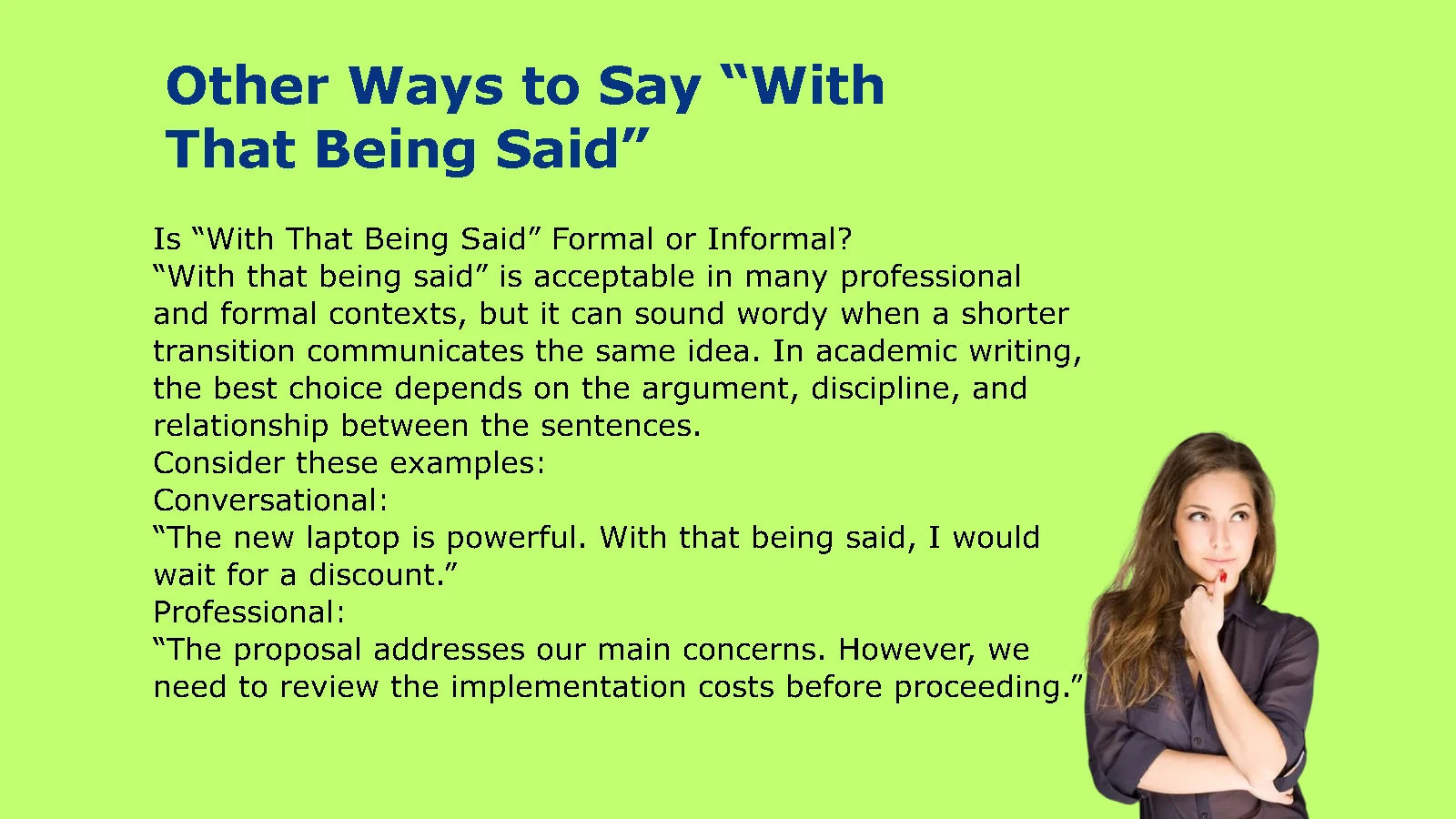
Is “With That Being Said” Formal or Informal?
“With that being said” is acceptable in many professional and formal contexts, but it can sound wordy when a shorter transition communicates the same idea. In academic writing, the best choice depends on the argument, discipline, and relationship between the sentences.
Consider these examples:
Conversational:
“The new laptop is powerful. With that being said, I would wait for a discount.”
Professional:
“The proposal addresses our main concerns. However, we need to review the implementation costs before proceeding.”
Academic:
“The findings support the initial hypothesis. Nevertheless, the limited sample size prevents us from drawing broad conclusions.”
All three examples connect related ideas, but the transitions differ in length and precision.
For a research paper, “however,” “nevertheless,” and “despite this” often make the relationship between claims clearer. In an email or a discussion, “with that being said” may sound more natural and conversational.
The phrase is not inherently incorrect or unprofessional. The main concern is whether it adds meaning or simply makes the sentence longer.
How to Use “With That Being Said” in a Sentence
Place “with that being said” at the beginning of a sentence when you want to acknowledge the previous point before introducing a related thought. Follow it with a comma. Make sure the new statement connects logically to the sentence before it.
Here are examples from different contexts.
Everyday conversation
“I know you have a busy schedule. With that being said, could we meet for lunch on Friday?”
Academic writing
“The study identifies a clear relationship between sleep and concentration. With that being said, further research is needed to establish causation.”
Business communication
“The current design meets most of our requirements. With that being said, we should address the accessibility issues before launch.”
Personal opinion
“I enjoy working from home. With that being said, I sometimes miss collaborating with my colleagues in person.”
A useful test is to ask whether the second sentence acknowledges, qualifies, or shifts the first statement. If it simply states a direct result, choose a transition that expresses that result more accurately.
35+ Other Ways to Say “With That Being Said”
The best alternatives to “with that being said” depend on your purpose. Some introduce contrast, others acknowledge an exception, and some connect a statement to its logical consequence. Grouping these expressions by function makes it easier to select one that fits your sentence.
Formal Alternatives to “With That Being Said”
Use these alternatives when you want a polished tone in professional communication, reports, or formal discussions.
Nevertheless
Meaning: Despite what was previously mentioned.
Example: “The initial results were disappointing. Nevertheless, the team continued testing the product.”
Best for situations where a previous difficulty does not prevent the next statement from being true.
Nonetheless
Meaning: Even so; despite the preceding circumstances.
Example: “The proposal has several limitations. Nonetheless, it offers a practical starting point.”
“Nonetheless” is similar to “nevertheless” and often works well in formal writing.
Despite this
Meaning: Even though the previous point is true.
Example: “The project exceeded its original budget. Despite this, the client approved the final delivery.”
This phrase works particularly well when the second statement contrasts with an expected outcome.
Even so
Meaning: Despite what has just been said.
Example: “The journey takes nearly six hours. Even so, many travelers consider it worthwhile.”
“Even so” is concise and natural in both conversation and general writing.
Having said that
Meaning: After acknowledging a point, the speaker introduces a qualification or another perspective.
Example: “The software is easy to use. Having said that, its reporting features need improvement.”
This alternative is close in meaning to “with that being said,” although it may sound slightly more conversational.
That said
Meaning: A shorter way to acknowledge a previous statement before qualifying it.
Example: “The apartment is small. That said, its location is excellent.”
This is one of the most versatile alternatives because it is brief, natural, and suitable for many professional settings.
All the same
Meaning: Despite the circumstances or previous argument.
Example: “The task was difficult. All the same, the team completed it before the deadline.”
Use it when you want to emphasize persistence or an outcome that holds despite a challenge.
Academic Alternatives for Essays
Academic writing benefits from transitions that express the exact relationship between claims. These alternatives can help you move between evidence, counterarguments, limitations, and interpretations.
However
Meaning: Introduces a contrast or qualification.
Example: “The survey suggests that customers prefer online shopping. However, the results vary significantly by age group.”
Use “however” when the next statement contrasts with the previous one.
Nevertheless
Meaning: Indicates that a point remains valid despite a limitation or opposing consideration.
Example: “The experiment involved a relatively small sample. Nevertheless, the results provide a useful basis for further investigation.”
Although this is true
Meaning: Acknowledges a statement before introducing a limitation or counterpoint.
Example: “Although this is true, the available evidence does not establish a direct causal relationship.”
This wording can be useful when you want to make the concession explicit. Avoid using it mechanically at the beginning of every paragraph.
In contrast
Meaning: Introduces a difference between two ideas, findings, groups, or outcomes.
Example: “Urban participants reported higher public transportation use. In contrast, rural participants relied more heavily on private vehicles.”
Use this phrase when the contrast itself matters.
Despite this
Meaning: Introduces a statement that remains true even after considering a previous fact.
Example: “The intervention produced only modest improvements. Despite this, participants reported greater confidence.”
On the other hand
Meaning: Presents a different perspective or contrasting consideration.
Example: “Online courses offer flexibility. On the other hand, some students benefit more from face-to-face instruction.”
This expression is especially useful when comparing two approaches, provided the contrast is clear.
At the same time
Meaning: Recognizes another consideration that exists alongside the first.
Example: “The policy may reduce operating costs. At the same time, it could increase the workload for existing employees.”
Use it when both statements deserve consideration rather than treating the second as a direct contradiction.
Notwithstanding this
Meaning: Despite the previously mentioned fact or circumstance.
Example: “Notwithstanding these limitations, the report provides a useful overview of current trends.”
This is a formal option. In most student essays, “despite these limitations” will sound more natural.
Alternatives That Introduce a Conclusion or Result
Not every transition that follows a previous statement is a synonym for “with that being said.” If the next sentence expresses a result, consequence, or logical conclusion, choose a phrase that makes that connection explicit.
Therefore
Meaning: For that reason; as a logical consequence.
Example: “The evidence consistently supports the hypothesis. Therefore, the researchers retained their original conclusion.”
Use “therefore” when the second statement follows logically from the first.
Consequently
Meaning: As a result of a preceding action or condition.
Example: “The supplier missed two delivery dates. Consequently, the company revised its production schedule.”
This is useful in analytical writing, reports, and explanations of cause and effect.
As a result
Meaning: Because of what happened or what was established previously.
Example: “The team simplified the checkout process. As a result, customers completed purchases with fewer steps.”
This phrase is clear and accessible, making it suitable for both formal and general writing.
Accordingly
Meaning: In a way that responds appropriately to the preceding information.
Example: “The original estimate did not account for additional labor. Accordingly, the project budget was revised.”
Use it when a decision or action follows from the circumstances.
Thus
Meaning: Therefore; as a logical consequence.
Example: “The two variables changed together across the observations. Thus, the researchers identified an association between them.”
Remember that an association alone does not establish causation. Your transition should not imply a stronger conclusion than the evidence supports.
For this reason
Meaning: Because of the point just explained.
Example: “The instructions were unclear to several participants. For this reason, the research team revised the questionnaire.”
This phrase makes the connection between the explanation and its consequence easy to follow.
Alternatives for Everyday Conversations
For casual discussions, personal messages, and everyday writing, shorter expressions often sound more natural than a long transitional phrase.
Still
Example: “The weather forecast looks uncertain. Still, I think we should leave early.”
But then again
Example: “I could buy a new phone. But then again, my current one works perfectly well.”
With that in mind
Example: “We have a limited budget. With that in mind, let’s focus on the features we need most.”
This phrase usually introduces a decision or action that takes an earlier point into account.
On that note
Example: “We’ve covered the main project updates. On that note, let’s discuss next week’s priorities.”
Use it to move to a related subject, not necessarily to introduce a contrast.
All things considered
Example: “The trip was expensive, and the weather was unpredictable. All things considered, we had a wonderful time.”
This phrase introduces an overall assessment after considering multiple factors.
Even then
Example: “The instructions were complicated. Even then, she managed to finish the task.”
Use it when the second statement remains true despite a particular condition.
Still and all
Example: “The restaurant was crowded. Still and all, the service was friendly.”
This expression is conversational and somewhat less common than “even so” or “nevertheless.”
Alternatives for Professional Emails and Business Writing
Professional writing calls for transitions that are clear, respectful, and appropriate to the situation. You can often remove “with that being said” entirely and move straight to the decision, recommendation, or limitation.
With this in mind
Example: “We have identified three recurring customer concerns. With this in mind, I recommend revising the support process.”
Taking this into account
Example: “The launch date is approaching quickly. Taking this into account, we should prioritize the remaining critical tasks.”
Despite these considerations
Example: “The revised proposal requires additional investment. Despite these considerations, it may offer better long-term value.”
Even so
Example: “The vendor cannot guarantee delivery this week. Even so, we can prepare the internal documentation in advance.”
That said
Example: “The first draft meets our requirements. That said, I would like to review the final figures before approval.”
Given these circumstances
Example: “Given these circumstances, we recommend postponing the meeting until the revised figures are available.”
This phrase works well when the next statement is a recommendation based on the situation.
What Is Another Way to Say “With That Being Said” in an Essay?
The best alternative in an essay depends on whether you are introducing a counterargument, acknowledging a limitation, comparing evidence, or drawing a conclusion. “However,” “nevertheless,” and “despite this” often work for contrast, while “therefore” and “consequently” express results.
Best Alternatives for Argumentative Essays
Argumentative essays often present a claim, examine opposing evidence, and explain why the writer’s position still holds. Your transition should help readers follow that reasoning.
Consider these options:
- However: Introduces a contrasting claim.
- Nevertheless: Acknowledges an objection without abandoning the original position.
- On the other hand: Presents an alternative perspective.
- Despite this: Shows that a point remains valid despite a limitation.
- Even so: Introduces a counterpoint in a concise way.
Example:
“Public transportation can reduce the number of private vehicles on the road. However, its effectiveness depends on route coverage, reliability, and affordability.”
Here, “however” directly introduces conditions that qualify the first claim.
Another example:
“Some critics argue that remote learning reduces classroom interaction. Nevertheless, well-designed online courses can support collaboration through structured discussions and group projects.”
The word “nevertheless” signals that the main argument remains relevant despite the criticism.
Best Alternatives for Research Papers and Academic Reports
Research papers need transitions that accurately describe the relationship between findings, interpretations, and limitations. Avoid choosing a phrase merely because it sounds sophisticated.
| Transition | Best use | Example |
| However | Contrasting findings | “The first trial showed improvement. However, the second trial produced mixed results.” |
| Nevertheless | Acknowledging a limitation | “The sample was small. Nevertheless, the results justify further testing.” |
| In contrast | Comparing different outcomes | “Group A improved. In contrast, Group B showed no measurable change.” |
| Therefore | Drawing a supported conclusion | “The required conditions were met. Therefore, the procedure could proceed to the next stage.” |
| Consequently | Describing an outcome | “The input data contained errors. Consequently, the analysis required correction.” |
| These findings suggest | Interpreting evidence cautiously | “These findings suggest that the intervention may improve participation.” |
| Despite these limitations | Qualifying a result | “Despite these limitations, the study offers useful preliminary evidence.” |
Important: “These findings suggest” should introduce an interpretation supported by the results. It should not be used to disguise speculation as evidence.
Best Alternatives for Concluding or Qualifying an Argument
Sometimes your essay needs to recognize an opposing point without abandoning its main argument. In other cases, you need to explain why a limitation matters.
For these situations, consider:
Even so
“The proposed solution requires substantial investment. Even so, it may reduce maintenance costs over time.”
Although this may be true
“Although this may be true, the available data does not support applying the finding to every population.”
Despite these limitations
“Despite these limitations, the research identifies several areas worth investigating further.”
With this in mind
“The evidence highlights the importance of early intervention. With this in mind, policymakers should evaluate programs that improve access to support.”
On balance
“On balance, the benefits appear to outweigh the disadvantages, although further evaluation is needed.”
Use “on balance” when you have considered multiple factors and are presenting an overall judgment.
Transitions to Avoid Repeating in Academic Writing
Repeatedly using “with that being said” can make an essay feel mechanical. However, replacing it with “however” in every paragraph creates the same problem.
Instead, identify the relationship between the sentences.
For example:
Repetitive version:
“Online learning offers flexibility. With that being said, some students struggle with motivation. With that being said, teachers can provide additional support.”
Improved version:
“Online learning offers flexibility. However, some students struggle with motivation. To address this problem, teachers can provide regular feedback and structured deadlines.”
The revised version does more than vary the transitions. It makes the logical progression clearer: benefit, limitation, and response.
For a longer essay, you can also use topic sentences that explain the next idea directly rather than beginning every paragraph with a transition.
“With That Being Said” Synonyms: Meaning and Usage Compared
Synonyms are not always interchangeable. Two expressions may sound similar but communicate different logical relationships. Use the following comparison to choose an alternative based on meaning, formality, and context.
Comparison Table of Common Alternatives
| Alternative | Main purpose | Formality | Best use |
| That said | Qualification | Neutral | General and professional writing |
| However | Contrast | Formal or neutral | Essays, reports, and arguments |
| Nevertheless | Concession | Formal | Academic arguments |
| Nonetheless | Concession | Formal | Reports and analytical writing |
| Even so | Concession | Neutral | Conversations and general writing |
| Despite this | Contrast or concession | Formal or neutral | Essays and business writing |
| Therefore | Logical consequence | Formal or neutral | Conclusions and reasoning |
| Consequently | Result | Formal | Analytical reports |
| As a result | Cause and effect | Neutral | Explanations and reports |
| With that in mind | Applying an earlier point | Neutral | Decisions and recommendations |
| On the other hand | Contrasting perspective | Neutral | Comparisons and arguments |
| At the same time | Balancing considerations | Neutral | Nuanced discussions |
| All things considered | Overall assessment | Neutral | Evaluations and summaries |
| On that note | Topic transition | Conversational | Meetings and discussions |
| Accordingly | Response to circumstances | Formal | Decisions and recommendations |
The table highlights an important distinction: “therefore” is not a direct synonym for “however.” The first expresses a consequence, while the second introduces contrast.
For example:
- “The roads were flooded. However, the airport remained open.” This introduces a contrast.
- “The roads were flooded. Therefore, the delivery was delayed.” This expresses a consequence.
The correct choice depends on the meaning you want to communicate, not just on the position of the transition in the sentence.
How to Choose the Right Synonym
Before replacing “with that being said,” ask yourself what the next sentence does.
If the next sentence challenges the previous point, use “however.”
“The plan is affordable. However, it does not meet every requirement.”
If the next sentence remains true despite a limitation, use “nevertheless.”
“The evidence is incomplete. Nevertheless, it provides a useful starting point.”
If the next sentence follows logically from the first, use “therefore.”
“The documents are incomplete. Therefore, the application cannot be processed yet.”
If the next sentence applies an earlier consideration, use “with that in mind.”
“The team has limited resources. With that in mind, we should focus on the highest-priority tasks.”
If the next sentence presents an alternative perspective, use “on the other hand.”
“The first option costs less. On the other hand, the second offers more flexibility.”
This simple approach helps you select a precise transition instead of relying on a familiar phrase out of habit.
“With That Being Said” in a Sentence: Examples
Seeing the phrase in context makes its meaning easier to understand. The following examples demonstrate how it works in everyday conversation, academic writing, and professional communication.
Examples in Everyday Conversation
- “I enjoyed the movie. With that being said, I thought the ending was rushed.”
- “The new café is a little expensive. With that being said, its coffee is excellent.”
- “I know you’re tired. With that being said, we should finish the packing tonight.”
- “The weather might change tomorrow. With that being said, we can still plan the picnic.”
- “Your idea sounds interesting. With that being said, we should consider the cost before making a decision.”
- “The apartment is far from the office. With that being said, the neighborhood is quiet and safe.”
- “I prefer shopping in person. With that being said, online shopping saves me a lot of time.”
These examples acknowledge one point before introducing a qualification, additional consideration, or contrasting preference.
Examples in Academic Writing
- “The study found a positive association between exercise and concentration. With that being said, the findings do not establish a direct causal relationship.”
- “The proposed method reduces processing time. With that being said, its performance requires further evaluation under heavier workloads.”
- “Several participants reported improved confidence. With that being said, the limited sample size restricts the generalizability of the findings.”
- “The policy may improve access to educational resources. With that being said, implementation costs remain a concern.”
- “The experiment supports the initial hypothesis. With that being said, additional trials are needed to determine whether the result is consistent.”
- “The historical evidence supports this interpretation. With that being said, other explanations should also be considered.”
- “The intervention produced measurable improvements. With that being said, the long-term effects remain uncertain.”
In formal academic writing, these sentences may read more smoothly with “however,” “nevertheless,” or “despite this.” The longer expression remains understandable, but a more precise transition may improve concision.
Examples in Professional Emails
- “The draft meets the main requirements. That said, I recommend reviewing the final figures before approval.”
- “We can complete the initial phase this week. However, the full rollout will require additional testing.”
- “The client has approved the design. With that in mind, we can begin preparing the production files.”
- “The vendor has offered a lower price. Nevertheless, we should review the service agreement before signing.”
- “The team has completed most of the required work. Even so, we need to resolve the remaining security issues before launch.”
Notice how the transition changes with the purpose of the sentence. “That said” qualifies a point, “however” introduces contrast, and “with that in mind” connects information to a planned action.
Incorrect or Awkward Examples and How to Fix Them
A transition can be grammatically correct but still make a sentence confusing. These examples show common problems.
Problem: Using “therefore” when the relationship is contrast.
Awkward: “The restaurant is expensive. Therefore, the food tastes excellent.”
Better: “The restaurant is expensive. However, the food tastes excellent.”
Why it works: The second sentence presents a contrast, not a logical consequence of the price.
Problem: Using “with that being said” without a meaningful connection.
Awkward: “The report was submitted yesterday. With that being said, the office has six meeting rooms.”
Better: “The report was submitted yesterday. The office also has six meeting rooms.”
Why it works: The second fact does not acknowledge or qualify the first. A simple addition is more appropriate.
Problem: Repeating the transition unnecessarily.
Awkward: “The software is affordable. With that being said, it is easy to install. With that being said, it also includes technical support.”
Better: “The software is affordable, easy to install, and includes technical support.”
Why it works: You do not need a transition between every related statement.
Problem: Using a transition that overstates the evidence.
Awkward: “The survey included 20 people. Therefore, the results represent every customer.”
Better: “The survey included 20 people. Therefore, the results describe the responses of those participants, but broader conclusions require more evidence.”
Why it works: A transition cannot make weak evidence stronger than it is.
What Are the Antonyms of “With That Being Said”?
“With that being said” has no single, exact antonym because it functions as a transitional expression rather than a word with one fixed opposite. However, phrases such as “similarly,” “likewise,” “furthermore,” and “in addition” can serve a different purpose by reinforcing or extending a point instead of qualifying it or introducing a contrast.
Expressions That Signal Agreement or Continuation
Use these transitions when you want the next sentence to support, reinforce, or continue the previous idea.
Similarly
Meaning: In a comparable way.
Example: “The first study found improved retention. Similarly, the second study reported better recall among participants.”
Likewise
Meaning: In the same way or to the same extent.
Example: “The company improved its customer service. Likewise, it invested in better employee training.”
In the same way
Meaning: By following a similar pattern or principle.
Example: “Regular practice improves writing fluency. In the same way, consistent reading can expand vocabulary.”
Furthermore
Meaning: In addition to what has already been stated.
Example: “The proposal reduces administrative costs. Furthermore, it simplifies the approval process.”
Moreover
Meaning: Adds another supporting point, often in formal writing.
Example: “The system improves accuracy. Moreover, it reduces the amount of manual work required.”
These expressions are not exact opposites. They simply perform a different function by building on the previous statement instead of qualifying it.
Expressions That Introduce a Supporting Point
Sometimes the next sentence adds information rather than contrasting with an earlier idea. In these cases, an additive transition is usually more suitable.
In addition
Example: “The course teaches grammar fundamentals. In addition, it includes practical writing exercises.”
Also
Example: “The software tracks expenses. It also generates monthly reports.”
More importantly
Example: “The update improves loading speed. More importantly, it fixes a security issue.”
Beyond that
Example: “The proposal reduces costs. Beyond that, it gives the team greater flexibility.”
Choose the transition that matches the relationship between the ideas. If the second sentence merely adds information, you may not need a transition at all.
Antonyms vs. Alternatives With Different Functions
Consider the following comparison.
| Purpose | Transition | Example |
| Contrast | However | “The plan is affordable. However, it requires more time.” |
| Concession | Nevertheless | “The plan is difficult. Nevertheless, it remains achievable.” |
| Addition | Furthermore | “The plan saves money. Furthermore, it reduces waste.” |
| Similarity | Likewise | “The first team improved. Likewise, the second team made progress.” |
| Consequence | Therefore | “The deadline has passed. Therefore, the application is late.” |
| Overall assessment | All things considered | “All things considered, the proposal offers reasonable value.” |
The most useful question is not “What is the opposite of this phrase?” but “What relationship do I want to express between these two sentences?”
Is “That Being Said” Formal?
“That being said” is acceptable in many professional and formal contexts, although it is often less concise than alternatives such as “however” or “nevertheless.” In academic writing, use it when it fits the discussion, but choose a more precise transition when your argument depends on a clear distinction between contrast, concession, and consequence.
Can You Use “That Being Said” in an Academic Essay?
Yes. You can use “that being said” in an academic essay when you want to acknowledge a previous point before introducing a qualification. However, academic writing usually benefits from transitions that state the logical relationship directly.
Compare these versions:
General version:
“The proposed approach reduces costs. That being said, it may take longer to implement.”
More concise academic version:
“The proposed approach reduces costs. However, implementation may take longer.”
The second version is shorter and more direct. It also makes the contrast easier to identify.
That does not mean you must remove every instance of “that being said.” Instead, review each use and decide whether the phrase adds clarity. If the transition merely delays the main point, revise the sentence.
Is “With That Being Said” Appropriate for Business Emails?
Yes. The phrase can work in business emails, especially when you want to acknowledge someone’s suggestion before raising a concern.
For example:
“Your proposed schedule gives us enough time for the initial review. With that being said, we may need an additional day to complete testing.”
The tone is professional but conversational.
For a shorter message, you could write:
“Your proposed schedule works for the initial review. However, we may need an additional day for testing.”
For a decision-oriented message, try:
“Given the additional testing requirements, I recommend moving the launch to Thursday.”
This version removes the transition and moves directly to the recommendation.
Practical tip: Use longer transitional phrases when they help maintain a considerate tone. Choose concise alternatives when your email needs to communicate a decision quickly.
“That Being Said” vs. “With That Being Said”
Both expressions can acknowledge a previous point before introducing a qualification, contrasting idea, or related consideration. Their meanings overlap, and writers often use them in the same situations.
| Phrase | Typical effect | Example |
| With that being said | Slightly longer, often conversational | “With that being said, we should review the budget.” |
| That being said | Similar meaning, with fewer words | “That being said, we should review the budget.” |
| That said | Most concise of the three | “That said, we should review the budget.” |
There is no universal rule that makes one expression correct and the others incorrect. In many contexts, “that said” offers the same transition with fewer words.
“With That Being Said” vs. “Therefore,” “However,” and “Nevertheless”
These expressions may appear in similar positions, but they do not communicate the same meaning. Understanding their differences helps you avoid awkward transitions and makes your writing more precise.
With That Being Said vs. Therefore
“With that being said” acknowledges a previous point before adding a qualification or shifting perspective. “Therefore” introduces a conclusion that follows logically from the information already presented.
Example of “with that being said”:
“The new policy may improve efficiency. With that being said, employees will need time to adjust.”
Example of “therefore”:
“The new policy requires all staff to complete training. Therefore, managers must schedule the sessions before implementation.”
In the first example, the writer qualifies the expected benefit. In the second, the writer identifies a practical consequence of the requirement.
Use “therefore” only when the reasoning supports the conclusion.
With That Being Said vs. However
“However” is a direct way to introduce a contrast or qualification. “With that being said” can perform a similar role, but it is longer and may also introduce a broader shift in perspective.
Example:
“The course covers the main concepts. However, students need additional practice to apply them.”
You could write:
“The course covers the main concepts. With that being said, students need additional practice to apply them.”
Both versions are understandable. The first is more concise, which makes it a strong choice for academic papers and business reports.
With That Being Said vs. Nevertheless
“Nevertheless” emphasizes that the next statement remains valid despite a difficulty, limitation, or opposing consideration.
Example:
“The experiment did not produce consistent results. Nevertheless, the researchers identified a promising area for further investigation.”
“With that being said” could introduce the second sentence, but “nevertheless” makes the concession more explicit.
Choose “nevertheless” when the contrast is important to the argument. Use “that said” when you want a lighter, more conversational qualification.
With That Being Said vs. That Said
“That said” is a shorter alternative to “with that being said.” Both can introduce a qualification or a different perspective.
Example:
“The proposal has several advantages. That said, its long-term costs need further review.”
This version is concise and natural. It works well in professional emails, articles, reports, and everyday writing.
If you are editing a long article, replacing repeated instances of “with that being said” with “that said” may improve readability. However, do not make the replacement automatically. Sometimes “however,” “therefore,” or no transition at all will be more accurate.
Common Mistakes When Using “With That Being Said”
The phrase is easy to use, but repeated or misplaced transitions can weaken your writing. Focus on the relationship between your ideas, keep sentences direct, and use punctuation consistently.
Using It When “Therefore” Is More Accurate
Writers sometimes use “with that being said” whenever one sentence follows another. However, a sentence that presents a conclusion needs a transition that signals cause and effect.
Weak example:
“The company reduced operating expenses. With that being said, its profit margin increased.”
Clearer version:
“The company reduced operating expenses. Therefore, its profit margin increased, assuming revenue and other relevant costs remained unchanged.”
The second version makes the intended causal relationship explicit while recognizing that other factors can affect profit margins.
Repeating the Phrase Too Often
Using the same transition in every paragraph makes writing predictable. Readers begin to notice the repeated wording instead of following the argument.
For example:
“The service is affordable. With that being said, it is reliable. With that being said, the support team responds quickly.”
A better version is:
“The service is affordable and reliable. Its support team also responds quickly.”
If you need to introduce a limitation, add a transition where it genuinely helps:
“The service is affordable and reliable. However, support hours are limited on weekends.”
Editing rule: Remove a transition if the sentence remains clear without it.
Using It Without a Clear Connection Between Sentences
A transition should help readers understand why one idea follows another. It should not disguise two unrelated statements as if they form an argument.
Weak example:
“The company released a new product. With that being said, the office closes at five.”
Improved version:
“The company released a new product. Its office closes at five.”
If the facts are unrelated, use separate sentences without a forced connection. If the second sentence qualifies the first, explain the relationship.
Punctuating the Phrase Incorrectly
When “with that being said” begins a sentence, place a comma after it.
Correct:
“With that being said, we should review the proposal again.”
Incorrect:
“With that being said we should review the proposal again.”
The same principle applies to “that said” and “however” when they begin a sentence:
- “That said, the results need further review.”
- “However, the deadline remains unchanged.”
- “Nevertheless, the team completed the work.”
You can also place a transition inside a sentence when the structure supports it:
“The proposal, with that being said, requires further review.”
Although this construction is possible, it often sounds awkward. A simpler version usually works better:
“That said, the proposal requires further review.”
Remember that a transition cannot repair a sentence that lacks a clear grammatical or logical connection. Review both the punctuation and the relationship between the ideas.
Frequently Asked Questions
What Is the Best Synonym for “With That Being Said”?
“That said” is a concise general alternative to “with that being said.” However, “however” works better for direct contrast, “nevertheless” emphasizes concession, and “therefore” introduces a logical consequence. Choose the phrase that matches the relationship between your sentences.
What Is Another Way to Say “With That Being Said” in an Essay?
For an essay, use “however,” “nevertheless,” “despite this,” or “on the other hand” when you want to introduce a contrasting point. Use “therefore” or “consequently” when the next sentence follows logically from the evidence. The correct choice depends on the argument you are making.
Is “With That Being Said” Too Informal for Academic Writing?
No. “With that being said” is understandable and can appear in academic writing, but it may sound wordy when a shorter transition would be clearer. In formal essays and research papers, consider “however,” “nevertheless,” or “despite these limitations” when those expressions accurately reflect your meaning.
What Does “With That Being Said” Mean in Simple Words?
It means “considering what I just said, here is another point.” The phrase acknowledges a previous statement before introducing a qualification, contrasting idea, or related thought. For example, “The hotel is expensive. With that being said, the location is excellent.”
What Are the Antonyms of “With That Being Said”?
There is no exact antonym because “with that being said” is a transitional expression. However, “similarly,” “likewise,” “furthermore,” and “in addition” serve different purposes by showing similarity or adding supporting information rather than qualifying a previous point.
Can I Use “Therefore” Instead of “With That Being Said”?
Yes, but only when the next statement expresses a logical consequence of the previous one. For example, “The application is incomplete. Therefore, it cannot be approved yet.” If you want to introduce a contrasting idea instead, “however” or “that said” is usually more appropriate.
Choose the Right Transition for Clearer Writing
The best alternatives to “with that being said” do more than make your writing sound different. They help readers understand how your ideas connect. “However” introduces contrast, “nevertheless” acknowledges a limitation, “therefore” signals a logical consequence, and “that said” offers a concise way to qualify a previous point.
Before you use a transition in an essay, email, or article, identify what the next sentence is doing. Is it challenging the previous point, adding evidence, explaining a result, or applying an earlier consideration? Once you know the relationship, the right phrase becomes easier to choose.
For your next writing task, review every instance of “with that being said.” Keep the phrase where it adds clarity, replace it where a more precise transition works better, and remove it when the sentence reads well without it. This simple editing habit will make your writing more direct, natural, and persuasive.













