There are many ways to say “hurry up,” and the best expression depends on your tone, urgency, and relationship with the person you’re speaking to. You might use “hurry up” when you want someone to move faster, but expressions such as “get a move on,” “step on it,” “pick up the pace,” “be quick,” “move it,” and “let’s get going” can sound more casual, urgent, polite, or direct.
The phrase “hurry up” means to do something more quickly or to stop delaying. It is commonly used when someone is taking too long to get ready, finish a task, arrive somewhere, or make a decision. However, the phrase can sometimes sound impatient or commanding, especially when used without additional context. Choosing an alternative can help you communicate the same idea while making your message sound more polite, friendly, professional, urgent, or encouraging.
In this guide, you’ll learn other ways to say “hurry up” in different situations, including casual conversations, polite requests, professional settings, urgent situations, and friendly messages. You’ll also see clear examples of expressions such as “get a move on,” “pick up the pace,” “step on it,” “let’s get going,” “be quick,” and “we’re running out of time” so you can choose the right phrase for each context.
By the end, you’ll know exactly how to say “hurry up” in different ways and how to choose an expression that matches the level of urgency and tone you want to convey.
What Does “Hurry Up” Mean?
Hurry up means to do something more quickly or to move faster because you don’t want to waste time.
It can be used as a command:
“Hurry up! We’re going to be late.”
It can also appear in a softer request:
“Can you hurry up? The movie is about to start.”
The expression is extremely common in everyday English. However, the tone can change significantly depending on how you say it.
For example, “Hurry up!” may sound impatient or demanding. If you’re speaking to a coworker, customer, or someone you don’t know well, a softer expression may be more appropriate.
Instead of:
“Hurry up with that report.”
you could say:
“Could you prioritize the report? We’re working with a tight deadline.”
The second version communicates urgency without sounding like a blunt command.
Best Ways to Say “Hurry Up”
Here are 27 natural expressions you can use instead of hurry up.
1. Be Quick
Meaning: Do something quickly.
Best for: Everyday situations when you need someone to act faster.
Tone: Direct.
Example:
“Be quick. The bus is already waiting.”
Be quick is one of the simplest alternatives to “hurry up.” It is especially natural when the person only has a short amount of time.
You can also soften it with “please”:
“Please be quick. We don’t have much time.”
2. Hurry
Meaning: Move or act quickly.
Best for: Everyday speech and urgent situations.
Tone: Direct.
Example:
“Hurry! We need to leave before the traffic gets worse.”
“Hurry” works almost the same way as “hurry up.” It can stand alone as a command, especially when the situation is already obvious.
Because it is direct, it can sound impatient depending on your tone.
3. Move Faster
Meaning: Increase your speed.
Best for: Physical movement or tasks that someone is completing too slowly.
Tone: Direct.
Example:
“Move faster if you want to catch the train.”
This phrase is useful when you’re specifically talking about speed. It can refer to walking, running, working, cleaning, preparing, or completing a task.
4. Get a Move On
Meaning: Start moving or do something more quickly.
Best for: Friends, family, and informal situations.
Tone: Casual.
Example:
“Get a move on, or we’ll miss our reservation.”
Get a move on is a very natural informal expression. It often sounds less severe than a shouted “Hurry up!” while still communicating urgency.
It works particularly well when you’re encouraging someone to leave or get ready.
5. Pick Up the Pace
Meaning: Start moving or working faster.
Best for: Walking, running, work, projects, and activities.
Tone: Neutral.
Example:
“We need to pick up the pace if we’re going to finish before lunch.”
This expression is useful when someone is already doing something but needs to increase their speed.
It doesn’t necessarily mean “stop wasting time.” Instead, it focuses specifically on increasing the pace.
6. Step on It
Meaning: Go faster or hurry.
Best for: Informal conversations, especially when traveling or driving.
Tone: Casual and forceful.
Example:
“Step on it! We’re already ten minutes late.”
This is a strong informal expression. It can sound playful among friends, but it may come across as demanding in a professional setting.
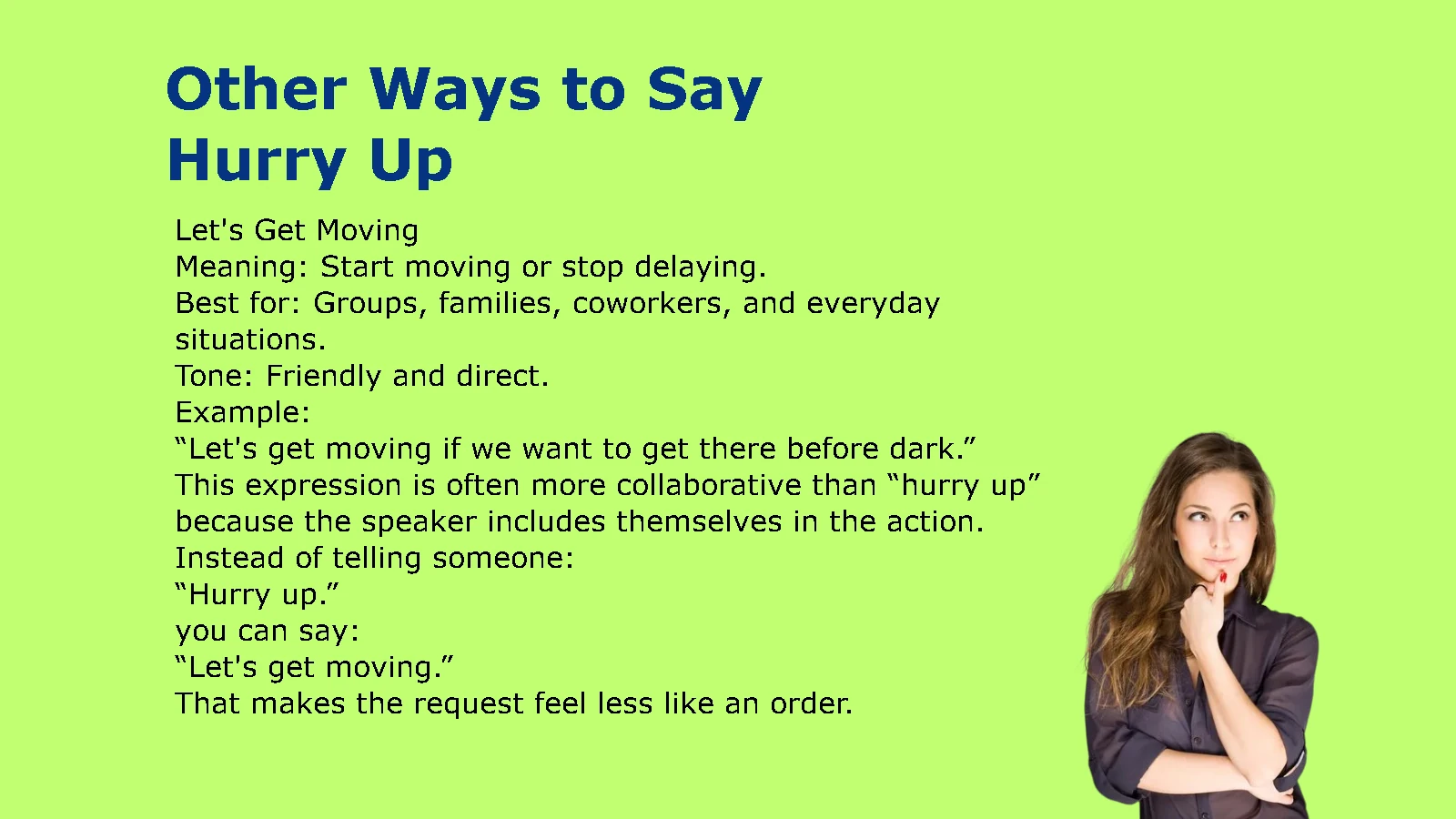
7. Let’s Get Moving
Meaning: Start moving or stop delaying.
Best for: Groups, families, coworkers, and everyday situations.
Tone: Friendly and direct.
Example:
“Let’s get moving if we want to get there before dark.”
This expression is often more collaborative than “hurry up” because the speaker includes themselves in the action.
Instead of telling someone:
“Hurry up.”
you can say:
“Let’s get moving.”
That makes the request feel less like an order.
8. Let’s Get Going
Meaning: Let’s leave or begin.
Best for: Starting an activity or leaving a place.
Tone: Neutral and friendly.
Example:
“Everyone’s ready, so let’s get going.”
This is one of the most natural alternatives when the real meaning is “It’s time to leave” rather than “Do that task faster.”
For example, “Let’s get going” works well before a road trip, meeting, class, or outing.
9. Make It Quick
Meaning: Finish something quickly.
Best for: Situations where someone has very little time.
Tone: Direct.
Example:
“You can grab your coat, but make it quick.”
The expression clearly communicates urgency. However, it can sound demanding, so it works better in casual or time sensitive situations than in formal workplace communication.
10. Don’t Take Too Long
Meaning: Finish or return without spending too much time.
Best for: Everyday requests where you want to sound less commanding.
Tone: Neutral.
Example:
“Go ahead and grab some coffee, but don’t take too long.”
This is useful when you don’t necessarily want someone to rush dangerously or recklessly. You’re simply asking them not to spend excessive time on something.
11. We Need to Move
Meaning: We need to leave or start moving now.
Best for: Urgent situations and group decisions.
Tone: Direct.
Example:
“We need to move if we’re going to make the last train.”
The phrase is especially natural when the whole group needs to act rather than one individual.
12. We’re Running Out of Time
Meaning: There is very little time remaining.
Best for: Deadlines, events, travel, meetings, and tasks.
Tone: Neutral and urgent.
Example:
“We’re running out of time, so let’s finish the last two questions.”
This is a useful indirect way to tell someone to hurry. Instead of giving an order, you’re explaining why speed matters.
13. We’re Short on Time
Meaning: We don’t have much time available.
Best for: Work, meetings, appointments, and everyday situations.
Tone: Neutral and professional.
Example:
“We’re short on time, so let’s focus on the most important points.”
This is particularly useful in professional communication because it communicates urgency without sounding impatient.
14. Time Is Running Out
Meaning: The available time is almost finished.
Best for: Deadlines, competitions, tests, and urgent situations.
Tone: Urgent.
Example:
“Time is running out, so we need to submit the application now.”
This expression focuses on the limited amount of time rather than directly telling another person to move faster.
15. We’re in a Hurry
Meaning: We need to do something quickly because we have limited time.
Best for: Everyday explanations.
Tone: Neutral.
Example:
“Sorry, we can’t stop for lunch. We’re in a hurry.”
This doesn’t directly command someone to hurry. Instead, it explains the circumstances.
That makes it useful when you want to communicate urgency without sounding bossy.
16. Can You Speed It Up?
Meaning: Can you do what you’re doing more quickly?
Best for: Casual requests and familiar relationships.
Tone: Casual.
Example:
“Can you speed it up? We need to get this done before five.”
This is a conversational alternative to “Hurry up.” It works especially well when someone is already working on a task.
In a formal workplace situation, however, you may want a softer version.
17. Could You Move a Little Faster?
Meaning: Please increase your speed somewhat.
Best for: Polite requests.
Tone: Polite and neutral.
Example:
“Could you move a little faster? We’re trying to stay on schedule.”
This is a gentler option because “a little” reduces the force of the request.
It can work when you need someone to speed up without wanting to sound irritated.
18. Please Be Quick
Meaning: Please do something quickly.
Best for: Urgent but polite requests.
Tone: Polite and direct.
Example:
“Please be quick. The doctor is ready to see you.”
Adding “please” makes the request more courteous, although the phrase still clearly communicates urgency.
19. Please Hurry
Meaning: Please move or act quickly.
Best for: Everyday situations where urgency is important.
Tone: Polite but urgent.
Example:
“Please hurry. The doors are closing.”
This is a straightforward alternative when you want to keep the meaning of “hurry up” almost exactly the same.
20. Please Work as Quickly as Possible
Meaning: Complete the task as fast as reasonably possible.
Best for: Workplace instructions, deadlines, and professional communication.
Tone: Professional.
Example:
“Please work as quickly as possible so we can submit the proposal before the deadline.”
This sounds more appropriate in a professional environment than simply saying “Hurry up.”
Still, use it thoughtfully. In some workplace situations, quality and accuracy may matter more than speed.
21. Could You Expedite This?
Meaning: Could you make this process happen faster?
Best for: Business communication, customer service, administrative tasks, and formal requests.
Tone: Formal and professional.
Example:
“Could you expedite this request? We need the documents by Friday.”
Expedite means to make something happen sooner or more quickly.
This isn’t normally a replacement for “hurry up” when you’re talking to someone who needs to walk faster or get dressed. It works mainly with processes, requests, orders, applications, and tasks.
22. Let’s Keep Things Moving
Meaning: Let’s continue making progress without unnecessary delays.
Best for: Meetings, projects, work, and organized activities.
Tone: Professional and neutral.
Example:
“Let’s keep things moving so we can cover all the agenda items.”
This phrase doesn’t necessarily mean everyone needs to move physically faster. It often means avoid delays and maintain progress.
That’s why it’s particularly useful at work.
23. We Need to Get This Moving
Meaning: We need to start or accelerate progress on something.
Best for: Projects, plans, decisions, and workplace tasks.
Tone: Professional and direct.
Example:
“We need to get this moving if we’re going to launch the project this month.”
This is a good choice when the problem isn’t someone’s physical speed but a project that has stalled.
24. Let’s Make a Move
Meaning: Let’s leave, start doing something, or take action.
Best for: Casual conversations.
Tone: Casual.
Example:
“It’s getting late. Let’s make a move.”
The phrase is particularly natural when you’re suggesting that a group should leave somewhere.
It doesn’t necessarily mean “do what you’re doing faster,” so context matters.
25. Come On, Let’s Go
Meaning: Start moving or stop delaying.
Best for: Friends, family, children, and informal situations.
Tone: Casual and direct.
Example:
“Come on, let’s go. The movie starts in ten minutes.”
This is one of the most natural everyday alternatives when you’re trying to get someone to leave or start moving.
Depending on your tone, though, it can sound encouraging or impatient.
26. Get Cracking
Meaning: Start working or acting immediately.
Best for: Informal situations where you want someone to get started.
Tone: Informal.
Example:
“We’ve got a lot to finish, so let’s get cracking.”
This phrase is useful when the problem is that someone hasn’t started yet. It isn’t necessarily about physical speed.
For example, “Get cracking on the report” means start working on the report without delay.
27. Shake a Leg
Meaning: Hurry up or move faster.
Best for: Informal and playful situations.
Tone: Informal and somewhat old fashioned.
Example:
“Shake a leg! We’re going to miss the bus.”
Shake a leg is a genuine English expression, but it isn’t as neutral or universally suitable as “be quick” or “let’s get going.” It can sound playful, humorous, or old fashioned.
Use it when that tone fits the conversation.
Professional Ways to Say “Hurry Up”
If you’re writing an email or speaking to a coworker, manager, client, or employee, “hurry up” can sound too blunt.
A better approach is to communicate the deadline or request faster action without sounding impatient.
Consider these alternatives:
- Could you prioritize this?
- Could you expedite this?
- Please work as quickly as possible.
- We’re working with a tight deadline.
- We’re short on time.
- Let’s keep things moving.
- We need to get this moving.
- Could you move this forward?
For example, instead of:
“Hurry up with the report.”
try:
“Could you prioritize the report? We need to submit it by 3 p.m.”
The second version gives the person useful information: what needs attention and why it matters.
Another option is:
“We’re working with a tight deadline, so please let me know when you expect to have the report ready.”
This is more professional when you need an actual completion time rather than simply asking someone to work faster.
Polite Ways to Say “Hurry Up”
Sometimes you need urgency without sounding rude.
Try:
- Could you move a little faster?
- Please be quick.
- Could you speed things up a little?
- We’re running out of time.
- We’re short on time.
- Could we get moving?
- Let’s keep things moving.
- Could you prioritize this?
Compare these two sentences:
“Hurry up. We’re late.”
and:
“We’re running a little behind. Could we get moving?”
The second sentence is softer because it focuses on the situation rather than criticizing the person’s speed.
Casual Ways to Say “Hurry Up”
When you’re talking with friends or family, casual expressions often sound more natural.
Get a move on
“Get a move on! We’re already late.”
Step on it
“Step on it or we’ll miss the beginning.”
Let’s get going
“Everyone’s ready. Let’s get going.”
Come on, let’s go
“Come on, let’s go. We’ve been here long enough.”
Get cracking
“Let’s get cracking before the guests arrive.”
Shake a leg
“Shake a leg! We don’t want to miss the bus.”
These expressions vary in force. Let’s get going sounds relatively friendly, while step on it is much more forceful.
Ways to Say “Hurry Up” Without Sounding Rude
One of the easiest ways to soften an urgent request is to explain the reason.
Instead of:
“Hurry up.”
say:
“We’re running out of time.”
Instead of:
“Move faster.”
say:
“Could you move a little faster? We’re trying to stay on schedule.”
Instead of:
“Get this done now.”
say:
“Could you prioritize this? We need it by the end of the day.”
Another useful technique is to make the request collaborative:
“Let’s get moving.”
“Let’s get going.”
These expressions can reduce the feeling that you’re simply ordering someone around.
Ways to Say “Hurry Up” in a Work Email
The best workplace alternative depends on what you actually need.
When you need faster action
“Could you prioritize this request? We need to have it completed by Friday.”
When there’s a deadline
“We’re working with a tight deadline, so please let me know if you anticipate any delays.”
When you need a process accelerated
“Could you expedite the approval process if possible?”
When a project has stalled
“We need to get this moving so we can stay on schedule.”
When you’re managing a meeting
“Let’s keep things moving so we have enough time to cover the remaining items.”
When you need a task completed soon
“Please work on this as soon as possible and send me an update when it’s ready.”
These alternatives are usually better than simply writing “Hurry up” because they provide context and make the request more specific.
Ways to Say “Hurry Up” to a Friend
With friends, you can be more direct and playful.
- “Hurry up!”
- “Be quick!”
- “Get a move on!”
- “Step on it!”
- “Let’s get moving.”
- “Let’s get going.”
- “Come on, let’s go.”
- “Make it quick.”
- “Get cracking!”
- “Shake a leg!”
For example:
“Get a move on! The concert starts in twenty minutes.”
Or:
“Come on, let’s go. We’ve got a long drive ahead.”
The best choice depends heavily on your relationship and tone.
“Hurry Up” vs. “Get a Move On”
These expressions are very close in meaning, but get a move on is more distinctly informal.
Compare:
“Hurry up. We’re going to be late.”
“Get a move on. We’re going to be late.”
Both tell someone to move faster. The second sounds more conversational and casual.
For professional writing, neither would usually be your first choice. A phrase such as “We’re working with a tight deadline” is often more appropriate.
“Hurry Up” vs. “Pick Up the Pace”
These phrases overlap, but pick up the pace specifically means to increase the rate or speed of an activity.
For example:
“Pick up the pace. We’re falling behind.”
This works well when someone is already working or moving.
“Hurry up” is broader:
“Hurry up and get dressed.”
You wouldn’t normally say:
“Pick up the pace and get dressed.”
The expression doesn’t fit that context naturally.
“Hurry Up” vs. “Let’s Get Going”
Let’s get going usually means let’s leave or begin.
For example:
“It’s almost noon. Let’s get going.”
It doesn’t necessarily tell someone to perform a task faster.
Compare:
“Hurry up and finish your breakfast.”
with:
“Let’s get going.”
The first asks someone to speed up what they’re doing. The second suggests that it’s time to leave or begin the next activity.
“Hurry Up” vs. “We’re Running Out of Time”
These expressions have different grammatical functions.
Hurry up is a direct command.
“Hurry up. The store closes in ten minutes.”
We’re running out of time is a statement about the situation.
“We’re running out of time. Let’s finish this.”
The second can sound less confrontational because you’re explaining the reason for urgency instead of directly criticizing someone’s speed.
“Hurry Up” vs. “Expedite”
Expedite is much more formal and has a narrower use.
You can say:
“Could you expedite the application?”
But you wouldn’t normally say:
“Could you expedite? We’re late for dinner.”
The word works especially well when you’re talking about processing, delivery, approval, requests, orders, applications, or other procedures.
It is therefore a professional alternative in some contexts, not a universal synonym for “hurry up.”
How to Choose the Right Alternative
Before choosing an expression, consider three things:
- Who are you talking to?
- How urgent is the situation?
- Do you want to give a command or explain the urgency?
| Phrase | Tone | Best For | Example |
| Be quick | Direct | Everyday urgency | “Be quick; the bus is here.” |
| Get a move on | Casual | Friends and family | “Get a move on!” |
| Pick up the pace | Neutral | Work or activity | “Let’s pick up the pace.” |
| Let’s get going | Friendly | Leaving or starting | “Let’s get going.” |
| Don’t take too long | Neutral | Softer requests | “Don’t take too long.” |
| We’re running out of time | Neutral | Deadlines | “We’re running out of time.” |
| We’re short on time | Professional | Work and meetings | “We’re short on time.” |
| Could you move a little faster? | Polite | Softer requests | “Could you move a little faster?” |
| Please hurry | Direct | Clear urgency | “Please hurry; we’re late.” |
| Could you expedite this? | Formal | Business processes | “Could you expedite this request?” |
| Let’s keep things moving | Professional | Meetings and projects | “Let’s keep things moving.” |
| Come on, let’s go | Casual | Friends and family | “Come on, let’s go.” |
| Get cracking | Informal | Starting work | “Let’s get cracking.” |
| Shake a leg | Playful | Informal urgency | “Shake a leg!” |
Common Mistakes When Using Alternatives to “Hurry Up”
Not every expression that suggests speed works in every situation.
Using “expedite” for physical movement
“Expedite” is mainly used for processes and tasks.
Natural:
“Could you expedite the order?”
Unnatural:
“Expedite! The bus is leaving!”
Use hurry, be quick, move faster, or let’s get going instead.
Using “networking” style language for every situation
Just as “hurry up” has different alternatives depending on context, so do many English expressions. Don’t choose a formal word simply because it sounds more sophisticated.
For everyday conversation:
“Let’s get going.”
is often much better than an unnecessarily formal expression.
Forgetting that tone matters
“Step on it!” and “Please work as quickly as possible” can communicate urgency, but they belong to very different situations.
Always consider your relationship with the listener before choosing a direct command.
Which Alternative Is Best for Different Situations?
For a friend
Get a move on or come on, let’s go works naturally.
“Get a move on! We’re going to miss the movie.”
For a coworker
Could you prioritize this? or we’re working with a tight deadline is usually more appropriate.
“Could you prioritize this request? We need it by noon.”
For a client
Use a polite request rather than a command.
“Could you please let us know if this can be expedited?”
During a meeting
Let’s keep things moving works well.
“Let’s keep things moving so we can cover the final two items.”
When you’re late
We’re running out of time or we’re short on time communicates the urgency without blaming anyone.
“We’re running out of time, so let’s head out.”
When someone needs to leave
Let’s get going is usually natural.
“It’s getting late. Let’s get going.”
When someone needs to start a task
Let’s get cracking works in casual settings.
“We’ve got three hours left, so let’s get cracking.”
Common Questions
What is another way to say hurry up?
Some natural alternatives are be quick, move faster, get a move on, pick up the pace, let’s get moving, let’s get going, make it quick, and don’t take too long.
The best choice depends on the situation and tone.
What is a polite way to say hurry up?
Try “Could you move a little faster?”, “Please be quick,” “We’re running out of time,” or “Could you prioritize this?”
The last option works particularly well in professional situations.
What is a professional way to say hurry up?
Professional alternatives include “Could you prioritize this?”, “Could you expedite this?”, “We’re working with a tight deadline,” “Let’s keep things moving,” and “We need to get this moving.”
Choose based on whether you’re asking someone to speed up a task, accelerate a process, or meet a deadline.
What is a casual way to say hurry up?
You can say “Get a move on,” “step on it,” “come on, let’s go,” “get cracking,” or “shake a leg.”
Some of these sound playful or old fashioned, so use them with people and in situations where that tone feels natural.
Is “get a move on” rude?
Not necessarily. Get a move on is an informal way to tell someone to hurry. However, it is still a direct command and can sound impatient depending on your tone.
What can I say instead of “hurry up” at work?
Try “Could you prioritize this?”, “We’re short on time,” “We’re working with a tight deadline,” “Could you expedite this?”, or “Let’s keep things moving.”
These expressions generally communicate urgency more professionally.
What is a softer way to say hurry up?
“Could you move a little faster?”, “Don’t take too long,” and “We’re running out of time” are useful softer alternatives.
They communicate urgency without sounding as commanding as “Hurry up!”
What is a strong way to say hurry up?
“Step on it,” “make it quick,” “be quick,” and “move faster” are relatively direct.
Your tone can make any of these sound more or less forceful.
What does “pick up the pace” mean?
Pick up the pace means to increase the speed at which you’re moving or working.
For example:
“We need to pick up the pace if we’re going to finish on time.”
What does “get cracking” mean?
Get cracking means to start working or acting without delay. It is an informal expression.
For example:
“We’ve got a lot to do, so let’s get cracking.”
Is “expedite” the same as “hurry up”?
Not exactly. Expedite means to make a process happen faster or sooner. It is commonly used for requests, orders, applications, approvals, and other processes.
It isn’t a general replacement for “hurry up” in everyday conversation.
Final Thoughts
There are plenty of natural other ways to say hurry up, but the best phrase depends on what you mean.
Use be quick or please hurry when you need a direct request. Choose get a move on, step on it, or come on, let’s go for casual conversations. At work, phrases such as could you prioritize this, we’re working with a tight deadline, and let’s keep things moving usually communicate urgency more appropriately.
If you want to avoid sounding impatient, explain the reason for the urgency. “We’re running out of time” often works better than simply telling someone to hurry.
The goal isn’t to find the fanciest synonym. It’s to choose the expression that sounds natural for the person, situation, urgency, and tone you’re dealing with.













