When you need to say “I don’t know,” you don’t always have to use the same phrase. Depending on the situation, you might want to sound polite, professional, casual, uncertain, honest, or helpful. If you’re looking for other ways to say “I don’t know,” the right expression can make your response sound more natural and appropriate for the context.
The phrase “I don’t know” is commonly used when you do not have the information or answer someone is asking for. However, alternatives such as “I’m not sure,” “I’m not certain,” “I couldn’t say,” “I’m not aware of that,” “I don’t have that information,” and “That’s a good question” can communicate uncertainty in slightly different ways.
Choosing the right alternative depends on who you’re talking to, how formal the situation is, and whether you want to simply admit that you don’t know or offer to find the answer. A casual conversation may call for a simple expression, while a workplace email or professional discussion may sound better with a more polished response.
In this guide, you’ll learn 27 natural ways to say “I don’t know,” including polite, professional, casual, and conversational alternatives. You’ll also see clear examples of how to use each expression in texts, conversations, emails, and workplace situations.
By the end, you’ll know exactly how to say “I don’t know” in different situations without sounding repetitive, dismissive, or uncertain when a more precise expression would work better.
What Does “I Don’t Know” Mean?
“I don’t know” means that you don’t have the information, knowledge, or certainty needed to answer a question.
For example:
“Where is Sarah?”
“I don’t know.”
The phrase is simple and direct. It doesn’t necessarily mean that you have absolutely no knowledge about the subject. It can simply mean that you don’t know the answer to the particular question being asked.
You can also use it when you’re uncertain:
“Do you think they’ll approve the proposal?”
“I don’t know. We’ll have to wait and see.”
In that context, you’re not saying that the information is unavailable forever. You’re saying that you cannot confidently predict the answer.
The expression can sound perfectly polite when used appropriately. However, in professional situations, you may sometimes want to add a helpful next step:
“I don’t know, but I’ll check with the team and get back to you.”
That response is more useful than simply ending the conversation with “I don’t know.”
27 Other Ways to Say “I Don’t Know”
1. I’m Not Sure
Meaning: You don’t have enough certainty to give a definite answer.
Best for: Almost any situation, including everyday conversations and professional communication.
Tone: Neutral and polite.
Example:
“I’m not sure when the store closes, so I’d check before heading over.”
This is one of the most versatile alternatives to “I don’t know.” It also sounds less absolute because it communicates uncertainty rather than complete lack of knowledge.
2. I Have No Idea
Meaning: You don’t know the answer at all.
Best for: Informal conversations with friends, family, or familiar coworkers.
Tone: Casual.
Example:
“I have no idea where he put the keys.”
“I have no idea” is natural American English, but it can sound too casual for certain formal situations.
Compare:
“I have no idea what caused the error.”
with:
“I’m not sure what caused the error.”
The second version is usually safer in professional communication.
3. I Don’t Know
Meaning: You don’t have the information needed to answer.
Best for: Direct answers when there is no need to soften the statement.
Tone: Neutral.
Example:
“I don’t know what time the meeting starts.”
Although the goal may be to find other ways to say I don’t know, the original phrase is sometimes the clearest choice. There’s no need to replace it merely for variety if the direct wording works.
4. I’m Not Certain
Meaning: You aren’t completely confident that something is true or correct.
Best for: Formal writing, professional discussions, and situations where accuracy matters.
Tone: Formal and careful.
Example:
“I’m not certain whether the revised figures have been approved.”
This phrase focuses on certainty, so it’s especially useful when you have some information but don’t want to present it as fact.
5. I’m Unsure
Meaning: You don’t know something with enough confidence to give a definite answer.
Best for: Professional and everyday situations.
Tone: Neutral.
Example:
“I’m unsure which version of the document the client received.”
“I’m unsure” is concise and useful in writing, particularly when you want to avoid repeating “I don’t know.”
6. I Couldn’t Tell You
Meaning: You don’t know the answer and aren’t able to provide it.
Best for: Informal conversations.
Tone: Casual and conversational.
Example:
“I couldn’t tell you why the printer keeps doing that.”
This expression is usually conversational rather than formal. It can sound friendly and natural when you’re talking with someone you know.
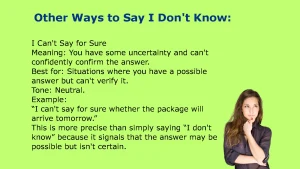
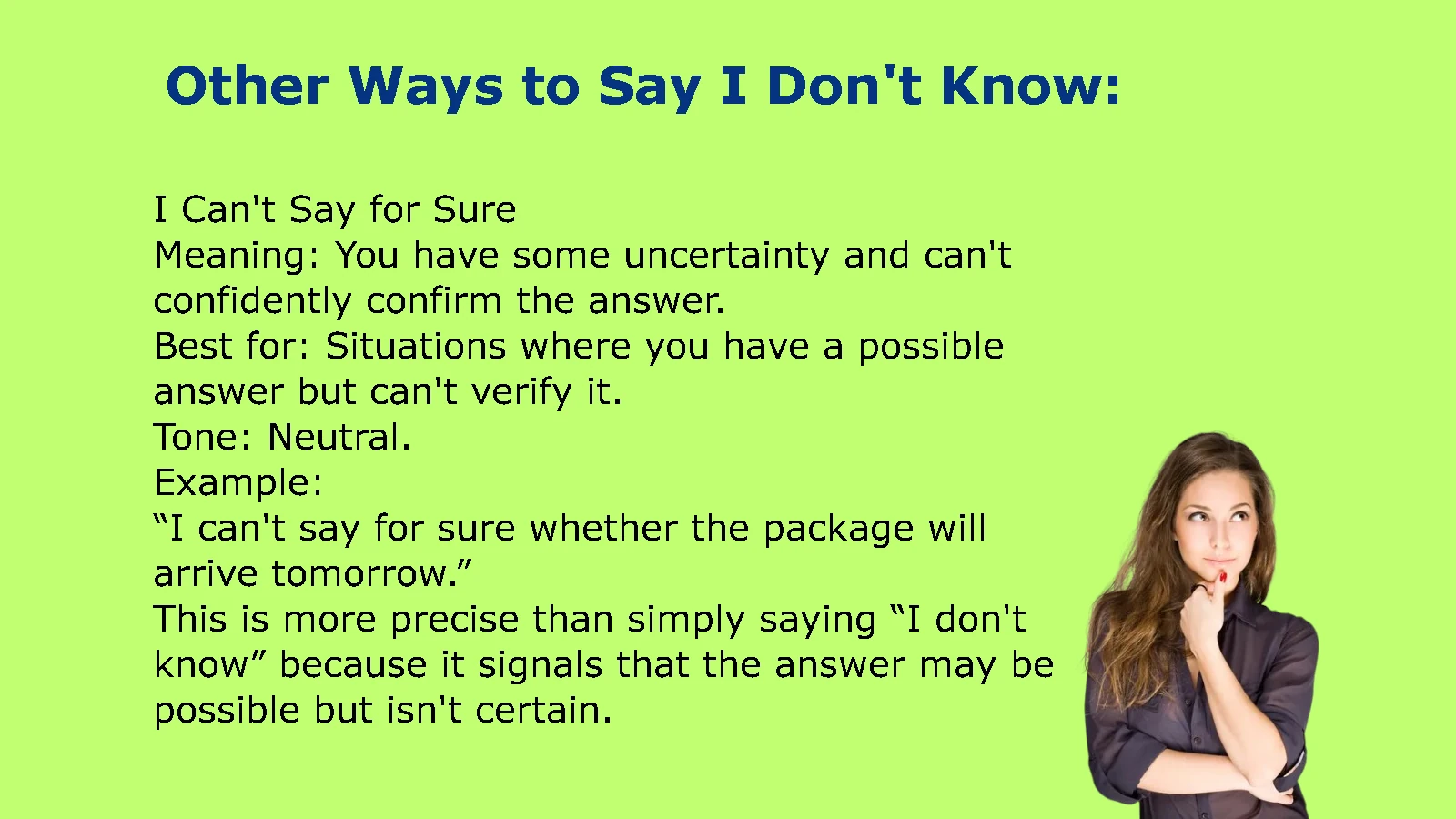
7. I Can’t Say for Sure
Meaning: You have some uncertainty and can’t confidently confirm the answer.
Best for: Situations where you have a possible answer but can’t verify it.
Tone: Neutral.
Example:
“I can’t say for sure whether the package will arrive tomorrow.”
This is more precise than simply saying “I don’t know” because it signals that the answer may be possible but isn’t certain.
8. I Don’t Have That Information
Meaning: You don’t currently possess the specific information someone is asking for.
Best for: Workplace conversations, customer service, business communication, and formal settings.
Tone: Professional.
Example:
“I don’t have that information in front of me, but I can check the records.”
This is one of the strongest professional ways to say I don’t know because it focuses on the information rather than making a broad statement about your knowledge.
9. I’m Not Familiar With That
Meaning: You don’t know much about a particular subject, system, person, process, or topic.
Best for: Professional conversations and unfamiliar subjects.
Tone: Professional and neutral.
Example:
“I’m not familiar with that software, so I don’t want to give you the wrong instructions.”
This doesn’t necessarily mean you know nothing about the subject. It means you don’t have enough familiarity to speak confidently about it.
10. That’s Beyond Me
Meaning: Something is outside your knowledge, ability, or area of expertise.
Best for: Informal conversations.
Tone: Casual.
Example:
“Why the system keeps crashing is beyond me.”
“That’s beyond me” is more expressive than “I don’t know.” It can sometimes suggest that the question is difficult or outside your expertise.
11. Your Guess Is as Good as Mine
Meaning: You don’t know, and the other person’s guess would be no better or worse than yours.
Best for: Casual conversations when neither person has useful information.
Tone: Casual and conversational.
Example:
“When will the construction finally finish? Your guess is as good as mine.”
This expression is idiomatic rather than a literal synonym for “I don’t know.” It works best when you’re emphasizing shared uncertainty.
12. I Haven’t Heard Anything About That
Meaning: You haven’t received information or news about the subject.
Best for: Workplace discussions, social conversations, and questions about recent developments.
Tone: Neutral.
Example:
“I haven’t heard anything about that change yet.”
This phrase is more specific than “I don’t know.” It means you don’t know because you haven’t received any relevant information.
13. I’m Not Aware of That
Meaning: You don’t currently know about something or haven’t been informed of it.
Best for: Workplace communication, official conversations, and careful responses.
Tone: Professional and formal.
Example:
“I’m not aware of any changes to the current schedule.”
Be careful with this expression. It doesn’t always mean “that isn’t true.” It means you don’t have knowledge of it.
14. I Don’t Have an Answer Yet
Meaning: You don’t currently know the answer, but you may know it later.
Best for: Work, customer service, research, and ongoing situations.
Tone: Professional and neutral.
Example:
“I don’t have an answer yet, but we’re reviewing the issue.”
The word “yet” changes the meaning significantly. You’re communicating that the question remains unresolved rather than suggesting that an answer doesn’t exist.
15. I Need to Check
Meaning: You don’t know the answer immediately and need to verify the information.
Best for: Work emails, customer service, scheduling, and factual questions.
Tone: Professional and helpful.
Example:
“I need to check the latest inventory figures before I can confirm that.”
This is often better than simply saying “I don’t know” when you have access to a reliable source and can verify the answer.
16. Let Me Find Out
Meaning: You don’t know right now, but you’re willing to find the answer.
Best for: Customer service, workplace conversations, and helpful responses.
Tone: Helpful and professional.
Example:
“I don’t have the delivery date yet. Let me find out and I’ll update you.”
This expression shifts the conversation from uncertainty toward a solution.
17. I’ll Have to Look Into It
Meaning: You need to investigate or gather more information before answering.
Best for: Workplace problems, research, technical issues, and situations requiring investigation.
Tone: Professional.
Example:
“I’ll have to look into it before I can tell you what caused the discrepancy.”
Use this when the answer isn’t immediately available and requires some work to establish.
18. I Can’t Answer That Right Now
Meaning: You aren’t able to provide an answer at the present time.
Best for: Professional conversations or situations where you need more information.
Tone: Neutral.
Example:
“I can’t answer that right now because we haven’t received the final report.”
This phrase can mean more than simple uncertainty, so context matters. You might know the answer but be unable or unwilling to provide it. If you specifically mean that you lack knowledge, another phrase may be clearer.
19. I’m Drawing a Blank
Meaning: You can’t remember something or can’t think of the answer at the moment.
Best for: Informal conversations.
Tone: Casual.
Example:
“I’m drawing a blank on the name of that restaurant.”
This is particularly useful when you normally know the information but can’t retrieve it right now.
It isn’t the same as permanently not knowing something.
20. It Slipped My Mind
Meaning: You forgot something that you previously knew or intended to remember.
Best for: Everyday conversations and informal apologies.
Tone: Casual.
Example:
“It slipped my mind, so I forgot to send you the address.”
This isn’t a direct synonym for “I don’t know.” Use it when forgetting, rather than lack of knowledge, is the reason you can’t provide the information.
21. I Don’t Recall
Meaning: You don’t remember something.
Best for: Formal or careful communication.
Tone: Formal.
Example:
“I don’t recall receiving an updated version of the agreement.”
“I don’t recall” is useful when you want to communicate that you cannot remember something without claiming that it never happened.
22. I Can’t Remember
Meaning: You knew or encountered the information before but can’t retrieve it from memory now.
Best for: Everyday conversations.
Tone: Neutral.
Example:
“I can’t remember where I saved the original file.”
The distinction is straightforward: “I don’t know” concerns knowledge, while “I can’t remember” concerns memory.
23. I’m at a Loss
Meaning: You don’t know what to say, think, or do in a particular situation.
Best for: Difficult situations, problems, and conversations.
Tone: Neutral to somewhat formal.
Example:
“I’m at a loss for how to explain the sudden change.”
This expression is broader than “I don’t know.” It can communicate uncertainty about what to do, not just a missing fact.
24. I Couldn’t Say
Meaning: You aren’t able to give a definite answer or judgment.
Best for: Questions involving uncertainty, predictions, or incomplete information.
Tone: Neutral.
Example:
“I couldn’t say whether the project will be finished by Friday.”
This is useful when you don’t want to make a claim without enough evidence.
25. I Wouldn’t Know
Meaning: You don’t have the knowledge or experience needed to answer.
Best for: Casual and neutral conversations.
Tone: Neutral.
Example:
“I wouldn’t know which camera is better because I haven’t used either one.”
Unlike “I don’t know,” this expression can emphasize that the subject isn’t within your experience or expertise.
26. Not That I’m Aware Of
Meaning: Based on the information you currently have, you don’t know of anything that fits the question.
Best for: Careful professional or everyday responses.
Tone: Neutral.
Example:
“Not that I’m aware of, but I’ll double check before we make a decision.”
This is a qualified answer. It leaves room for the possibility that something exists without your knowing about it.
27. That’s Not Something I Know Much About
Meaning: You have limited knowledge of a particular subject.
Best for: Conversations involving specialized subjects or areas outside your expertise.
Tone: Neutral and polite.
Example:
“That’s not something I know much about, so I’d rather not speculate.”
This is useful when you want to acknowledge a knowledge gap without making the stronger statement that you know absolutely nothing about the topic.
Professional Ways to Say “I Don’t Know”
In professional communication, simply replacing “I don’t know” with a more complicated phrase isn’t always necessary.
The better approach is to explain what you don’t know and what you’ll do next.
Here are several strong choices:
- I’m not sure.
- I’m not certain.
- I don’t have that information.
- I’m not familiar with that.
- I’m not aware of that.
- I don’t have an answer yet.
- I need to check.
- Let me find out.
- I’ll have to look into it.
- I can’t say for sure.
For example, instead of:
“I don’t know when the report will be ready.”
you could write:
“I’m not sure when the report will be ready, but I’ll confirm the timeline with the team.”
That response sounds natural because it combines uncertainty with a useful next step.
Another example:
“I don’t have that information at the moment. Let me check the latest records.”
There’s no need to say something overly elaborate such as “I am currently unable to ascertain the requested information.” Clear English usually works better.
Formal Ways to Say “I Don’t Know”
When writing a formal email, report, business letter, or professional response, these expressions are useful:
I’m not certain
“I’m not certain whether the revised policy has taken effect.”
I don’t have that information
“I don’t have that information available at this time.”
I’m not aware of that
“I’m not aware of any additional requirements.”
These expressions allow you to be honest about uncertainty without sounding dismissive.
Casual Ways to Say “I Don’t Know”
Everyday conversations give you more freedom.
Natural casual alternatives include:
- I have no idea.
- I’m drawing a blank.
- That’s beyond me.
- I couldn’t tell you.
- Your guess is as good as mine.
- I can’t remember.
- It slipped my mind.
- I wouldn’t know.
For example:
“Where did Mike go?”
“I have no idea.”
Or:
“What’s that song called?”
“I’m drawing a blank.”
These expressions sound natural because they fit the relaxed nature of the conversation.
Ways to Say “I Don’t Know” in a Work Email
The best workplace wording often combines uncertainty + action.
Here are several complete examples.
When you need to verify something
“I’m not sure of the exact deadline. I’ll check the project schedule and confirm.”
When another department has the answer
“I don’t have that information, but I’ll check with the finance team.”
When you’re investigating a problem
“I’m not certain what caused the discrepancy yet. We’re looking into it now.”
When you haven’t received an update
“I haven’t heard anything about the revised timeline yet.”
When you need more time
“I don’t have an answer yet, but I should have more information by tomorrow.”
When you don’t know the subject well
“I’m not familiar with that system, so I’d rather confirm the details before advising you.”
When you want to offer help
“I’m not sure of the answer, but let me find out and get back to you.”
Notice that none of these responses tries to hide uncertainty. They simply make the uncertainty clear and useful.
“I Don’t Know” vs. “I’m Not Sure”
These two expressions are closely related, but there’s a small difference.
“I don’t know” directly states that you don’t have the answer.
“I’m not sure” communicates uncertainty. You may have an idea, but you aren’t confident enough to state it as fact.
Compare:
“I don’t know where Sarah is.”
You have no information about her location.
“I’m not sure where Sarah is.”
You may have an idea, but you can’t confirm it.
In everyday speech, the two can overlap. Still, “I’m not sure” is often useful when you want to avoid presenting an uncertain answer as a definite fact.
“I Don’t Know” vs. “I Have No Idea”
The main difference is tone and strength.
“I don’t know” is neutral.
“I have no idea” is more emphatic and generally more casual.
Compare:
“I don’t know who changed the settings.”
with:
“I have no idea who changed the settings.”
The second sentence emphasizes how little information you have.
For a professional email, “I’m not sure” or “I don’t have that information” may be more appropriate.
“I Don’t Know” vs. “I Don’t Recall”
These expressions shouldn’t be treated as exact synonyms.
“I don’t know” means you lack knowledge.
“I don’t recall” means you don’t remember something.
For example:
“I don’t know who sent the email.”
You don’t know the sender.
“I don’t recall who sent the email.”
You may have known or seen the sender before, but you don’t remember now.
That distinction is especially important in professional or formal communication.
“I Don’t Know” vs. “I’m Not Aware”
“I’m not aware” means that you don’t have knowledge of something.
For example:
“I’m not aware of any changes to the policy.”
This doesn’t necessarily mean that no changes exist. It means you don’t currently know of any.
By comparison:
“I don’t know whether the policy has changed.”
This is a more direct statement of uncertainty about a specific question.
How to Choose the Right Alternative
Start by identifying why you don’t know.
| Situation | Best Phrase | Example |
| General uncertainty | I’m not sure | “I’m not sure when it starts.” |
| Complete lack of knowledge | I have no idea | “I have no idea where it went.” |
| Formal uncertainty | I’m not certain | “I’m not certain that’s correct.” |
| Missing information | I don’t have that information | “I don’t have that information yet.” |
| Unfamiliar subject | I’m not familiar with that | “I’m not familiar with that system.” |
| Need to verify | I need to check | “I need to check the records.” |
| Willing to investigate | Let me find out | “Let me find out for you.” |
| Forgotten information | I can’t remember | “I can’t remember his name.” |
| Temporarily forgotten | I’m drawing a blank | “I’m drawing a blank right now.” |
| Formal memory issue | I don’t recall | “I don’t recall seeing that.” |
| Shared uncertainty | Your guess is as good as mine | “Your guess is as good as mine.” |
| Outside your expertise | That’s beyond me | “Why it failed is beyond me.” |
| Limited knowledge | I don’t know much about that | “I don’t know much about the topic.” |
| No definite prediction | I can’t say for sure | “I can’t say for sure yet.” |
| Unknown but being investigated | I’ll have to look into it | “I’ll have to look into it.” |
This approach prevents you from choosing a phrase that technically sounds similar but doesn’t actually communicate what you mean.
How to Say “I Don’t Know” Without Sounding Dismissive
Sometimes the problem isn’t the phrase itself. It’s what happens after it.
A bare:
“I don’t know.”
can end a conversation.
That’s perfectly fine when a short answer is all that’s needed. But if someone needs help, adding a next step can make your response much more useful.
Instead of:
“I don’t know.”
try:
“I’m not sure, but I can check.”
Or:
“I don’t have that information yet. Let me find out.”
You can also explain the limitation:
“I’m not familiar with that system, so I don’t want to give you inaccurate information.”
This is especially useful at work because it communicates both honesty and responsibility without pretending to know something you don’t.
Common Mistakes When Replacing “I Don’t Know”
Using “I have no idea” in every situation
“I have no idea” is natural, but it can sound too casual or emphatic in a formal email.
Use “I’m not sure” or “I don’t have that information” when a more professional tone is appropriate.
Using “I don’t recall” when you never knew
“I don’t recall” refers to memory.
If you never had the information, “I don’t know” is more accurate.
Using “I’m not aware” to claim something is false
“I’m not aware of any changes” doesn’t mean “There are no changes.”
It only communicates that you don’t currently know of any.
Using “I need to check” when you can’t actually verify it
“I need to check” implies that you have a way to obtain the answer.
If you genuinely have no way to find out, “I’m not sure” or “I couldn’t say” may be more accurate.
Confusing uncertainty with lack of knowledge
Someone who says:
“I’m not sure.”
may have a strong guess.
Someone who says:
“I have no idea.”
is communicating much less knowledge.
Choosing the right expression helps your listener understand the difference.
Common Questions
What is another way to say “I don’t know”?
Some natural alternatives are I’m not sure, I have no idea, I’m unsure, I’m not certain, I couldn’t tell you, I can’t say for sure, and I wouldn’t know.
The best option depends on whether you’re expressing uncertainty, lack of information, or unfamiliarity.
What is a professional way to say “I don’t know”?
Try “I’m not sure,” “I don’t have that information,” “I’m not certain,” “I’m not aware of that,” or “I need to check.”
For workplace communication, adding a next step often makes the response more useful.
What is a polite way to say “I don’t know”?
“I’m not sure” is one of the simplest polite alternatives.
You can also say:
“I’m not sure, but I’ll check.”
This communicates uncertainty without leaving the other person without help.
What is a formal way to say “I don’t know”?
Depending on the context, use “I’m not certain,” “I don’t have that information,” “I couldn’t say,” “I don’t recall,” or “I’m not aware of that.”
Choose based on whether you’re discussing knowledge, certainty, or memory.
What can I say instead of “I don’t know” in an email?
For a professional email, try:
“I’m not sure of the exact details, but I’ll confirm and get back to you.”
Other useful options include “I don’t have that information yet,” “I need to check,” and “I’ll have to look into it.”
How do you say “I don’t know” without sounding rude?
Use a softer or more helpful expression such as:
“I’m not sure.”
or:
“I don’t have that information at the moment, but I’ll check.”
The second option works especially well when you can actually find the answer.
Is “I have no idea” rude?
Not necessarily. It’s a common conversational expression, but it can sound blunt or overly casual in some professional settings.
With friends, it’s usually perfectly natural. In a formal email, “I’m not sure” is often a better fit.
What is a casual way to say “I don’t know”?
You can say “I have no idea,” “I’m drawing a blank,” “That’s beyond me,” “I couldn’t tell you,” or “Your guess is as good as mine.”
The exact choice depends on whether you’re talking about missing information, forgetting something, or not understanding a subject.
What is the difference between “I don’t know” and “I’m unsure”?
“I don’t know” directly states that you don’t have the answer. “I’m unsure” emphasizes uncertainty and can suggest that you have some information but aren’t confident enough to give a definite answer.
What is a good way to say “I don’t know” in a meeting?
A useful professional response is:
“I’m not sure about that. Let me check the details and follow up.”
If someone else on the team is likely to know, you could also say:
“I don’t have that information, but I’ll confirm with the team.”
Final Thoughts
There are plenty of natural other ways to say “I don’t know,” but the best phrase depends on exactly why you don’t know.
Use “I’m not sure” for general uncertainty, “I have no idea” for a casual and emphatic response, and “I’m not certain” when you want a more formal tone. If you simply lack information, “I don’t have that information” is precise. When you can investigate, “Let me find out” or “I need to check” gives the conversation a useful next step.
Remember, some expressions describe different situations rather than serving as direct synonyms. “I don’t recall” is about memory, “I’m not familiar with that” is about limited knowledge, and “I’m drawing a blank” usually means you’ve temporarily forgotten something.
The most natural replacement isn’t always the fanciest one. Choose the expression that tells the truth about what you know, what you don’t know, and what you can do next.