Ways to say speed up the process include expedite the process, accelerate the process, streamline the workflow, fast-track the request, and reduce processing time. The best alternative depends on what you want to achieve: finish a task sooner, remove unnecessary steps, reduce delays, or give a project higher priority. In business communication, choosing the right phrase makes emails, reports, and project updates more precise. Understanding the differences between expedite, accelerate, streamline, and fast-track also helps you avoid using these terms interchangeably when they describe different actions.
| Question | Answer |
| What is another word for speed up the process? | Expedite, accelerate, hasten, quicken, or streamline, depending on the context. |
| What is another word for speed up the process in business? | Expedite a request, streamline a workflow, or reduce turnaround time. |
| What does speed up the process mean? | It means making a task, procedure, or series of steps happen faster. |
| What is the past tense of speed up? | Sped up is the usual form, although speeded up is also correct. |
| What does expedite mean? | To make something happen sooner or progress faster, often by reducing delays. |
What Does “Speed Up the Process” Mean?
Speed up the process means to make a task, procedure, or series of actions happen faster so that it reaches completion sooner. The phrase can refer to working more quickly, removing unnecessary steps, reducing waiting time, or improving the way people and systems operate. Its exact meaning depends on the situation.
For example, a company might speed up the hiring process by scheduling interviews sooner. A software team might speed up development by automating repetitive tasks. A customer service department might shorten response times by routing requests to the right employees.
The phrase does not always mean that people should work faster. Sometimes, the real improvement comes from eliminating delays or simplifying a complicated procedure.
Simple Examples of “Speed Up the Process” in Sentences
Here are examples that show how the phrase works in different contexts.
- Business: We introduced an online approval system to speed up the process.
- Education: The teacher shared a study guide to speed up the revision process.
- Technology: The development team automated routine tests to speed up software delivery.
- Customer service: A new ticketing system helped speed up the process of resolving complaints.
- Personal tasks: I prepared all the documents in advance to speed up the application process.
- Manufacturing: The factory upgraded its equipment to speed up production.
Each example describes an action intended to reduce the time required to finish something.
Is “Speed Up the Process” Formal or Informal?
Speed up the process is a neutral expression that works in casual conversations, professional emails, reports, and meetings. It sounds clear and natural without being overly technical.
However, a more specific phrase may suit formal writing better. For instance, expedite the approval process sounds appropriate in a business email, while streamline the workflow works well when discussing operational improvements.
Consider these examples:
- Everyday: Can we speed up the process?
- Professional: Can we expedite the approval process?
- Technical: Can we reduce the average processing time?
- Operational: Can we streamline the workflow to eliminate unnecessary steps?
Choose the wording that describes the action you want someone to take. Formal vocabulary does not automatically make a sentence more effective.
25+ Other Ways to Say “Speed Up the Process”
The most useful alternatives include expedite the process, accelerate the process, streamline the process, fast-track the request, and make the process faster. Other options include hasten progress, shorten the turnaround time, and move things along. Each expression emphasizes a slightly different aspect of speed, efficiency, urgency, or completion.
Common Synonyms for “Speed Up the Process
Professional and Formal Alternatives
Professional writing often benefits from precise verbs and measurable outcomes. Instead of repeating speed up the process throughout a report, select a phrase that describes the intended result.
Expedite the process works when someone needs to act promptly.
Could you expedite the approval process so we can begin implementation next week?
Streamline the workflow works when you want to simplify a procedure.
We plan to streamline the workflow by combining the two review stages.
Reduce turnaround time works when you want to measure how long a task takes from start to finish.
The revised procedure should reduce customer onboarding turnaround time.
Accelerate project delivery works when you want to increase the pace of a project.
Additional engineering support will help accelerate project delivery.
Fast-track the request works when a request needs an accelerated route or special priority.
The department agreed to fast-track the request because of the approaching deadline.
Other useful professional phrases include:
- Improve operational efficiency: Make work more productive by reducing wasted resources.
- Eliminate unnecessary steps: Remove actions that do not add value.
- Minimize administrative delays: Reduce waiting caused by paperwork or approvals.
- Optimize the workflow: Adjust the sequence of tasks and resources to improve performance.
- Shorten the approval cycle: Reduce the time required to review and approve a request.
These expressions also make reports more informative because they tell readers what the proposed improvement involves.
Casual Alternatives for Everyday Conversations
In everyday English, short and familiar expressions often sound more natural than formal business vocabulary.
- Get it done faster: We need to get this done faster.
- Pick up the pace: Let’s pick up the pace and finish before lunch.
- Hurry things along: I’ll call the office to hurry things along.
- Move things forward: Let’s move things forward before everyone leaves.
- Get the ball rolling: We should get the ball rolling on the renovation.
- Get things moving: A quick decision will help get things moving.
- Keep things moving: Let’s keep things moving so we stay on schedule.
- Cut to the chase: Let’s cut to the chase and decide what needs to happen next.
The final expression, cut to the chase, deserves special attention. It means getting to the main point without unnecessary discussion. It does not necessarily mean making an entire process faster.
Best Alternatives at a Glance
Use this table when you need to choose a phrase quickly.
| Alternative | Best use | Tone |
| Expedite the process | Urgent requests and approvals | Formal |
| Accelerate the process | Faster progress or development | Professional |
| Streamline the process | Removing unnecessary steps | Business |
| Fast-track the request | Priority handling | Professional |
| Make the process faster | General situations | Neutral |
| Reduce processing time | Measurable performance improvements | Technical |
| Move things along | Encouraging progress | Conversational |
| Hasten progress | Formal descriptions of quicker progress | Formal |
| Shorten the turnaround time | Service and delivery targets | Professional |
| Get the ball rolling | Starting an activity | Casual |
Another Word for “Speed Up the Process” in Business
In business, the best alternative depends on whether you want to reduce delays, simplify operations, give a task priority, or finish a project earlier. Expedite suits urgent requests, streamline suits process improvements, accelerate suits faster progress, and reduce turnaround time suits measurable performance goals.
Best Business Synonyms for Emails and Reports
Business communication requires more than replacing one phrase with another. The wording should explain the action, the expected result, or the problem that needs attention.
| Business situation | Recommended phrase | Example |
| An approval is taking too long | Expedite the approval process | Could you expedite the approval process? |
| A workflow contains redundant steps | Streamline the workflow | We should streamline the workflow to remove duplicate reviews. |
| A project is behind schedule | Accelerate project delivery | Additional resources could accelerate project delivery. |
| Orders take too long to fulfill | Reduce order processing time | The new system should reduce order processing time. |
| A request needs special priority | Fast-track the request | Please fast-track the request if resources allow. |
| A service team responds slowly | Improve response times | The revised routing system should improve response times. |
| A decision is blocking progress | Move the decision forward | We need to move the decision forward this week. |
| Several departments are waiting on one team | Remove the bottleneck | Assigning another reviewer may remove the bottleneck. |
A precise phrase can also make your proposal easier to evaluate. For example, improve efficiency describes a broad goal, while reduce average approval time from five business days to three defines a measurable target.
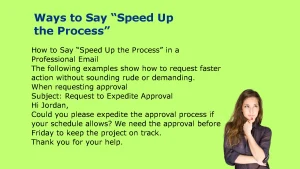
How to Say “Speed Up the Process” in a Professional Email
The following examples show how to request faster action without sounding rude or demanding.
When requesting approval
Subject: Request to Expedite Approval
Hi Jordan,
Could you please expedite the approval process if your schedule allows? We need the approval before Friday to keep the project on track.
Thank you for your help.
When following up on a delayed task
Hi Taylor,
I’m following up on the pending documents. Could you let me know whether anything is holding up the process and whether we can move things forward?
Thanks for the update.
When suggesting a more efficient workflow
Hi Team,
I suggest streamlining the current workflow by combining the initial review and data verification stages. This change could reduce duplicate work and help us complete requests sooner.
Please share your thoughts before we finalize the revised procedure.
When asking a colleague to prioritize work
Hi Morgan,
Could you prioritize this request today? Completing it earlier would help us meet the client’s delivery deadline.
I appreciate your support.
Notice that each message explains the request and its reason. This approach is usually more effective than simply telling someone to work faster.
Examples for Project Management and Operations
Different business functions use different language to describe faster processes.
Project management: A team may accelerate project delivery by resolving dependencies, assigning additional resources, or making decisions sooner.
Human resources: A hiring team can shorten the recruitment cycle by coordinating interviews and collecting feedback promptly.
Customer service: A support department can reduce resolution time by routing complex tickets to specialists instead of passing them between teams.
Logistics: A shipping company can expedite an order by prioritizing its handling, where its operational procedures permit.
Finance: An accounts payable team can streamline invoice processing by automating data entry and eliminating duplicate checks.
Manufacturing: A factory can increase production speed by reducing machine downtime and improving material flow.
In each case, the best improvement targets the actual source of delay. Simply asking employees to move faster may not solve a problem caused by a complicated approval chain, missing information, or outdated software.
Which Business Synonym Should You Choose?
The following decision guide helps you select a phrase based on your objective.
| Your objective | Best phrase | Reason |
| Get an urgent request handled sooner | Expedite the request | Emphasizes prompt action |
| Remove unnecessary work | Streamline the process | Emphasizes simplification |
| Increase the rate of progress | Accelerate progress | Emphasizes faster movement toward a goal |
| Give a project priority | Fast-track the project | Suggests an accelerated route or priority |
| Reduce the time required for a task | Reduce processing time | Focuses on elapsed time |
| Improve resource use | Optimize the workflow | Focuses on overall performance |
| Finish a project earlier | Bring forward the completion date | Focuses on the schedule |
One important distinction: prioritizing a task does not automatically make the process faster. Priority may help the task receive attention sooner, but the work can still take the same amount of time once it begins.
Expedite Meaning and How to Use It
Expedite is a verb that means to make something happen sooner or progress more quickly, often by taking steps to prevent or reduce delays. People commonly use it in business, shipping, customer service, administration, and project management when a task needs prompt attention.
For example, a manager might expedite an approval, a warehouse might expedite an order, or a customer might ask a service provider to expedite a repair.
Expedite Meaning in Business and Professional English
In professional settings, expedite often describes an effort to move a task through an existing process more quickly.
Common combinations include:
- Expedite an application: Help an application move through the review process sooner.
- Expedite an order: Arrange for an order to be handled or delivered sooner.
- Expedite payment: Take action to make payment occur sooner.
- Expedite approval: Encourage or arrange for a decision to be made promptly.
- Expedite delivery: Make arrangements to shorten delivery time.
- Expedite a request: Help a request receive timely attention.
- Expedite processing: Reduce delays in handling documents, information, or transactions.
Consider this example:
The supplier agreed to expedite delivery after the production team reported a shortage of materials.
The sentence means that the supplier took steps to make delivery happen sooner. It does not necessarily mean the supplier changed the entire delivery process.
Synonyms for Expedite
Several words can replace expedite, but their meanings differ slightly.
| Synonym | Meaning | Example |
| Accelerate | Increase the rate of progress | We need to accelerate development. |
| Hasten | Cause something to happen sooner | The announcement hastened the decision. |
| Fast-track | Give something an accelerated route or priority | They fast-tracked the application. |
| Speed up | Make something happen faster | We need to speed up production. |
| Facilitate | Make an action or result easier | The new system facilitates faster processing. |
| Streamline | Simplify a process by removing inefficiencies | We streamlined the application procedure. |
| Advance | Move something forward in time or progress | We advanced the meeting to Tuesday. |
| Prioritize | Give something greater importance or urgency | The team prioritized urgent customer requests. |
Expedite and prioritize are not exact synonyms. Prioritizing a request means giving it greater importance relative to other work. Expediting it means taking action to help it proceed sooner.
Similarly, facilitate means making something easier or helping it happen. It does not always imply greater speed.
Expedite in Sentences
Here are additional examples of how to use expedite naturally.
- The manager contacted the finance department to expedite the payment.
- We submitted the missing documents to expedite the application.
- The warehouse changed its handling arrangements to expedite the shipment.
- Please let us know whether you can expedite the review.
- The company hired temporary staff to expedite order processing.
- The support team escalated the issue to expedite a resolution.
A useful grammatical pattern is expedite + noun. For example, you expedite a request, an application, a shipment, or a process.
You can also use the passive form:
The application was expedited after the applicant supplied the missing information.
This construction focuses on the application rather than the person who took action.
Expedite vs. Accelerate vs. Streamline
These three verbs often appear in professional writing, but each highlights a different type of improvement.
| Word | Core meaning | Best example |
| Expedite | Help something happen sooner | Expedite the pending approval. |
| Accelerate | Increase the rate of progress | Accelerate product development. |
| Streamline | Remove inefficiencies and simplify steps | Streamline the onboarding workflow. |
Imagine a company that takes ten days to approve a purchase.
- If a manager asks reviewers to handle the pending request immediately, the manager wants to expedite the approval.
- If the company increases review capacity so approvals move through the system faster, it wants to accelerate the process.
- If the company removes duplicate approval stages, it wants to streamline the process.
These actions may produce similar outcomes, but they solve different problems. Using the right verb makes the intended action clearer.
“To Make the Process Faster” Synonyms
Useful synonyms for to make the process faster include accelerate, expedite, hasten, quicken, and streamline. You can also use phrases such as reduce the time required, shorten the turnaround time, and eliminate delays. Select a verb when you want concise writing and a descriptive phrase when you need to explain the specific improvement.
One-Word Alternatives
Use these verbs to replace longer expressions when the meaning fits.
Accelerate: Increase the rate at which something progresses.
The additional developers will accelerate software development.
Expedite: Help something happen sooner, often by reducing delays.
Please expedite the review of the contract.
Hasten: Cause something to happen earlier or more quickly.
The new evidence hastened the investigation.
Quicken: Make an action or process happen more quickly.
The revised procedure quickened the verification process.
Streamline: Simplify a process by removing unnecessary steps or inefficiencies.
We streamlined the workflow by consolidating three forms into one.
Optimize: Adjust a process to achieve better performance. Optimization may improve speed, but it can also improve accuracy, cost, quality, or resource use.
The team optimized the delivery schedule to reduce idle time.
Do not treat these verbs as perfect replacements in every sentence. For example, optimize a process does not necessarily mean making it faster; it means improving how well it works.
Short Phrases for Clearer Writing
Long expressions sometimes communicate a business goal more clearly than a single verb.
| Phrase | When to use it | Example |
| Reduce the time required | When the total duration matters | The new form reduces the time required to register a customer. |
| Cut down on delays | When waiting is the main problem | Better coordination will cut down on delays. |
| Improve efficiency | When work needs fewer wasted resources | Automation can improve efficiency. |
| Shorten turnaround time | When measuring completion from receipt to delivery | We aim to shorten turnaround time to two days. |
| Eliminate unnecessary steps | When a process contains redundant actions | The revised policy eliminates unnecessary steps. |
| Complete the task sooner | When the completion date matters | Extra support will help us complete the task sooner. |
| Reduce waiting time | When queues or approvals cause delays | Online booking can reduce waiting time. |
| Remove bottlenecks | When one stage restricts the entire process | Adding a reviewer may remove the bottleneck. |
The most precise wording often identifies the source of the delay. A sentence about reducing waiting time means something different from a sentence about increasing production speed.
Before-and-After Sentence Examples
Use these examples to make your writing more concise and specific.
| Original sentence | Improved sentence |
| We need to find a way to speed up the process of reviewing applications. | We need to expedite application reviews. |
| The company wants to speed up the process by removing extra steps. | The company wants to streamline the process. |
| We need to speed up the process because the project is behind schedule. | We need to accelerate the project to recover lost time. |
| Our goal is to speed up the process of completing customer orders. | Our goal is to reduce order processing time. |
| We should speed up the process by dealing with urgent requests first. | We should prioritize urgent requests. |
| The team worked hard to speed up the process of delivering the product. | The team worked to accelerate product delivery. |
The improved sentences do more than replace words. They explain the intended action with fewer unnecessary phrases.
“Speed Up the Process” Past Tense
The usual past-tense form of speed up is sped up. Use it when describing an action that made a task or procedure happen faster in the past. Speeded up is also grammatically correct, but sped up is the more familiar choice in everyday American English.
Speed Up vs. Sped Up vs. Speeding Up
The correct form depends on the sentence’s tense and structure.
| Form | Grammar | Example |
| Speed up | Base form | We need to speed up the process. |
| Speeds up | Present simple, third-person singular | The new system speeds up processing. |
| Sped up | Simple past | The update sped up the process. |
| Speeded up | Alternative simple past | The update speeded up the process. |
| Speeding up | Present participle or gerund | We are speeding up the process. |
| Has sped up | Present perfect | The new system has sped up delivery. |
| Had sped up | Past perfect | The team had sped up the process before the deadline changed. |
| Will speed up | Future construction | The change will speed up approval. |
Remember that speed up is a phrasal verb. The particle up stays with the verb in these examples, and the verb changes according to the tense.
Past-Tense Examples in Sentences
- The new approval system sped up the process considerably.
- Our revised checklist sped up application reviews.
- The software update sped up data processing.
- Better communication sped up the decision-making process.
- The company has sped up order fulfillment since introducing automated tracking.
- The team was speeding up production when the equipment stopped working.
Use sped up for a completed past action. Use has sped up when the earlier change remains relevant to the present.
Is “Speeded Up” Correct?
Yes. Speeded up is a correct past-tense and past-participle form of speed up. However, sped up is generally more common in ordinary American English.
For example, both sentences are grammatically acceptable:
- The new procedure sped up the review process.
- The new procedure speeded up the review process.
For a general American English article, sped up is a practical default. Whichever form you choose, keep the wording consistent throughout the same piece of writing.
Is “Speed-Up” a Noun?
Yes. Speed-up can function as a noun meaning an increase in speed or pace. The verb phrase speed up describes the action of making something faster, while the noun describes the increase itself. The noun also appears as speedup, especially in technical and computing contexts.
Speed Up vs. Speed-Up
The difference is mainly grammatical.
| Form | Part of speech | Example |
| Speed up | Phrasal verb | We need to speed up production. |
| Speed-up | Noun | The factory introduced a speed-up in production. |
| Speedup | Noun, often technical | The software update delivered a significant speedup. |
In everyday writing, speed-up is less common than the verb phrase speed up. In technical writing, speedup often describes a performance improvement, such as a program running faster after optimization.
For example:
The new algorithm produced a substantial speedup during data processing.
Here, speedup refers to the improvement in execution speed, not the action of speeding up.
Speed-Up Noun Examples
- The production speed-up helped the factory meet its delivery target.
- Engineers measured the speedup after optimizing the application.
- The unexpected speed-up in demand required additional inventory.
- Management introduced a production speed-up to meet seasonal demand.
- The system achieved a measurable speedup after the database changes.
The precise meaning depends on context. In manufacturing, the noun can refer to a faster pace of production. In computing, it usually refers to a gain in processing performance.
Should “Speed-Up” Be One Word or Hyphenated?
Both speed-up and speedup appear as noun forms. Technical publications often prefer speedup, while general writing may use speed-up. The verb remains two words: speed up.
Use these patterns as a guide:
- Verb: The update will speed up the application.
- Noun: The update delivered a speedup.
- Hyphenated noun: The production speed-up improved output.
Follow your publication’s style guide when one exists. More importantly, avoid using the noun form when the verb is what your sentence requires.
How to Choose the Right Synonym for “Speed Up the Process”
The best synonym describes the change you want to make. Use expedite when a request needs prompt attention, streamline when you want to remove unnecessary steps, accelerate when you want faster progress, and reduce processing time when you want to measure how long a task takes.
Use “Expedite” When Something Needs Prompt Attention
Choose expedite when a task needs to move through a process sooner.
Examples:
- Could you expedite the pending application?
- We contacted the supplier to expedite delivery.
- The manager asked finance to expedite the payment.
This word works particularly well when you are requesting action from another person or department. It is professional without sounding unnecessarily complicated.
Use “Streamline” When Removing Unnecessary Steps
Choose streamline when the existing process includes duplication, unnecessary approvals, confusing instructions, or avoidable manual work.
For example, a company might require employees to enter the same information into three different systems. Combining the systems could streamline the process by removing repetitive data entry.
Other examples include:
- We streamlined customer onboarding by combining two forms.
- The team streamlined invoice processing through automation.
- Management plans to streamline the internal review procedure.
A streamlined process may become faster, but its main defining feature is improved simplicity and efficiency.
Use “Accelerate” When Increasing the Rate of Progress
Choose accelerate when you want a project, activity, or development effort to advance more quickly.
Examples:
- The additional funding will accelerate product development.
- Better coordination helped accelerate the rollout.
- The team accelerated testing to meet the launch date.
This verb works well when discussing progress toward a goal. It can also describe a measurable increase in the rate of work.
Use “Fast-Track” When Prioritizing a Task or Project
Choose fast-track when a task receives an accelerated route, priority handling, or a shortened schedule.
Examples:
- Management agreed to fast-track the hiring process.
- The company fast-tracked the software update.
- We asked the department to fast-track the urgent request.
However, do not assume that fast-tracking always means skipping required checks. In regulated or safety-sensitive work, the process may move faster through better coordination while retaining all necessary reviews.
Use “Reduce Processing Time” When Describing Measurable Improvements
Choose reduce processing time when you want to explain a result that can be measured.
For example:
The revised workflow reduced average invoice processing time from five business days to three.
This statement gives readers a specific outcome rather than a general claim that the process became faster.
To evaluate such improvements, track relevant measures such as:
- Average time from submission to approval
- Percentage of requests completed within the target period
- Number of tasks waiting for review
- Average time spent on manual data entry
- Error rates and the amount of rework required
A process is not necessarily better just because it becomes faster. If speed increases but errors rise sharply, the change may create more work later. Good process improvement balances speed, quality, cost, and reliability.
A Practical Example: How to Speed Up a Business Process
Imagine a company that takes five business days to approve routine purchase requests. Employees complain about delays, and project teams sometimes wait for essential supplies.
The company investigates the workflow and finds three problems: incomplete forms, duplicate reviews, and requests waiting in a shared inbox.
Instead of simply asking employees to work faster, the company takes three steps.
- Improve submissions: Add clear instructions and required fields to the request form.
- Remove duplication: Combine two reviews that check the same information.
- Improve routing: Send requests directly to the appropriate reviewer.
The team then measures the average approval time again.
| Measure | Before improvement | After improvement |
| Average approval time | 5 business days | 3 business days |
| Reduction in processing time | — | 40% |
| Main changes | Manual routing and duplicate reviews | Clearer forms and simplified approvals |
The 40% reduction is calculated from the hypothetical figures in this example: the process saves two days out of the original five.
This scenario illustrates the difference between expediting a request and streamlining a process. A manager could expedite one urgent purchase by asking for immediate attention. However, streamlining the workflow addresses the recurring causes of delay across many requests.
The lesson is simple: identify what slows the process down before choosing the improvement.
Frequently Asked Questions
What Is Another Word for “Speed Up the Process”?
Common alternatives include expedite the process, accelerate the process, streamline the process, hasten progress, and reduce processing time. Use expedite for urgent requests, accelerate for faster progress, and streamline for simplifying a workflow.
What Is Another Word for “Speed Up the Process” in Business?
Useful business alternatives include expedite the request, streamline the workflow, accelerate project delivery, fast-track the application, and reduce turnaround time. Select the phrase that matches your goal, whether that means reducing delays, removing redundant steps, or finishing work sooner.
What Does “Speed Up the Process” Mean?
The phrase means making a task, procedure, or series of actions happen faster. This can involve increasing the pace of work, removing unnecessary steps, reducing waiting time, or improving coordination between people and systems.
What Is the Past Tense of “Speed Up”?
The usual past tense is sped up. For example, “The new software sped up the process.” Speeded up is also correct, although sped up is the more familiar form in everyday American English.
What Does “Expedite” Mean?
Expedite means to make something happen sooner or progress more quickly, often by taking action to reduce delays. Common expressions include expedite an order, expedite an application, and expedite approval.
Is “Speed-Up” a Noun?
Yes. Speed-up and speedup can function as nouns referring to an increase in speed or pace. The verb is written as two words: speed up. For example, “The software update delivered a significant speedup.”
Conclusion
The best ways to say speed up the process depend on the situation. Use expedite when a request needs prompt attention, accelerate when progress needs to increase, streamline when you want to remove unnecessary steps, and reduce processing time when you need to describe a measurable result.
For business emails, choose direct and professional wording that explains what needs to happen and why. For reports, focus on specific improvements such as shorter turnaround times, fewer approval stages, or reduced waiting periods. When writing about grammar, remember that sped up is the usual past tense and that speed-up or speedup can function as a noun.
Before choosing a synonym, identify the actual problem: slow progress, unnecessary work, low priority, or excessive waiting. Choose the phrase that describes the solution accurately, and your writing will sound clearer, more natural, and more professional.