Ways to say coming soon include phrases such as arriving shortly, on the way, almost here, launching soon, forthcoming, and stay tuned. The best alternative depends on whether you’re announcing a business opening, promoting a new product, teasing a website launch, or sending a personal message.
Some coming soon synonyms sound professional and direct, while others create curiosity, excitement, or urgency. For example, a business might say “Scheduled for release” to communicate a planned launch, while a social media creator might use “The wait is almost over” to build anticipation. Choosing the right coming soon phrase helps you communicate clearly without making promises you can’t keep.
| Question | Answer |
| What is another way to say coming soon? | Arriving shortly, on the way, almost here, or forthcoming. |
| What is a professional way to say coming soon? | Scheduled for release, expected shortly, or further details will follow. |
| What are catchy coming soon phrases? | The wait is almost over, the countdown is on, or something exciting is on the horizon. |
| What is a slang alternative to coming soon? | Dropping soon, new heat incoming, or almost here, depending on the context. |
| What does coming soon mean? | It means something is expected to arrive, happen, or become available in the near future. |
What Are the Best Ways to Say Coming Soon?
The best ways to say coming soon include arriving soon, almost here, on the way, launching shortly, forthcoming, and stay tuned. Each phrase communicates an upcoming event, release, or arrival, but the tone differs. Choose a phrase that matches your audience, message, and expected timeline.
15 Common Alternatives to Coming Soon
These alternatives work in everyday conversations, announcements, marketing messages, and website copy.
| Alternative | Best Use | Tone |
| Arriving soon | Product announcements | Neutral |
| On the way | General updates | Casual |
| Launching soon | New products or services | Professional |
| Coming shortly | Business updates | Formal or neutral |
| Available soon | Products and services | Informative |
| Stay tuned | Social media announcements | Casual |
| Almost here | Launch teasers | Exciting |
| Coming up | Upcoming activities | Conversational |
| Set to launch | Planned releases | Professional |
| Releasing soon | Music, books, software | Direct |
| In the works | Projects under development | Informal |
| Under development | Websites and software | Technical |
| Opening soon | Shops, offices, restaurants | Informative |
| More details coming soon | Unfinished announcements | Neutral |
| Watch this space | Updates and teasers | Engaging |
Quick tip: Don’t treat every synonym as interchangeable. “Under development” suggests ongoing work, while “available soon” suggests that customers will soon be able to access or purchase something.
For example:
- Product page: “Our newest collection is arriving soon.”
- Company website: “Our redesigned website is launching shortly.”
- Personal message: “I’m on my way.”
- Event promotion: “More details coming soon.”
The last two examples show why context matters. A phrase that works for a marketing teaser might sound unnatural in a personal conversation.
Creative Ways to Say Coming Soon
Creative ways to say coming soon make announcements feel memorable, personal, and exciting. They work especially well for product launches, brand campaigns, event promotions, website teasers, and social media posts. The strongest phrases create curiosity while giving readers a clear sense that something new is approaching.
Creative Coming Soon Phrases for Announcements
Use these phrases when you want to announce something without making the message sound ordinary.
- Something exciting is on the horizon.
- A little something is in the making.
- The countdown to something special begins.
- A new chapter is just around the corner.
- Big things are brewing.
- Your next favorite thing is almost here.
- Something fresh is taking shape.
- A new experience is waiting in the wings.
- We’re getting ready to surprise you.
- A fresh idea is about to come to life.
- The next chapter starts soon.
- Something wonderful is finding its way to you.
These phrases suit brands that want to build anticipation before revealing a product, service, event, or new collection.
For example, a skincare brand preparing to launch a new collection could write:
“Your next skincare favorite is almost here. Stay tuned for the reveal.”
This line gives readers a reason to pay attention without making unsupported claims about the product.
Catchy Coming Soon Phrases That Grab Attention
Catchy coming soon phrases use rhythm, curiosity, and simple wording to make announcements stand out.
Try these options:
- The wait is almost over.
- Get ready for what’s next.
- The big reveal is near.
- The next big thing is almost here.
- Ready or not, here it comes.
- Something worth waiting for is coming.
- The countdown is on.
- Stay close. Something’s coming.
- Your sneak peek starts soon.
- A little excitement goes a long way. More soon.
- Something new is about to land.
- Mark your curiosity. The reveal is near.
Example for an online store:
“Something new is about to land. Our latest collection arrives soon.”
Example for a creative agency:
“The next big idea is almost here. We’re putting the finishing touches on something special.”
A catchy phrase should support the announcement rather than hide the information readers need. If you’re promoting an important event, include the event name and date whenever possible.
Mysterious and Intriguing Coming Soon Captions
Mysterious phrases can encourage people to follow an announcement series or watch for a reveal.
- Guess what’s around the corner?
- A little mystery. A big reveal.
- We can’t spill the details just yet.
- Something is happening behind the scenes.
- The secret won’t stay secret for long.
- Keep your eyes open.
- There’s more to the story.
- Something unexpected is taking shape.
- We’ve got something up our sleeve.
- You’ll want to see what’s next.
These captions work best when the audience already knows your brand or has a reason to care about the announcement.
For a new fashion collection, you might write:
“Something new is taking shape. A first look is coming your way.”
For an upcoming podcast:
“We’ve been working on something behind the scenes. The first episode is almost here.”
Avoid making every announcement mysterious. A teaser can create interest, but customers still need practical information when they’re ready to buy, register, or attend.
Professional and Formal Ways to Say Coming Soon
Professional alternatives to coming soon communicate upcoming releases, business updates, and planned activities with a clear, polished tone. Expressions such as “scheduled for release,” “expected shortly,” and “further details will follow” suit business emails, corporate websites, product announcements, and customer communications.
Formal Synonyms for Coming Soon
Choose from these formal or business-friendly expressions.
| Formal Alternative | Meaning or Implication | Example |
| Forthcoming | Expected or planned in the future | Our forthcoming report will cover the latest findings. |
| Expected shortly | Anticipated in the near future | The revised document is expected shortly. |
| Scheduled for release | A release has a planned schedule | The software update is scheduled for release. |
| Due to launch | A launch is planned | Our new service is due to launch. |
| Anticipated soon | Expected with interest | The anticipated update will arrive soon. |
| To be announced | Details have not yet been disclosed | The event date is to be announced. |
| Available in the near future | Future availability is expected | The service will be available in the near future. |
| Further details will follow | Additional information will come later | Further details will follow after approval. |
A few distinctions matter:
- Forthcoming sounds formal and works well for reports, publications, announcements, and planned developments.
- Scheduled for release implies that someone has planned a release schedule. Use it only when that description is accurate.
- To be announced communicates that information remains undisclosed. It doesn’t necessarily mean the announcement will happen soon.
- Expected shortly suggests a relatively near timeframe but doesn’t provide an exact date.
If your organization hasn’t confirmed a launch date, avoid language that makes the schedule sound final.
Professional Alternatives to Coming Soon for Business
If you’re searching for another term for coming soon in a business context, choose wording that explains what customers should expect.
For a product launch:
“Our latest product is scheduled for release soon.”
For a new service:
“We’re preparing to introduce a new service. Further details will follow.”
For a business opening:
“Our new location will open soon. We look forward to welcoming you.”
For a website redesign:
“Our redesigned website is in development and will launch soon.”
For a company announcement:
“We’ll share additional information in the coming weeks.”
For a registration announcement:
“Registration will open shortly. Please check back for updates.”
These expressions help readers understand what is approaching instead of simply telling them to wait.
Business Announcement Examples
Use these ready-to-adapt examples for different business situations.
| Situation | Recommended Wording | Example |
| New business opening | Opening soon | Our doors will open soon. We can’t wait to meet you. |
| Product launch | Scheduled for release | Our new product is scheduled for release soon. |
| New service | Coming your way | A new service is coming your way. |
| Website launch | Launching soon | Our new website is launching soon. |
| Company update | Further details will follow | Further details will follow after the announcement. |
| New collection | Arriving soon | Our latest collection is arriving soon. |
| Software update | Expected shortly | The update is expected shortly. |
| Event registration | Registration opens soon | Registration opens soon. Watch for the announcement. |
Practical business tip: If customers need to make a decision, provide a date or timeframe rather than relying on “soon.”
For example:
- Vague: “Our new service is coming soon.”
- Clearer: “Our new service launches on November 15.”
- If the date isn’t confirmed: “Our new service is in development. We’ll announce the launch date when it’s confirmed.”
The clearer versions help manage expectations and reduce unnecessary questions.
Coming Soon Synonyms for Social Media, Casual Writing, and Slang
Casual and slang-inspired coming soon synonyms help brands sound friendly, energetic, and relatable. They’re useful for Instagram captions, TikTok announcements, music releases, fashion drops, creator updates, and informal messages. Choose wording that fits the audience rather than adding slang simply to sound trendy.
Casual Ways to Say Coming Soon
These expressions feel natural in everyday communication.
- It’s almost here.
- Just around the corner.
- Stay tuned.
- It’s on the way.
- Coming your way.
- Not long now.
- Hang tight.
- More coming soon.
- You’ll see it soon.
- It’s nearly time.
- We’re almost ready.
- Keep watching.
Example captions:
“Our new designs are almost here. Keep watching.”
“Hang tight. We’ve got something exciting on the way.”
“Not long now. We’ll share the details soon.”
Casual phrases can make your announcement more inviting, especially when your brand communicates directly with customers.
However, a phrase like “Hang tight” may not suit a formal customer-service notice about a delayed order. In that situation, explain the delay and provide a useful update.
Fun and Playful Coming Soon Phrases
Playful expressions add personality to a launch campaign.
- The magic is almost here.
- Something cool is cooking.
- The hype starts now.
- Get hyped.
- It’s nearly showtime.
- The fun starts soon.
- Our little surprise is almost ready.
- Something awesome is on its way.
- The excitement is building.
- The next adventure starts soon.
These phrases work well for entertainment, lifestyle brands, community events, and creative projects.
For example, an event organizer could write:
“It’s nearly showtime. Our next event lineup drops soon.”
A children’s activity center might use:
“Your next little adventure is almost here.”
The wording should reflect the experience you’re offering. A playful phrase can feel warm and engaging, but it may appear out of place in serious industries or sensitive announcements.
Slang-Inspired Coming Soon Captions
These options suit informal campaigns, particularly in music, fashion, gaming, and creator culture.
- Big things are dropping soon.
- New heat incoming.
- Something fire is on the way.
- It’s about to go down.
- The drop is almost here.
- Stay locked in.
- Fresh vibes incoming.
- The next drop is loading.
- We’re cooking something up.
- This one’s worth the wait.
Some phrases have specific associations:
- Dropping soon: Commonly used for music, clothing, digital content, and product releases.
- New heat incoming: A playful expression suggesting something exciting or impressive.
- Stay locked in: Encourages followers to keep paying attention.
- The next drop is loading: A playful digital-style teaser for a release.
Slang changes quickly, and its meaning can vary by community. A phrase that feels natural to a gaming audience might sound forced in a professional email.
Example for a streetwear brand:
“New heat incoming. Our next drop is almost here.”
Example for a music artist:
“New music dropping soon. Stay locked in.”
Use slang as a style choice, not as a replacement for important release information.
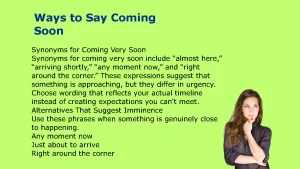
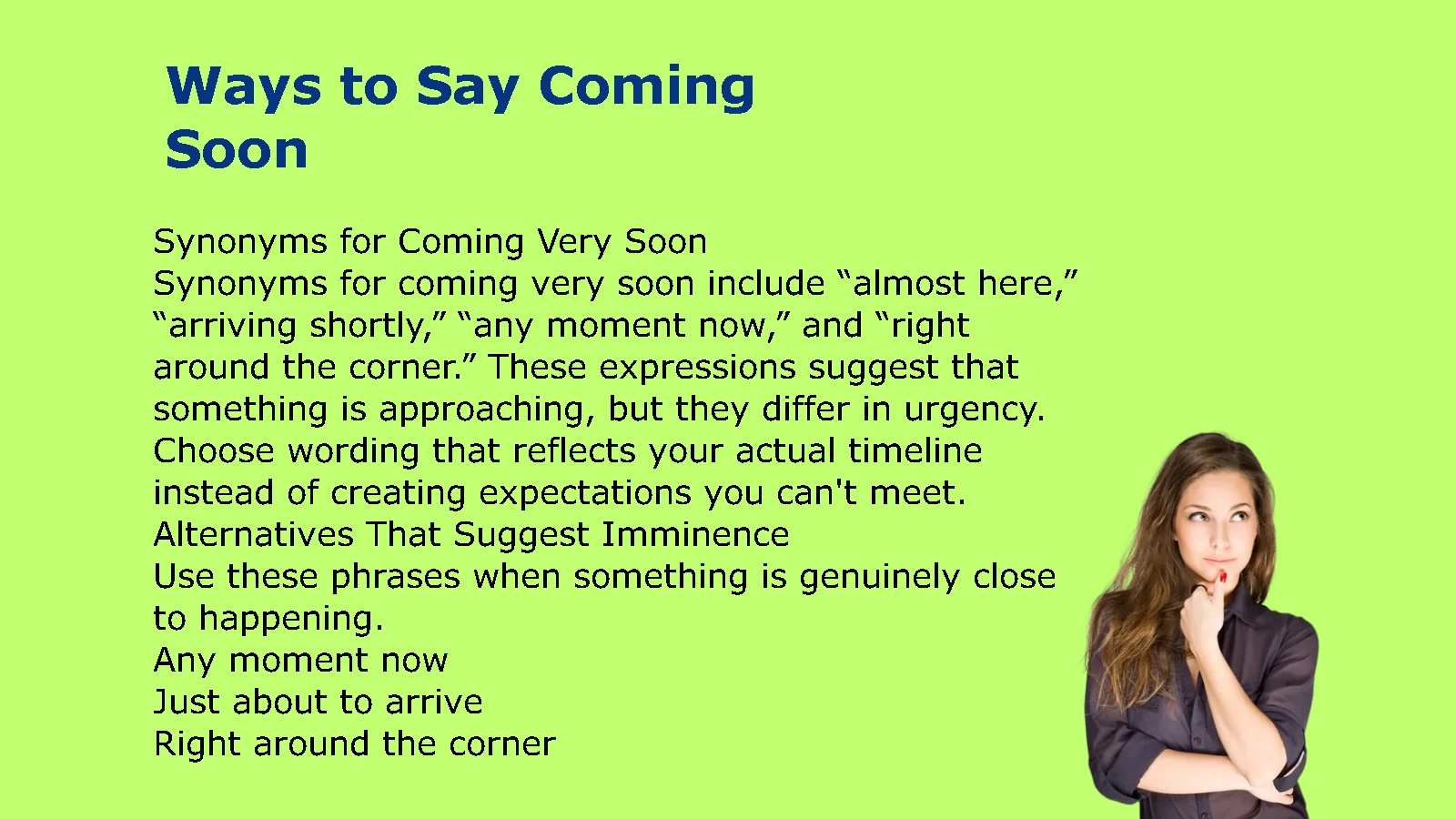
Synonyms for Coming Very Soon
Synonyms for coming very soon include “almost here,” “arriving shortly,” “any moment now,” and “right around the corner.” These expressions suggest that something is approaching, but they differ in urgency. Choose wording that reflects your actual timeline instead of creating expectations you can’t meet.
Alternatives That Suggest Imminence
Use these phrases when something is genuinely close to happening.
- Any moment now
- Just about to arrive
- Right around the corner
- Almost here
- Imminent
- Expected any day now
- Arriving shortly
- Just a little longer
- On the verge of launching
- Launching in the coming days
- Happening shortly
- Nearly ready
How they differ:
Any moment now suggests an event could happen very soon, sometimes within minutes.
Example: “The live broadcast will begin any moment now.”
Almost here creates a sense of closeness without specifying a deadline.
Example: “Our new collection is almost here.”
Imminent is more formal and often describes an event expected to happen very soon.
Example: “The announcement is imminent.”
Expected any day now suggests a near-term expectation but doesn’t guarantee the exact day.
Example: “The final approval is expected any day now.”
On the verge of launching suggests that preparations are nearly complete.
Example: “We’re on the verge of launching our new platform.”
Use the most accurate expression for the situation. A phrase that communicates urgency can become misleading if the release remains months away.
How to Choose the Right Phrase for Your Timeline
Your wording should match the level of certainty you have.
| Timeline Situation | Suggested Phrase | Why It Works |
| Launching within minutes | Beginning any moment now | Communicates immediate timing |
| Launching very shortly | Arriving shortly | Suggests a near arrival |
| Launching soon, exact date unknown | Coming soon | Flexible and familiar |
| Launching within a few days | Arriving in the coming days | More specific |
| Launching next month | Launching next month | Sets a clearer expectation |
| Launch date not confirmed | Launch date to be announced | Avoids an unsupported promise |
For business communication, a specific timeframe is often more useful than an exciting teaser.
For example, “Launching next month” helps customers plan. “Something big is coming” might generate curiosity, but it doesn’t tell them when to return.
Coming Soon Meaning and How to Use It Correctly
Coming soon means that something is expected to arrive, happen, appear, or become available in the near future. People commonly use it for product launches, business openings, website updates, events, movies, publications, and personal visits. The phrase communicates anticipation but doesn’t establish an exact date or deadline.
Coming Soon Meaning in Different Contexts
The meaning of “coming soon” stays broadly similar, but the expected action changes with context.
On a website
A “Coming Soon” page usually tells visitors that a website, product page, or online service isn’t ready yet.
Example: “Our new website is coming soon.”
In a business announcement
The phrase signals an upcoming opening, service, or company development.
Example: “A new café is coming soon to your neighborhood.”
In a product launch
It builds anticipation before customers can buy or use the product.
Example: “Our latest collection is coming soon.”
In movies and entertainment
It teases an upcoming release, trailer, show, or event.
Example: “Coming soon to theaters.”
In a personal message
It may describe a person’s expected arrival.
Example: “I’m coming soon.”
In this context, the phrase can sound incomplete if the listener needs to know where you’re going. “I’ll be there soon” often communicates the message more naturally.
What Does “I Will Be Coming Soon” Mean?
“I will be coming soon” generally means that the speaker expects to arrive or visit in the near future. It describes a future movement or visit, not necessarily an upcoming product or announcement. The exact meaning depends on the surrounding conversation and the destination.
For example:
- “I will be coming soon to your office.” This means the speaker plans to visit the office soon.
- “I’ll be there soon.” This is a more natural everyday alternative when the destination is already clear.
- “I’ll arrive shortly.” This sounds slightly more formal.
- “I’m on my way.” This usually suggests the journey has already started.
Is “I will be coming soon” correct?
Yes, it can be grammatically correct. The future construction “will be coming” uses the future auxiliary “will” with the progressive form “be coming.”
However, grammatical correctness doesn’t always mean natural phrasing.
Compare these sentences:
| Sentence | Typical Meaning |
| I will be coming soon. | I expect to come or visit in the near future. |
| I’ll be there soon. | I expect to reach your location soon. |
| I’m coming soon. | I’m expected to come shortly. |
| I’m on my way. | I’ve generally started traveling toward you. |
| I’ll visit you soon. | I plan to visit you in the near future. |
If you’re texting a friend, “I’ll be there soon” usually sounds more direct.
If you’re describing a planned visit, “I’ll visit you soon” may be clearer.
Coming Soon vs. Coming Shortly vs. Coming Up
These phrases share a sense of future timing, but they don’t always mean the same thing.
| Phrase | Meaning | Typical Use |
| Coming soon | Expected in the near future | General announcements |
| Coming shortly | Expected relatively soon | Formal or neutral communication |
| Coming up | Approaching or scheduled next | Events, activities, programs |
| On the way | Approaching, arriving, or being delivered | People, packages, updates |
| Forthcoming | Expected or planned in the future | Formal writing |
| Arriving soon | Expected to reach a destination or become available | Products, visitors, releases |
| Launching soon | A product or service is about to launch | Business announcements |
Coming up deserves special attention.
For example:
“Our next guest is coming up after the break.”
This means the guest’s appearance is approaching in the program.
“Our next collection is coming soon.”
This refers to a future product release.
Although both phrases describe future events, they serve different communication purposes.
Coming shortly and coming soon can overlap, but “shortly” may sound more formal or suggest a relatively brief wait. Neither phrase gives a guaranteed time.
How to Choose the Best Alternative to Coming Soon
The right alternative depends on your audience, platform, purpose, and timeline. A short, catchy phrase may work well on social media, while a customer announcement needs clear information. Choose wording that communicates the next step without creating unnecessary confusion.
Choose Based on Your Audience
Think about who will read your message.
Business clients
Use clear, professional wording.
Examples:
- Our new service will launch soon.
- Further details will follow.
- Registration opens shortly.
Existing customers
Focus on what the announcement means for them.
Examples:
- Your new account features are arriving soon.
- Our updated service will be available shortly.
- We’re preparing something new for you.
Social media followers
Use engaging, memorable language.
Examples:
- The countdown is on.
- Something exciting is almost here.
- Stay tuned for the big reveal.
Friends and family
Keep it natural.
Examples:
- I’ll be there soon.
- I’m coming over shortly.
- See you in a bit.
The same phrase doesn’t need to work for everyone. Good communication adapts to the reader.
Choose Based on Your Purpose
Different announcements need different wording.
To build excitement
Try:
- The wait is almost over.
- The big reveal is near.
- Something special is on the horizon.
To communicate a planned launch
Try:
- Launching soon.
- Scheduled for release.
- Our new service launches on November 15.
To announce availability
Try:
- Available soon.
- Preorders open shortly.
- Now accepting registrations from November 15.
Only use the last two examples if the availability details are confirmed.
To create curiosity
Try:
- We’ve got something up our sleeve.
- There’s more to the story.
- A little mystery. A big reveal.
To set expectations
Try:
- We’re aiming to launch next month.
- The release date will be announced soon.
- We’ll share an update by Friday.
If the date is tentative, say so. Readers appreciate honest updates more than vague promises.
Common Mistakes to Avoid
Even a short announcement can confuse readers if you choose the wrong expression.
Using vague promises when customers need dates
“Coming soon” might work for a teaser, but it isn’t always enough for a preorder, appointment, event, or scheduled service.
Using “available soon” when something is already available
If customers can buy the product today, tell them it’s available now.
Using slang in formal communication
“New heat incoming” might fit a fashion launch, but it may not suit a corporate software announcement.
Creating false urgency
Avoid “Any moment now” if the launch is still weeks away.
Confusing “coming up” with “coming soon”
Use “coming up” for something approaching in a sequence, schedule, or program. Use “coming soon” for a broader upcoming release or event.
Using creative language without context
“Something amazing is brewing” might sound engaging, but it doesn’t explain what customers should expect.
A useful rule: Lead with clarity when readers need information. Lead with creativity when readers need a reason to pay attention.
Ready-to-Use Coming Soon Phrases for Different Situations
The easiest way to write an effective announcement is to start with a phrase that matches your situation and then add the details readers need.
Coming Soon Website Banner Examples
A website banner should be brief, readable, and clear.
Here are copy-ready options:
- Our new website is launching soon.
- A better experience is on the way.
- We’re getting things ready. See you soon.
- Something new is coming. Stay tuned.
- We’re building something better for you.
- Our new online home is almost here.
- A fresh look is arriving soon.
- We’ll be back with something new.
Example website coming soon page:
A Better Experience Is Almost Here
We’re working on a refreshed website to make your experience easier. We’ll announce the launch date soon.
Want to be the first to know? Join our mailing list for updates.
This example works because it explains what’s changing, gives visitors a reason to care, and offers a next step.
Don’t use a countdown timer unless you have a reliable launch date. A countdown that resets or expires without a launch can damage trust.
Coming Soon Instagram and Social Media Captions
Social media captions can be more expressive, especially when paired with relevant visuals.
Try these options:
- The countdown starts now.
- Almost time for the big reveal.
- A fresh drop is on the way.
- Keep watching. We’re just getting started.
- Your next favorite thing is almost here.
- We’ve been working on something special.
- New beginnings are just around the corner.
- The reveal is closer than you think.
- Save the date. Something exciting is coming.
- Your sneak peek starts soon.
Example Instagram caption for a clothing brand:
“New season. New styles. Our latest collection is almost here. Stay tuned for the reveal.”
Example caption for a creator:
“I’ve been working on something behind the scenes. Can’t wait to share it with you.”
A good social media caption should fit the creative itself. If the image already explains the product, the caption can focus on excitement. If the image is abstract, add enough context to make the announcement understandable.
Coming Soon Product Launch Examples
Product announcements should balance excitement with practical information.
Use these phrases:
- Meet your next favorite product soon.
- Our latest collection arrives soon.
- New features are on the way.
- Get ready for our upcoming release.
- A new way to work is coming.
- Your next upgrade is almost here.
- The next chapter of our product starts soon.
- Our newest design is nearly ready.
Example product launch announcement:
“Something new is taking shape. Our latest collection launches soon, with fresh designs made for everyday wear.”
If the launch date is confirmed, make the copy more specific:
“Our latest collection launches November 15. Sign up for release updates.”
Specific dates help shoppers plan and give your announcement a concrete purpose.
Coming Soon Business Opening Examples
For a new physical location, customers often want to know where and when they can visit.
Try these phrases:
- Our doors will open soon.
- A new destination is coming to your neighborhood.
- We’re preparing to welcome you.
- Opening soon. More details to follow.
- Your new local favorite is on the way.
- A fresh experience is coming to town.
- We’re getting ready for opening day.
- A new chapter begins in your neighborhood.
Example for a new café:
“Your new neighborhood coffee spot is almost here. We’re preparing to welcome you soon. Follow us for opening updates.”
Example for a fitness studio:
“A new space to move, train, and grow is coming soon. Opening details will be announced shortly.”
Include the business name, neighborhood, opening date, or address whenever possible. These details turn a generic teaser into a useful local announcement.
Mini Case Study: Choosing the Right Coming Soon Phrase
Imagine a small online store preparing to launch a handmade candle collection.
The owner wants to announce the launch three weeks before the products become available.
Three possible messages are:
| Version | Message | Assessment |
| Generic | Coming soon. Stay tuned. | Short, but offers little context. |
| Creative | Something warm is on the horizon. | Memorable, but doesn’t identify the product. |
| Clear and engaging | Our new handmade candle collection launches in three weeks. Get a first look soon. | Communicates the product and timeframe while building anticipation. |
Best choice: The third message.
Why? It combines three useful elements:
- Clarity: Readers know what’s coming.
- Timing: They understand when to expect it.
- Engagement: The promise of a first look gives them a reason to follow the brand.
This example illustrates a practical copywriting principle: creativity works best when it supports useful information.
The lesson applies to restaurants, clothing stores, software companies, event organizers, and service providers.
Conclusion: Find the Right Way to Say Coming Soon
The best ways to say coming soon depend on what you’re announcing and who will read your message. Phrases such as “arriving shortly,” “almost here,” “forthcoming,” “launching soon,” and “stay tuned” can all work, but each serves a different purpose.
For professional announcements, prioritize clarity with expressions such as “scheduled for release” or “further details will follow.” For creative campaigns, use catchy phrases like “The wait is almost over” or “Something exciting is on the horizon.” If you’re writing for social media, a casual expression such as “The next drop is almost here” may fit your audience.
Before publishing, check three things:
- Does the phrase match your audience?
- Does it communicate the right level of urgency?
- Does it set realistic expectations?