Other ways to say please consider include “I would appreciate your consideration,” “please take this into account,” “I invite you to consider,” and “I would value your feedback.” The best alternative depends on whether you want someone to review a document, evaluate a proposal, think about an idea, or make a decision.
Choosing the right please consider alternative can make your writing sound more natural, respectful, and professional. In business emails, phrases such as please review and I would appreciate your feedback communicate a clear action. In essays and research writing, verbs such as examine, analyze, and evaluate often provide greater precision. For job applications, thank you for your time and consideration remains a useful closing expression.
Quick Answer: Other Ways to Say Please Consider
| Question | Answer |
| What is another way to say please consider? | I would appreciate your consideration. |
| What is a professional synonym for consider? | Review, evaluate, assess, or take into account. |
| What is a formal alternative to please consider? | We respectfully request your consideration. |
| What is another word for consider in an essay? | Examine, analyze, evaluate, or explore. |
| What is another way to say considering my application? | Thank you for reviewing my application or considering my candidacy. |
What Does Please Consider Mean?
Please consider means asking someone to think carefully about an idea, request, proposal, possibility, or piece of information. It expresses a request for attention or evaluation without necessarily demanding agreement. The phrase often appears in professional emails, applications, business proposals, academic discussions, and formal correspondence.
For example:
- Please consider my suggestion for improving the workflow.
- Please consider the attached proposal before making a decision.
- Please consider my application for the position.
In each sentence, the writer asks the reader to give something attention. However, the expected action changes with the context.
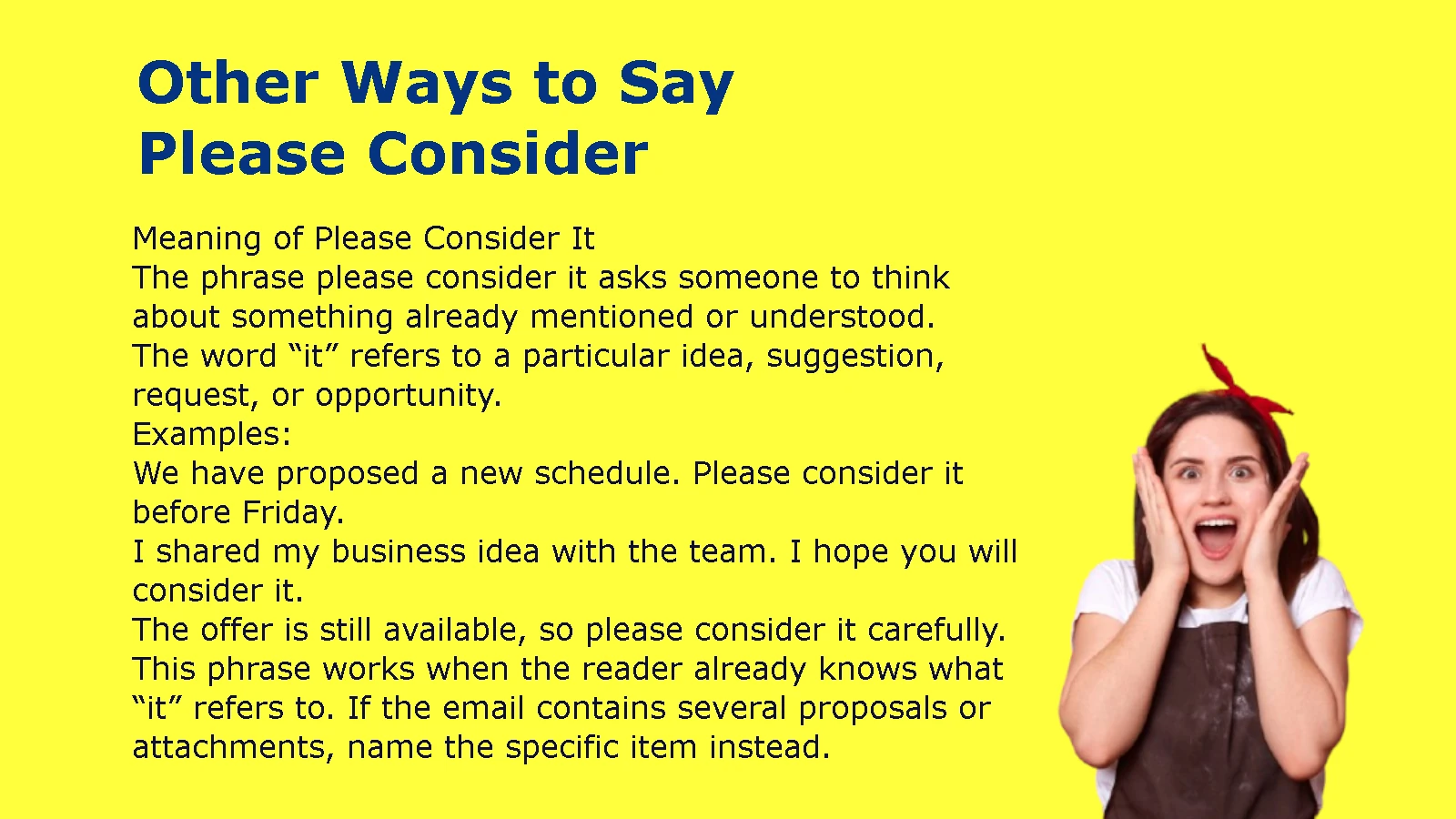
Meaning of Please Consider It
The phrase please consider it asks someone to think about something already mentioned or understood.
The word “it” refers to a particular idea, suggestion, request, or opportunity.
Examples:
- We have proposed a new schedule. Please consider it before Friday.
- I shared my business idea with the team. I hope you will consider it.
- The offer is still available, so please consider it carefully.
This phrase works when the reader already knows what “it” refers to. If the email contains several proposals or attachments, name the specific item instead.
For example:
Instead of: “Please consider it.”
Write: “Please consider the revised project timeline.”
The second sentence removes ambiguity and gives the reader a clearer reference.
Is Please Consider Formal or Polite?
Please consider sounds polite and moderately formal in most professional settings. It suits emails, business requests, proposals, and applications. However, the phrase can feel vague if the writer does not explain what the recipient should consider or why it matters.
Its tone depends on the surrounding words.
- Polite: I would appreciate it if you could consider my suggestion.
- Neutral: Please consider the following options.
- Formal: We respectfully request your consideration of this proposal.
- Direct: Please evaluate the proposed changes.
Use a softer construction when you ask for a favor. Choose a direct verb when you need a specific action.
35+ Other Ways to Say Please Consider
The best alternatives to please consider preserve the intended meaning while improving clarity, tone, or context. Some phrases invite reflection, others request a review, and a few communicate a more formal appeal.
Polite and Professional Alternatives to Please Consider
These expressions work well in emails, workplace conversations, requests, and business correspondence.
| Alternative | Best use |
| I would appreciate your consideration. | Formal requests |
| Kindly consider. | Brief formal messages |
| I ask that you consider. | Direct, respectful requests |
| I would be grateful if you would consider. | Courteous appeals |
| Please give this some thought. | Ideas and suggestions |
| I invite you to consider. | Proposals and discussions |
| I hope you will take this into account. | Decisions involving relevant factors |
| I would appreciate it if you could review this. | Documents and requests |
| I would value your perspective on this. | Feedback and opinions |
| Please give this matter your attention. | Matters requiring attention |
Example:
Original: Please consider my suggestion for the next meeting.
Improved: I would appreciate your consideration of my suggestion for the next meeting.
More conversational: I would value your thoughts on my suggestion for the next meeting.
The last version works particularly well when you want feedback rather than a formal decision.
Formal Alternatives to Please Consider
Formal expressions suit official letters, client communication, institutional requests, and business proposals.
- We respectfully request that you consider.
- We ask for your thoughtful consideration.
- We respectfully invite you to evaluate.
- We request that you take this proposal into account.
- Your consideration of this matter would be appreciated.
- We would welcome your assessment of this proposal.
- We respectfully ask you to review the following.
- We request your review and feedback on this matter.
Example:
Original: Please consider our request for an extension.
Formal: We respectfully request your consideration of an extension.
Clearer and more direct: We request an extension until November 15 to complete the remaining work.
The direct version often works better because it states the requested outcome immediately. Formal language should support clarity, not replace it.
Short and Natural Alternatives to Please Consider
Short phrases can make your emails easier to read, especially when the context already explains your request.
- Please keep this in mind.
- Think about this.
- Take a look at this.
- Please review this.
- Give this some thought.
- Bear this in mind.
- Please weigh these options.
- Keep this in consideration.
The final expression, “keep this in consideration,” sounds less natural in many situations than keep this in mind or take this into account.
Examples:
- Please keep the revised deadline in mind.
- Take a look at the attached presentation.
- Please review the updated figures.
- Give this suggestion some thought before the next meeting.
Choose “review” when you expect someone to inspect material. Use “give this some thought” when you want them to reflect on an idea.
Stronger Alternatives for Requests and Proposals
Sometimes, “please consider” sounds too weak because the writer needs the recipient to evaluate a specific opportunity or make a decision.
These alternatives communicate a clearer purpose:
- Please give this proposal your full consideration.
- We encourage you to evaluate this option.
- Please weigh the benefits and drawbacks.
- We urge you to consider this opportunity.
- Please assess the following proposal.
- We ask that you carefully review the proposed changes.
- Please evaluate whether this approach meets your needs.
- We recommend that you examine the available options.
Example:
Original: Please consider the new pricing structure.
More precise: Please evaluate whether the new pricing structure meets your budget requirements.
The improved version tells the reader what kind of consideration matters.
Best Alternatives by Context
| Situation | Recommended phrase |
| Professional email | I would appreciate your consideration. |
| Job application | Thank you for considering my application. |
| Business proposal | We invite you to review our proposal. |
| Academic essay | This analysis examines… |
| Research paper | The findings suggest… |
| Polite reminder | Please keep this in mind. |
| Formal request | We respectfully request your consideration. |
| Client feedback | I would value your feedback on… |
| Budget discussion | Please evaluate the proposed costs. |
| Decision-making | Please take these factors into account. |
How to Choose the Best Please Consider Alternative
Choose an alternative based on what you want the reader to do. Use review when you want someone to examine material, evaluate when you want a judgment, take into account when you want them to recognize relevant factors, and give thought to when you want reflection.
A suitable synonym should answer three questions:
- What do I want the reader to do?
- How formal should my message sound?
- Does the replacement preserve my original meaning?
Alternatives for Polite Requests
Polite requests acknowledge the reader’s time and allow them to respond without feeling pressured.
Consider these examples:
When asking for an opinion:
“I would appreciate your thoughts on the proposed changes.”
When requesting a decision:
“I would be grateful if you could consider my request.”
When sharing a new idea:
“I invite you to consider a different approach.”
When asking for feedback:
“Your feedback on this proposal would be greatly appreciated.”
Notice the distinction between asking for an opinion and asking for a decision. If you only need feedback, requesting someone’s “consideration” may sound unnecessarily formal.
Alternatives for Formal and Business Communication
Business writing benefits from specific action verbs. Instead of repeating “please consider,” identify the task directly.
| What you want | Better wording |
| Read a document | Please review the document. |
| Judge an option | Please evaluate this option. |
| Examine a problem | Please assess the situation. |
| Recognize relevant information | Please take this into account. |
| Think about an idea | I invite you to consider this idea. |
| Provide an opinion | We welcome your feedback. |
For example, imagine that you send a proposal to a potential client.
Weak: “Please consider our proposal.”
Stronger: “Please review our proposal and let us know whether the suggested timeline works for your team.”
The revised sentence gives the recipient a practical next step.
Alternatives for Academic and Research Writing
Academic writing often requires precision rather than extra politeness. Phrases such as “please consider” can sound conversational or instructional when the writer intends to present an argument.
Compare these sentences:
- General: Please consider the relationship between income and education.
- Academic: This section examines the relationship between income and education.
- Analytical: The study evaluates how income levels influence educational outcomes.
- Argumentative: The evidence supports a closer examination of educational inequality.
Each revision serves a different purpose. Pick the one that matches your argument rather than selecting a synonym simply to avoid repetition.
Another Word for Consider in an Essay
In an essay, useful alternatives to consider include examine, explore, evaluate, analyze, discuss, assess, and take into account. Choose the verb that reflects whether you are explaining an idea, judging evidence, or weighing different viewpoints.
Best Academic Synonyms for Consider
| Synonym | Meaning and academic use |
| Examine | Study a topic carefully |
| Analyze | Break information into parts to understand it |
| Evaluate | Judge the value, quality, or effectiveness of something |
| Explore | Investigate a subject or possibility |
| Assess | Make an informed judgment |
| Discuss | Present and explain relevant points |
| Investigate | Systematically study a question |
| Account for | Recognize or explain relevant factors |
| Contemplate | Think deeply about an idea |
These words do not have identical meanings.
For example, analyze suggests a closer examination of components or relationships. Evaluate requires judgment against some standard. Explore can introduce a topic without promising a final judgment.
Examples of Replacing Consider in an Essay
Original: We must consider the effects of social media on teenagers.
Revised: We must examine the effects of social media on teenagers.
Original: This essay considers both sides of the debate.
Revised: This essay discusses both sides of the debate.
Original: Researchers should consider the limitations of the study.
Revised: Researchers should acknowledge the limitations of the study.
Original: The report considers whether remote work improves productivity.
Revised: The report investigates whether remote work improves productivity.
Original: Policymakers should consider the economic consequences.
Revised: Policymakers should take the economic consequences into account.
Writing tip: Don’t replace every occurrence of “consider” with a different word. Repetition can be acceptable when a term accurately describes your argument. Precision matters more than synonym variety.
Words to Avoid When Writing Academically
Some words look like synonyms but change the meaning of your sentence.
| Word | Why it may not fit |
| Assume | Suggests accepting something without sufficient verification |
| Suppose | Introduces a possibility or hypothesis |
| Approve | Means accepting or authorizing something |
| Accept | Often suggests agreement or willingness |
| Ignore | Means giving no attention to something |
| Contemplate | Suggests reflection, not necessarily analysis |
For example, “The study assumes the effects of the intervention” differs from “The study examines the effects of the intervention.”
The first sentence suggests an assumption. The second describes an investigation.
Consider Synonym in Research and Academic Writing
In research writing, choose examine to investigate a topic, analyze to interpret data, evaluate to judge evidence, and account for to acknowledge relevant factors. The best synonym depends on the research method, the evidence, and the claim you want to communicate.
Research Synonyms Based on Purpose
Examine: Use this word when investigating a topic, relationship, or issue.
Example: “This paper examines the relationship between sleep duration and academic performance.”
Analyze: Choose this verb when interpreting data, patterns, or underlying relationships.
Example: “The researchers analyzed survey responses from participating students.”
Evaluate: Use it when judging quality, effectiveness, relevance, or strength.
Example: “The study evaluates the effectiveness of the training program.”
Investigate: This word works when describing an inquiry into a question or problem.
Example: “The research investigates factors associated with employee retention.”
Assess: Use it when measuring or judging a condition against defined criteria.
Example: “The research assesses customer satisfaction after implementation.”
Account for: Choose this expression when recognizing or explaining relevant influences.
Example: “The analysis accounts for differences in age and experience.”
Research Sentence Examples
The right replacement also depends on the section of your paper.
| Research section | Example wording |
| Introduction | This study investigates the impact of flexible working arrangements. |
| Literature review | This section examines previous findings on employee motivation. |
| Methodology | The research assesses responses using a standardized questionnaire. |
| Results | The analysis identifies differences between the two groups. |
| Discussion | These findings suggest several possible explanations. |
| Limitations | Future studies should account for additional variables. |
Don’t claim that a study “proves” something if its design only supports an association or a limited conclusion. Strong research writing uses verbs that reflect the evidence.
How to Avoid Repetition in Research Papers
Repeated wording can make a paper sound mechanical, but forced variation creates another problem: inaccurate claims.
Try this simple editing method:
- Highlight every occurrence of “consider.”
- Identify the intended action in each sentence.
- Replace vague wording with a more precise verb where appropriate.
- Keep “consider” when it expresses the meaning accurately.
- Check whether the revised sentence still reflects the study’s evidence.
For example:
Repetitive: “The paper considers income, considers age, and considers education.”
Improved: “The analysis examines income, accounts for age, and evaluates the role of education.”
Use this approach only if the verbs accurately describe what the analysis actually does.
Consider Synonym Professional: Better Alternatives for Emails and Work
For professional communication, use review, evaluate, take into account, or give your consideration to, depending on the request. These alternatives sound clearer when they identify exactly what the recipient should review, assess, or decide.
Professional Email Examples
When sharing an attachment
Instead of: “Please consider the attached document.”
Write: “Could you please review the attached document before Thursday’s meeting?”
When proposing an idea
Instead of: “Please consider my suggestion.”
Write: “I would welcome your feedback on my suggestion.”
When requesting a business decision
Instead of: “Please consider our proposal.”
Write: “Please evaluate our proposal and let us know your decision.”
When sharing important information
Instead of: “Please consider the budget limitations.”
Write: “Please take the budget limitations into account when planning the project.”
When asking for support
Instead of: “Please consider helping us with the project.”
Write: “Would you be available to support the project next week?”
These examples show a useful principle: the strongest professional alternative often removes unnecessary wording altogether.
Formal Synonyms for Business Requests
Use these expressions when communicating with clients, managers, vendors, or business partners.
- Review: Please review the revised contract.
- Evaluate: We invite you to evaluate the proposed solution.
- Assess: Please assess the potential risks.
- Take into account: Please take the delivery requirements into account.
- Give thought to: We encourage you to give this suggestion some thought.
- Examine: We ask that you examine the attached report.
- Weigh: Please weigh the costs against the expected benefits.
One important distinction: asking someone to review a contract does not necessarily ask them to approve it. If you need approval, say so explicitly.
For example: “Please review and approve the revised budget by Friday.”
Professional Alternatives That Sound Less Demanding
A request can remain clear without sounding forceful.
Try these phrases:
- I would appreciate your thoughts on this.
- When convenient, could you review the document?
- We welcome your feedback on the proposed changes.
- I would value your perspective on this matter.
- If you have time, please share your thoughts.
- Would you be open to considering this option?
Case study: Improving a workplace email
Suppose a team member wants a manager to adopt a new reporting process.
Original: “Please consider my idea for changing the reporting process.”
This message is polite, but it doesn’t explain the benefit or the requested action.
Improved: “I suggest replacing the weekly manual report with an automated dashboard. This could reduce duplicate data entry. Would you be open to reviewing the proposal?”
The revised version gives the manager three useful details:
- The proposed change.
- The expected benefit.
- The next action.
This approach makes a request more persuasive without relying on formal language alone.
Another Way to Say Considering My Application
When referring to a job application, use “Thank you for reviewing my application,” “Thank you for your time and consideration,” or “I appreciate your consideration of my candidacy.” Choose wording that fits whether you are applying, following up, or thanking an employer.
Alternatives for Job Application Emails
These phrases work well in cover letters, application emails, and professional follow-ups.
- Thank you for considering my application.
- I appreciate your time and consideration.
- Thank you for reviewing my qualifications.
- I appreciate the opportunity to be considered for this role.
- Thank you for taking the time to review my candidacy.
- I welcome the opportunity to discuss my qualifications.
- I look forward to hearing from you.
Use “Thank you for your time and consideration” when closing a cover letter.
Use “Thank you for reviewing my application” when the recipient has already reviewed it or when you want to acknowledge that specific action.
Examples for Cover Letters and Follow-Up Emails
Cover letter closing
“Thank you for your time and consideration. I would welcome the opportunity to discuss how my experience in project coordination could support your team.”
Application follow-up
“I’m following up on my application for the marketing coordinator position. I remain interested in the opportunity and would appreciate any updates you can share.”
After an interview
“Thank you for meeting with me to discuss the position. I appreciated learning more about the role and would welcome the opportunity to contribute to your team.”
When submitting additional information
“Please find my updated portfolio attached. I would appreciate your review.”
These examples communicate interest without demanding a favorable outcome.
What to Avoid When Asking an Employer to Consider Your Application
Avoid wording that sounds entitled, vague, or overly persistent.
Instead of:
“Please consider me because I really need this job.”
Write:
“I believe my experience in customer support and account management aligns well with the role’s requirements.”
Instead of:
“I demand that you consider my application.”
Write:
“I would appreciate the opportunity to be considered for the position.”
Focus on your qualifications, relevant experience, and professional interest. Employers need evidence of suitability, not repeated requests for consideration.
Consider Synonym and Antonym: Meaning, Differences, and Examples
Synonyms for consider include think about, examine, assess, evaluate, and contemplate. Antonyms depend on the intended meaning: ignore or disregard can express the opposite of giving attention, while dismiss suggests rejecting an idea or proposal.
Common Synonyms for Consider
| Synonym | Example |
| Think about | Please think about my suggestion. |
| Examine | Examine the evidence before deciding. |
| Evaluate | Evaluate the available options. |
| Assess | Assess the potential impact. |
| Contemplate | She contemplated a career change. |
| Reflect on | Reflect on the feedback you received. |
| Take into account | Take the additional costs into account. |
| Review | Review the proposal before the meeting. |
The most suitable word depends on the sentence.
For example, “consider the evidence” can mean examining evidence, evaluating its strength, or simply keeping it in mind. Your replacement should preserve the intended meaning.
Consider Antonyms
There isn’t one perfect antonym for every meaning of “consider.”
| Antonym | Meaning | Example |
| Ignore | Give no attention to something | He ignored the suggestion. |
| Disregard | Treat something as unimportant or irrelevant | They disregarded the warning. |
| Overlook | Fail to notice or account for something | The report overlooked an important factor. |
| Dismiss | Reject an idea or treat it as unworthy of attention | She dismissed the proposal. |
| Reject | Refuse to accept something | The committee rejected the application. |
Important distinction: “Ignore” and “reject” don’t mean exactly the same thing.
Someone may review a proposal carefully and then reject it. That person considered the proposal but didn’t accept it.
Likewise, someone can overlook an important detail unintentionally. The word doesn’t always suggest a deliberate choice.
Consider Synonyms vs. Antonyms in Sentences
Compare these examples:
Considering an idea:
“The manager considered the recommendation.”
Ignoring an idea:
“The manager ignored the recommendation.”
Evaluating an idea:
“The manager evaluated the recommendation.”
Rejecting an idea:
“The manager rejected the recommendation.”
Each sentence describes a different action. Evaluating does not necessarily lead to rejection, and considering does not guarantee acceptance.
This distinction matters in professional correspondence, where the wrong verb can misrepresent someone’s decision.
Common Mistakes When Replacing Please Consider
Choosing a synonym without checking its meaning can weaken a message. The best replacement makes your request easier to understand and keeps the tone appropriate.
Using Review When You Mean Evaluate
Review usually means examining something. Evaluate suggests judging its quality, effectiveness, or suitability.
For example:
“Please review our pricing options.”
This asks the reader to examine the options.
“Please evaluate our pricing options and recommend the most cost-effective plan.”
This asks the reader to make a judgment.
Choose the verb that matches the task.
Using Kindly in Every Professional Email
“Kindly” can express politeness, but it doesn’t automatically make a sentence sound warmer.
For example:
“Kindly send the report today.”
This is grammatically acceptable, though some readers may interpret it as formal or directive.
A more conversational alternative is:
“Could you please send the report today?”
For an established colleague, you may simply write:
“Please send the report by 3 p.m. today.”
The right wording depends on your relationship, workplace norms, and the urgency of the request.
Choosing Synonyms That Change the Original Meaning
Avoid treating these expressions as interchangeable:
- Consider: Think about something.
- Approve: Officially accept or authorize something.
- Review: Examine something.
- Accept: Agree to receive or take something.
- Evaluate: Judge something against relevant criteria.
For instance, “Please consider the proposal” leaves the decision open.
“Please approve the proposal” requests a specific outcome.
Don’t use the second sentence unless you genuinely want approval.
Making Requests Too Wordy
Long phrases can bury your main point.
Wordy: “I would be very grateful if you could possibly take some time out of your schedule to consider the possibility of reviewing the document.”
Clear: “Could you please review the document when you have time?”
The shorter version sounds natural and communicates the same basic request.
Use courtesy where it helps, but don’t add several expressions of politeness to one sentence.
Frequently Asked Questions
What Is Another Way to Say Please Consider?
Useful alternatives include “I would appreciate your consideration,” “please take this into account,” “I invite you to consider,” and “please give this some thought.” Use “please review” when you want someone to examine a specific document or proposal.
What Is a More Formal Word for Consider?
Evaluate, assess, examine, and contemplate are formal alternatives, but each has a different meaning. Evaluate and assess suggest judgment, examine suggests careful study, and contemplate suggests deep thought.
What Does Please Consider It Mean?
“Please consider it” politely asks someone to think about a previously mentioned idea, suggestion, offer, or request. The pronoun “it” refers to something already understood from the conversation.
What Is the Opposite of Consider?
Common antonyms include ignore, disregard, and dismiss. The best choice depends on context. Ignore means giving no attention, while dismiss suggests rejecting an idea or treating it as unworthy of attention.
What Is Another Word for Consider in an Essay?
Use examine, analyze, evaluate, explore, or discuss, depending on your purpose. Examine suits close study, analyze suits detailed interpretation, and evaluate suits judgments based on evidence or criteria.
How Do You Politely Ask Someone to Consider Your Application?
Write, “I would appreciate the opportunity to be considered for the position,” or close with, “Thank you for your time and consideration.” Mention relevant qualifications when you want to strengthen your application.
Conclusion: Choose a Please Consider Alternative That Fits Your Message
The best other ways to say please consider depend on your audience, purpose, and writing style. A professional email may need “I would appreciate your consideration,” while an academic essay may benefit from “examine,” “analyze,” or “evaluate.”
Use these simple guidelines when editing your next message:
- Choose review for documents and reports.
- Choose evaluate for decisions and judgments.
- Choose take into account for relevant factors.
- Choose give this some thought for ideas and suggestions.
- Choose thank you for your time and consideration for application closings.
Before sending your email or submitting your essay, check whether your chosen expression communicates the action you actually want. Replace vague wording with a clear request, and let your purpose guide your word choice.