If you want to express “looking forward to it” without repeating the same phrase, there are plenty of natural alternatives for different situations, from professional emails and workplace conversations to friendly messages and casual conversations. Expressions such as “I’m excited about it,” “I can’t wait,” “I’m eager for it,” “I’m anticipating it,” and “I’m really looking forward to it” can convey enthusiasm, anticipation, or genuine interest depending on the context.
The phrase “looking forward to it” means that you feel pleased, excited, or eager about something that is expected to happen in the future. However, the best alternative depends on the level of enthusiasm and the situation. For example, “I’m excited about it” sounds warm and enthusiastic, while “I’m eager to get started” can sound more professional and action-oriented. In a formal email, phrases such as “I look forward to it” or “I’m anticipating the opportunity” may be more appropriate.
In this guide, you’ll discover the best other ways to say “looking forward to it,” including professional, formal, friendly, casual, and enthusiastic alternatives. You’ll also see clear examples showing how to use each expression naturally in emails, conversations, text messages, meetings, and workplace situations.
By the end, you’ll know which alternatives to “looking forward to it” fit different situations and how to express anticipation naturally without sounding repetitive or overly formal.
What Does “Looking Forward to It” Mean?
“Looking forward to it” means feeling pleased, excited, or interested about something that is expected to happen in the future.
For example:
“Thanks for inviting me. I’m looking forward to it.”
Here, “it” refers to the event, activity, meeting, trip, or experience that will happen later.
The phrase is common in both personal and professional communication.
You might say:
“I’m looking forward to our meeting.”
Or:
“Thanks for organizing everything. I’m looking forward to it!”
The expression normally communicates a positive expectation. It tells someone that you are pleased about the upcoming event or experience.
Best Alternatives to “Looking Forward to It”
Here are 27 natural alternatives, with explanations of when each one works best.
1. I’m Excited About It
Meaning: You feel enthusiastic or happy about something that will happen.
Best for: Friends, coworkers, events, plans, trips, and positive upcoming experiences.
Tone: Friendly.
Example:
“Thanks for inviting me to the conference. I’m excited about it.”
This is one of the easiest replacements when you want to sound more enthusiastic than “looking forward to it.”
2. I Can’t Wait
Meaning: You are very eager for something to happen.
Best for: Friends, family, casual conversations, and informal messages.
Tone: Casual and enthusiastic.
Example:
“We’re finally going on vacation next week. I can’t wait!”
“I can’t wait” is stronger and more emotional than the standard “I’m looking forward to it.”
Avoid it in highly formal correspondence because it can sound conversational.
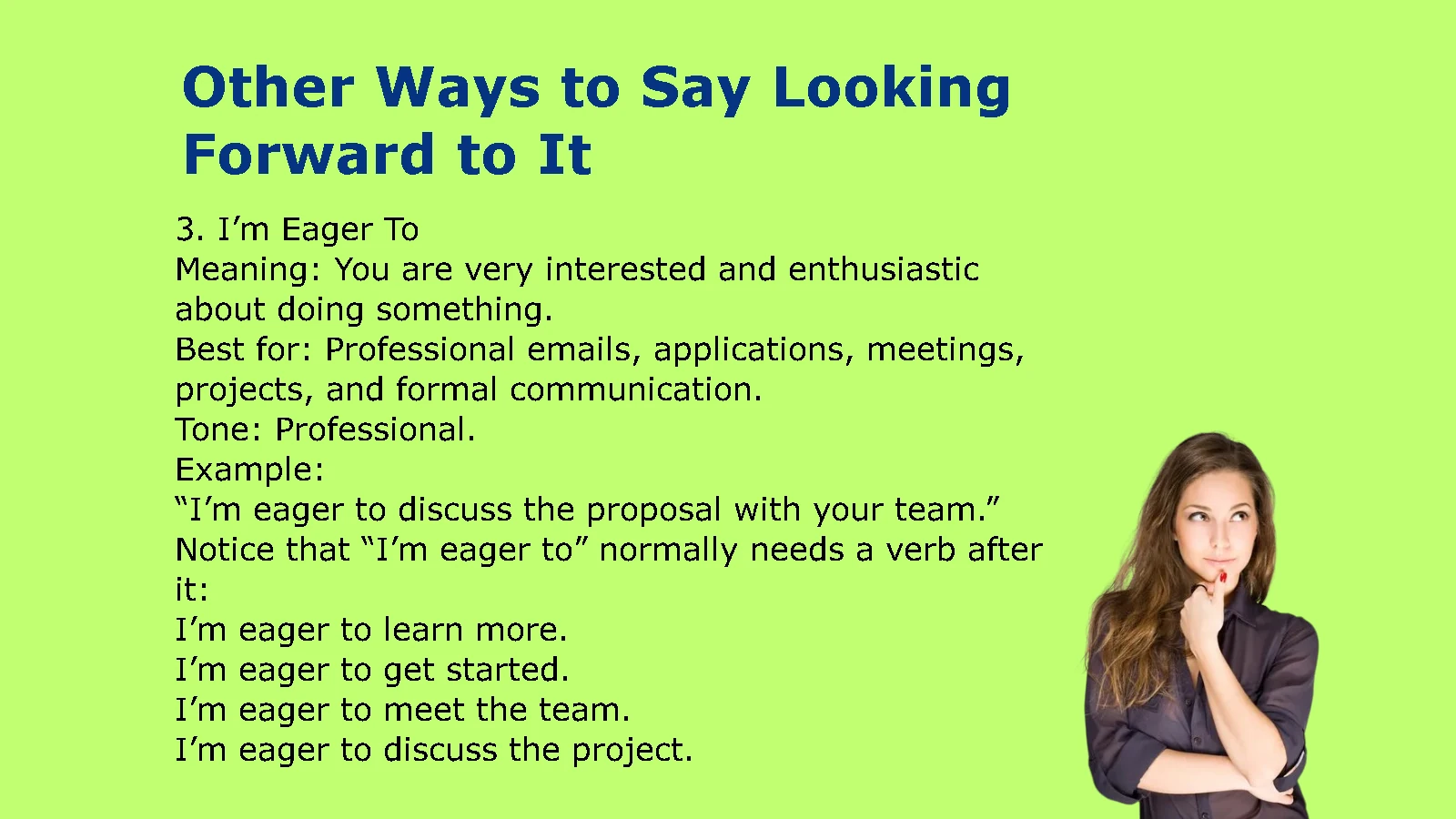
3. I’m Eager To
Meaning: You are very interested and enthusiastic about doing something.
Best for: Professional emails, applications, meetings, projects, and formal communication.
Tone: Professional.
Example:
“I’m eager to discuss the proposal with your team.”
Notice that “I’m eager to” normally needs a verb after it:
- I’m eager to learn more.
- I’m eager to get started.
- I’m eager to meet the team.
- I’m eager to discuss the project.
4. I’m Anticipating It
Meaning: You expect something and are thinking about it with interest or expectation.
Best for: Formal writing, events, experiences, and situations where you want a more polished expression.
Tone: Formal.
Example:
“We’re anticipating the conference and the opportunities it will provide.”
This isn’t always a direct replacement for “looking forward to it.” Anticipate can simply mean expecting something, so it doesn’t necessarily express the same warmth or excitement.
5. I’m Excited for It
Meaning: You feel enthusiastic about something that is going to happen.
Best for: Informal conversation, texts, social media, and friendly messages.
Tone: Casual and friendly.
Example:
“The concert is this weekend, and I’m so excited for it!”
This expression is common in everyday American English, although in more formal writing, “I’m excited about it” or a more specific phrase may sound more polished.
6. I’m Really Looking Forward to It
Meaning: You strongly anticipate something positively.
Best for: When you want to keep the original expression but add more enthusiasm.
Tone: Warm and enthusiastic.
Example:
“Thanks for making the arrangements. I’m really looking forward to it.”
Sometimes you don’t need a completely different expression. Simply strengthening the original phrase can make your message feel more personal.
7. I’m Looking Forward to the Opportunity
Meaning: You are pleased about the chance to participate in or experience something.
Best for: Job interviews, professional opportunities, business meetings, and formal emails.
Tone: Professional.
Example:
“I’m looking forward to the opportunity to work with your team.”
This is particularly useful when “it” is vague and you can name exactly what you’re anticipating.
8. I’m Excited About What’s Ahead
Meaning: You feel positive about the future and upcoming developments.
Best for: New projects, career changes, announcements, events, and personal milestones.
Tone: Positive and polished.
Example:
“We’ve made a lot of progress, and I’m excited about what’s ahead.”
It has a broader meaning than “looking forward to it” because it can refer to an entire period or series of future events.
9. I’m Eager to Get Started
Meaning: You are enthusiastic about beginning something.
Best for: Work projects, assignments, new roles, collaborations, and business communication.
Tone: Professional and motivated.
Example:
“Thank you for sending the materials. I’m eager to get started.”
This is more specific than “looking forward to it.” Use it when the important point is that you want to begin.
10. I’m Keen To
Meaning: You are enthusiastic or willing to do something.
Best for: Professional and conversational communication.
Tone: Professional to neutral.
Example:
“I’m keen to hear your thoughts on the proposal.”
Be careful with context. “Keen to” is natural English, but if you’re writing for a particular audience, you may prefer the more universally straightforward “I’m eager to”.
11. I’m Happy to Be Part of It
Meaning: You are pleased to participate in something.
Best for: Events, projects, teams, organizations, and collaborative activities.
Tone: Warm and appreciative.
Example:
“Thank you for including me. I’m happy to be part of it.”
This focuses more on participation than anticipation.
12. I’m Glad We Have This Planned
Meaning: You are pleased that a future meeting or activity has been arranged.
Best for: Personal plans, meetings, visits, and informal workplace communication.
Tone: Friendly.
Example:
“It’ll be great to catch up next week. I’m glad we have this planned.”
This is a natural option when you want to sound warm without sounding overly enthusiastic.
13. I’m Excited to Join You
Meaning: You are enthusiastic about participating with someone.
Best for: Invitations, gatherings, dinners, conferences, celebrations, and events.
Tone: Friendly and warm.
Example:
“Thanks for the invitation. I’m excited to join you for dinner.”
It works especially well when you’re responding to an invitation.
14. I’m Excited to See You
Meaning: You are happy about meeting someone in the future.
Best for: Friends, family, colleagues, and personal meetings.
Tone: Warm and friendly.
Example:
“It’s been a while. I’m excited to see you this weekend.”
This is more personal than simply saying “I’m looking forward to it.”
15. I’m Looking Forward to Seeing You
Meaning: You are pleased about an upcoming meeting with someone.
Best for: Emails, messages, invitations, visits, and professional meetings.
Tone: Warm and professional.
Example:
“Thank you for confirming the appointment. I’m looking forward to seeing you on Thursday.”
This is one of the most natural choices when you’re specifically anticipating someone’s company.
16. I’m Looking Forward to Hearing From You
Meaning: You expect and welcome a future response or communication.
Best for: Business emails, applications, customer communication, and professional correspondence.
Tone: Professional.
Example:
“Please let me know if you need any additional information. I’m looking forward to hearing from you.”
This is more specific than “looking forward to it” because the anticipated action is receiving a response.
17. I’m Excited to Hear More
Meaning: You are interested in receiving additional information.
Best for: Meetings, presentations, proposals, interviews, and professional conversations.
Tone: Professional and friendly.
Example:
“Thanks for sharing the initial details. I’m excited to hear more during our meeting.”
It’s useful when you’re interested in a future discussion rather than simply an event.
18. I’m Eager to See How It Goes
Meaning: You are interested in finding out what happens.
Best for: Projects, experiments, events, competitions, and new initiatives.
Tone: Neutral and positive.
Example:
“We’ve made all the preparations, and I’m eager to see how it goes.”
This communicates anticipation without necessarily suggesting strong excitement.
19. I’m Anticipating the Experience
Meaning: You are expecting an upcoming experience with interest.
Best for: Formal writing, special events, travel, performances, and significant experiences.
Tone: Formal.
Example:
“We’re anticipating the experience and look forward to spending the weekend in the mountains.”
This sounds more polished than conversational, so it isn’t usually the best choice for a casual text.
20. I’m Excited About the Plans
Meaning: You feel enthusiastic about arrangements that have already been made.
Best for: Trips, social events, meetings, celebrations, and group activities.
Tone: Friendly.
Example:
“Everything sounds great. I’m excited about the plans!”
It’s especially useful when you want to acknowledge several arrangements rather than one specific event.
21. I’m Counting Down the Days
Meaning: You are extremely eager for an upcoming event.
Best for: Vacations, weddings, concerts, holidays, birthdays, and other highly anticipated occasions.
Tone: Casual and enthusiastic.
Example:
“Our trip is only two weeks away, and I’m counting down the days!”
This is much more expressive than “looking forward to it,” so it should be used when that level of excitement is appropriate.
22. I’m Thrilled About It
Meaning: You are extremely pleased or excited about something.
Best for: Good news, opportunities, celebrations, achievements, and special events.
Tone: Enthusiastic.
Example:
“I heard the news, and I’m thrilled about it!”
“Thrilled” expresses stronger emotion than “looking forward to.”
23. I’m Excited to Make It Happen
Meaning: You are enthusiastic about taking action and turning a plan into reality.
Best for: Projects, events, collaborations, and ambitious plans.
Tone: Motivated and positive.
Example:
“We have the team in place, and I’m excited to make it happen.”
This works particularly well when you want to communicate both enthusiasm and action.
24. I’m Ready for It
Meaning: You feel prepared and willing to face an upcoming event or challenge.
Best for: Challenges, activities, projects, competitions, and informal situations.
Tone: Confident and casual.
Example:
“The big presentation is tomorrow, and I’m ready for it.”
This isn’t an exact synonym for “looking forward to it.” It emphasizes preparedness rather than anticipation.
25. I’m All Set and Excited
Meaning: You are prepared and enthusiastic about what is coming.
Best for: Trips, events, meetings, activities, and informal conversations.
Tone: Casual and upbeat.
Example:
“I’ve packed everything, so I’m all set and excited for the trip.”
It works well when you’ve already completed the necessary preparation.
26. I’m Excited to See What Comes Next
Meaning: You are enthusiastic or curious about future developments.
Best for: Projects, careers, stories, business plans, and new opportunities.
Tone: Positive and conversational.
Example:
“We’ve finished the first phase, and I’m excited to see what comes next.”
This is broader than “looking forward to it” and works well when the future outcome isn’t completely known.
27. It’ll Be Great to Experience It
Meaning: You expect an upcoming experience to be enjoyable or worthwhile.
Best for: Events, travel, performances, activities, and special occasions.
Tone: Neutral and positive.
Example:
“I’ve heard so much about the festival. It’ll be great to experience it in person.”
This expression is useful when you want to sound positive without using words such as “excited” or “thrilled.”
Professional Alternatives to “Looking Forward to It”
When writing a work email, you don’t always need an enthusiastic phrase. Professional communication often benefits from being specific and restrained.
Here are useful choices:
- I’m looking forward to the opportunity.
- I’m eager to get started.
- I’m eager to discuss this further.
- I’m looking forward to our meeting.
- I’m looking forward to working with you.
- I’m excited to collaborate with your team.
- I look forward to hearing from you.
- I’m pleased to move forward with this.
- I’m excited about the next steps.
- I’m eager to learn more.
For example:
“Thank you for sending the proposal. I’m looking forward to discussing it with you on Thursday.”
Or:
“Thank you for the opportunity. I’m eager to get started and contribute to the project.”
These sound more professional than simply writing:
“I can’t wait!”
Formal Alternatives to “Looking Forward to It”
For formal emails, business letters, applications, and professional correspondence, consider:
- I look forward to it.
- I look forward to the opportunity.
- I look forward to our meeting.
- I look forward to hearing from you.
- I anticipate it with interest.
- I’m eager to proceed.
- I’m eager to discuss this further.
- I look forward to moving forward.
- I look forward to working with you.
The most natural choice will usually be a specific version of “I look forward to…” rather than an unusually elaborate synonym.
For example:
“I look forward to meeting with you next week.”
is generally clearer than trying to replace the phrase with something overly formal.
Casual Alternatives to “Looking Forward to It”
If you’re texting a friend or responding to an informal invitation, you have more freedom.
Natural choices include:
- I can’t wait!
- I’m excited!
- I’m so excited for it!
- I’m really excited about it.
- It’ll be great!
- I’m counting down the days.
- I’m ready for it!
- I’m excited to see you.
- Can’t wait to see you!
- I’m glad we have this planned.
For example:
“Thanks for inviting me! I can’t wait!”
Or:
“Saturday sounds great. I’m excited to see everyone!”
These sound more natural in casual conversation than formal alternatives such as “I anticipate the experience.”
Alternatives to “Looking Forward to It” in an Email
The best wording depends on what you’re anticipating.
For a meeting
“I’m looking forward to our meeting on Tuesday.”
For a client conversation
“I’m eager to discuss the project and next steps with you.”
For a new opportunity
“I’m looking forward to the opportunity to work with your team.”
For a response
“I look forward to hearing from you.”
For starting a project
“I’m eager to get started.”
For collaborating
“I’m excited to collaborate with you on this project.”
For an upcoming event
“I’m excited about the event and look forward to seeing everyone there.”
For accepting an invitation
“Thank you for the invitation. I’m excited to join you.”
The strongest emails usually replace “it” with the actual thing whenever possible. Instead of:
“I’m looking forward to it.”
try:
“I’m looking forward to our conversation.”
That gives the reader more information and makes the message feel more deliberate.
“Looking Forward to It” vs. “Can’t Wait”
These phrases both communicate anticipation, but they have different levels of intensity and formality.
“I’m looking forward to it” is generally more neutral and versatile.
“I can’t wait” sounds more enthusiastic and conversational.
Compare:
“I’m looking forward to meeting you.”
with:
“I can’t wait to meet you!”
The second sentence communicates stronger excitement.
For a professional email, the first choice is usually easier to use naturally.
For a text to a friend, “I can’t wait” may fit better.
“Looking Forward to It” vs. “I’m Excited”
These expressions overlap, but “excited” usually puts more emphasis on emotion.
“I’m looking forward to the conference.”
This communicates positive anticipation.
“I’m excited about the conference.”
This places more emphasis on enthusiasm.
You can also combine the ideas:
“I’m excited about the conference and looking forward to seeing everyone there.”
“Looking Forward to It” vs. “I’m Eager To”
“I’m eager to” works particularly well when you are talking about an action you want to take.
For example:
“I’m eager to discuss the proposal.”
By contrast:
“I’m looking forward to the proposal.”
would not necessarily mean the same thing.
You can say:
“I’m looking forward to discussing the proposal.”
Both are natural, but “eager to discuss” places slightly more emphasis on your willingness and enthusiasm to take action.
“Looking Forward to It” vs. “I’m Anticipating It”
These phrases are related, but they don’t always carry exactly the same feeling.
Looking forward to normally expresses positive anticipation.
Anticipating can simply mean expecting something to happen.
For example:
“We’re looking forward to the celebration.”
clearly communicates positive feelings.
But:
“We’re anticipating heavy traffic.”
doesn’t express excitement. It simply means you expect heavy traffic.
That’s why “anticipating it” isn’t always a direct replacement for “looking forward to it.”
How to Choose the Right Alternative
Use the purpose and tone of your message as your guide.
| Phrase | Tone | Best For | Example |
| I’m excited about it | Friendly | General enthusiasm | “I’m excited about it.” |
| I can’t wait | Casual | Friends and informal messages | “I can’t wait!” |
| I’m eager to | Professional | Work and action | “I’m eager to get started.” |
| I’m looking forward to the opportunity | Professional | Jobs and business | “I’m looking forward to the opportunity.” |
| I’m thrilled about it | Enthusiastic | Very positive news | “I’m thrilled about it.” |
| I’m excited to see you | Warm | Personal meetings | “I’m excited to see you.” |
| I’m looking forward to hearing from you | Professional | Emails | “I look forward to hearing from you.” |
| I’m counting down the days | Casual | Major events | “I’m counting down the days.” |
| I’m eager to get started | Professional | Projects | “I’m eager to get started.” |
| I’m ready for it | Confident | Challenges and activities | “I’m ready for it.” |
| I’m excited about what’s ahead | Positive | Future plans | “I’m excited about what’s ahead.” |
| It’ll be great to experience it | Neutral | Events and experiences | “It’ll be great to experience it.” |
Common Questions
What is another way to say “looking forward to it”?
Natural alternatives include I’m excited about it, I can’t wait, I’m eager to, I’m really looking forward to it, I’m thrilled about it, and I’m excited about what’s ahead.
What is a professional way to say “looking forward to it”?
Try “I’m looking forward to the opportunity,” “I’m eager to get started,” “I look forward to our meeting,” or “I’m eager to discuss this further.”
What is a casual way to say “looking forward to it”?
“I can’t wait,” “I’m excited,” “I’m so excited for it,” and “I’m counting down the days” are natural casual choices.
Can I say “I can’t wait” instead of “I’m looking forward to it”?
Yes. Both express positive anticipation, but “I can’t wait” sounds more enthusiastic and casual.
What can I say instead of “looking forward to it” in an email?
You could write “I’m looking forward to our meeting,” “I’m eager to discuss this further,” “I’m looking forward to the opportunity,” or “I look forward to hearing from you.”
The best choice depends on what you’re expecting.
Is “I’m excited for it” grammatically correct?
Yes, “I’m excited for it” is used in everyday American English. In more formal writing, “I’m excited about it” or a more specific expression may be preferable.
Is “I’m eager to” formal?
It can sound professional and polished, which makes it useful in workplace communication. It is especially natural when followed by an action, such as “I’m eager to learn more” or “I’m eager to get started.”
Is “I’m anticipating it” the same as “I’m looking forward to it”?
Not always. Anticipating can mean simply expecting something, while looking forward to normally communicates positive anticipation.
How do I say “looking forward to it” without sounding repetitive?
Make the sentence more specific. Instead of repeatedly saying “I’m looking forward to it,” try:
- “I’m excited to see you.”
- “I’m eager to get started.”
- “I look forward to our conversation.”
- “I’m excited about the opportunity.”
- “I can’t wait for the event.”
Specific wording usually sounds more natural than repeatedly searching for a synonym.
Final Thoughts
The best other ways to say “looking forward to it” depend on how much enthusiasm you want to express and who you’re talking to.
For a professional email, choose phrases such as “I’m eager to,” “I look forward to the opportunity,” or “I look forward to hearing from you.” For a friendly conversation, “I’m excited,” “I can’t wait,” or “I’m really looking forward to it” sounds natural. If you’re especially enthusiastic about an event, “I’m thrilled about it” or “I’m counting down the days” adds more energy.
When possible, be specific about what you’re anticipating. “I’m looking forward to our meeting” tells the reader much more than simply “I’m looking forward to it.” The clearer the context, the more natural your writing will sound.













