Looking for other ways to say “take your time”? Natural alternatives include there’s no rush, take all the time you need, whenever you’re ready, no need to hurry, don’t rush, go at your own pace, take as long as you need, and when you’re ready.
The right expression depends on what you mean. You might reassure someone that they don’t need to hurry, give a customer time to decide, encourage a coworker to work at a comfortable pace, or tell a friend that you’re willing to wait.
Here are 27 natural ways to say “take your time”:
| Alternative | Best For | Tone |
| There’s no rush | Reassuring someone | Friendly, neutral |
| Take all the time you need | Giving someone plenty of time | Warm, supportive |
| Whenever you’re ready | Waiting for someone to act | Polite, neutral |
| No need to hurry | Telling someone not to rush | Friendly |
| Don’t rush | Casual reassurance | Casual |
| Go at your own pace | Work, learning, or tasks | Supportive |
| Take as long as you need | Offering unlimited time | Warm |
| When you’re ready | Waiting for someone | Neutral |
| There’s no need to rush | Professional or polite situations | Polite |
| Take your time with it | A specific task | Neutral |
| Work at your own pace | Work or study | Professional |
| No hurry | Short casual messages | Casual |
| No pressure | Decisions or responses | Friendly |
| Whenever you have a chance | Nonurgent requests | Polite |
| When you get a chance | Casual requests | Casual |
| You can take your time | Reassuring someone | Neutral |
| Feel free to take your time | Polite permission | Professional |
| There’s plenty of time | Reassuring someone about timing | Neutral |
| You don’t have to rush | Reducing pressure | Friendly |
| Take as long as you like | Giving someone freedom | Warm |
| Proceed at your own pace | Formal or professional contexts | Formal |
| Go at whatever pace works for you | Flexible situations | Supportive |
| Whenever it works for you | Scheduling | Polite |
| No need to decide right away | Decisions | Reassuring |
| Think it over | Giving someone time to consider something | Neutral |
| Take some time to think about it | Important decisions | Supportive |
| I’m happy to wait | Letting someone know you can wait | Warm |
What Does “Take Your Time” Mean?
“Take your time” means you don’t need to hurry or finish something quickly. It tells another person that they have enough time to complete a task, make a decision, respond, or get ready.
For example:
“Take your time. I can wait.”
Here, you’re reassuring the person that they don’t need to rush.
You can also use the phrase when someone is making a decision:
“Take your time and think about which option works best for you.”
In this case, you’re encouraging careful consideration rather than an immediate answer.
The expression can sound friendly, patient, or reassuring depending on the context.
Is “Take Your Time” Polite?
Yes. “Take your time” is generally polite and reassuring. It tells someone that you aren’t pressuring them to hurry.
For example:
“Take your time. There’s no rush.”
That’s a warm way to reassure someone who may feel pressured.
However, tone matters. If someone is already taking a long time, saying “Take your time” with a particular tone of voice could sound sarcastic or impatient. In writing, you can avoid that ambiguity by using a clearer expression such as “There’s no rush” or “Whenever you’re ready.”
Best Ways to Say “Take Your Time”
The following alternatives cover the most common situations, from casual conversations to professional messages.
1. There’s No Rush
Meaning: You don’t need to hurry.
Best for: Everyday conversations, work, messages, and customer interactions.
Tone: Friendly and neutral.
Example:
“Take a look at the proposal. There’s no rush.”
This is probably the closest natural alternative when your main goal is to remove pressure.
2. Take All the Time You Need
Meaning: You have as much time as necessary.
Best for: Reassuring someone who needs extra time.
Tone: Warm and supportive.
Example:
“Take all the time you need to review the documents before you respond.”
This sounds especially considerate when someone is dealing with a difficult or important decision.
3. Whenever You’re Ready
Meaning: You can do something when you feel prepared.
Best for: Waiting for someone to begin, respond, speak, or leave.
Tone: Polite and patient.
Example:
“Whenever you’re ready, we can start the presentation.”
It doesn’t necessarily mean someone can take an unlimited amount of time. It simply removes the pressure to begin immediately.
4. No Need to Hurry
Meaning: There’s no reason to do something quickly.
Best for: Casual and everyday situations.
Tone: Friendly.
Example:
“No need to hurry. The movie doesn’t start for another hour.”
This works naturally when you know there is plenty of time.
5. Don’t Rush
Meaning: Don’t do something too quickly.
Best for: Friends, family, coworkers, and informal conversations.
Tone: Casual and direct.
Example:
“Don’t rush. Double check the numbers before you send the report.”
“Don’t rush” is slightly more direct than “take your time,” but the intended message is often similar.
6. Go at Your Own Pace
Meaning: Work or proceed at a speed that feels comfortable for you.
Best for: Learning, training, projects, and personal tasks.
Tone: Supportive and encouraging.
Example:
“The course is self paced, so you can go at your own pace.”
This is one of the best choices when the person controls how quickly they progress.
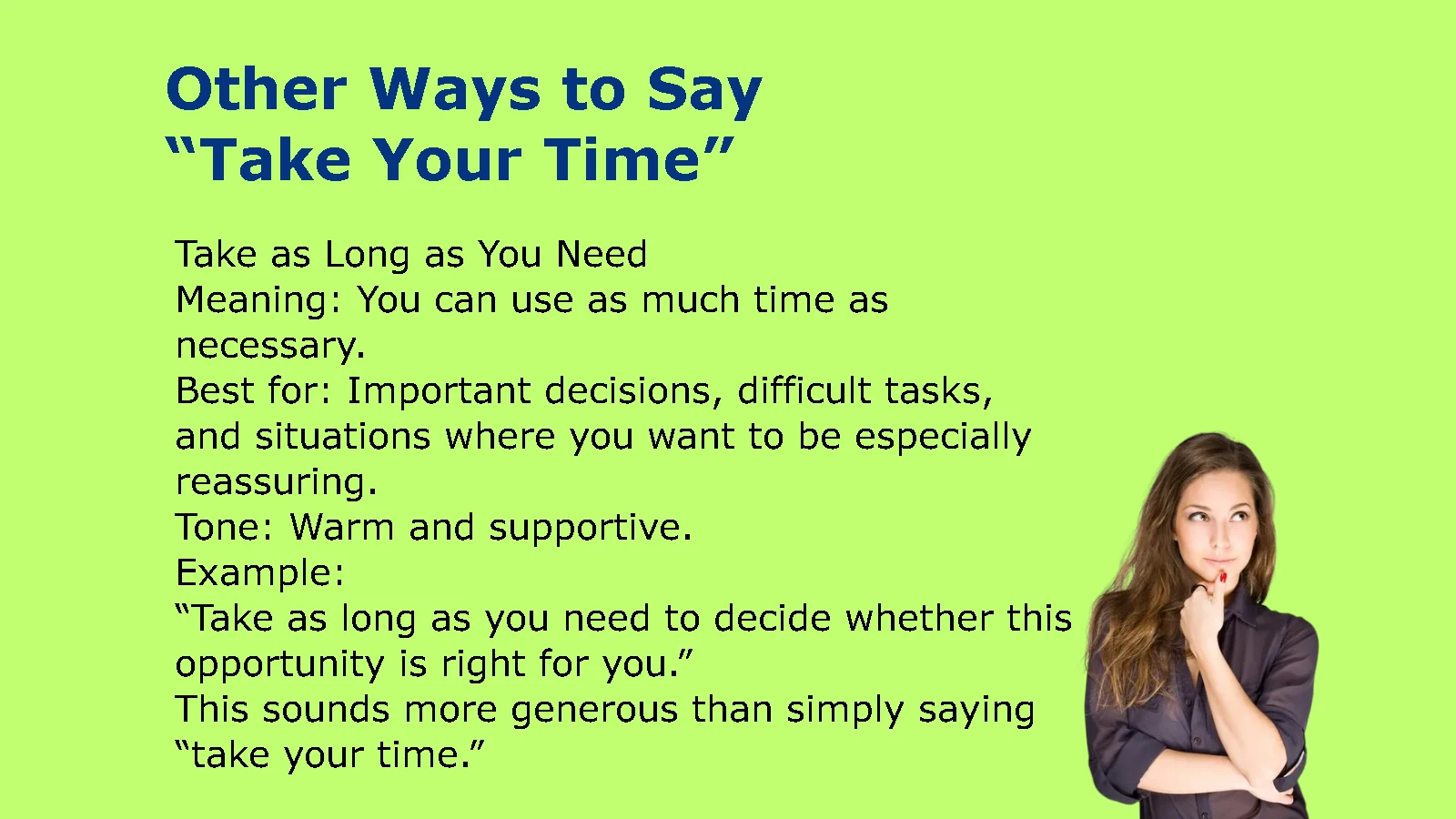
7. Take as Long as You Need
Meaning: You can use as much time as necessary.
Best for: Important decisions, difficult tasks, and situations where you want to be especially reassuring.
Tone: Warm and supportive.
Example:
“Take as long as you need to decide whether this opportunity is right for you.”
This sounds more generous than simply saying “take your time.”
8. When You’re Ready
Meaning: Do it when you feel prepared.
Best for: Conversations, meetings, decisions, and everyday requests.
Tone: Neutral and patient.
Example:
“When you’re ready, let me know which option you prefer.”
It’s concise and works particularly well in text messages and emails.
9. There’s No Need to Rush
Meaning: You don’t have to hurry.
Best for: Professional and personal communication.
Tone: Polite and reassuring.
Example:
“There’s no need to rush your decision. Please review the terms carefully.”
This is a strong choice when you want to sound considerate without being overly casual.
10. Take Your Time With It
Meaning: Spend enough time on something rather than completing it quickly.
Best for: Tasks, assignments, documents, and projects.
Tone: Neutral.
Example:
“Take your time with it and let me know if you have any questions.”
Adding “with it” makes the phrase focus more clearly on a particular task.
11. Work at Your Own Pace
Meaning: Complete your work according to a comfortable or suitable schedule.
Best for: Work, training, education, and projects.
Tone: Professional and supportive.
Example:
“You can work at your own pace and submit the assignment by Friday.”
This is more specific than “take your time” because it relates directly to the speed at which someone works.
12. No Hurry
Meaning: There is no need to do something immediately.
Best for: Short messages and casual conversations.
Tone: Casual.
Example:
“No hurry. Just send it over when you get a chance.”
“No hurry” is short, natural, and particularly useful in text messages.
13. No Pressure
Meaning: Someone doesn’t have to make a decision or take action because of pressure from you.
Best for: Decisions, invitations, requests, and personal conversations.
Tone: Friendly and reassuring.
Example:
“Think about the offer, but no pressure to decide today.”
This isn’t an exact synonym for “take your time.” It focuses more on removing pressure than on time itself.
14. Whenever You Have a Chance
Meaning: Do something when you have an available opportunity.
Best for: Nonurgent work requests and everyday communication.
Tone: Polite and neutral.
Example:
“Whenever you have a chance, could you review the attached file?”
This is useful when you want to make clear that the request isn’t urgent.
15. When You Get a Chance
Meaning: Do something when you have free time or an opportunity.
Best for: Casual workplace messages and conversations.
Tone: Casual.
Example:
“When you get a chance, could you send me the updated schedule?”
This expression is often more natural in an informal work message than “take your time.”
16. You Can Take Your Time
Meaning: You have permission or freedom not to hurry.
Best for: Reassuring someone directly.
Tone: Neutral and supportive.
Example:
“You can take your time reviewing the proposal. We won’t make a decision until next week.”
This version works especially well when you want to emphasize that the person genuinely has enough time.
17. Feel Free to Take Your Time
Meaning: You’re giving someone permission to proceed without rushing.
Best for: Emails, customer service, workplace communication, and polite requests.
Tone: Polite and professional.
Example:
“Feel free to take your time reviewing the information, and let me know if you have any questions.”
It’s courteous without sounding overly formal.
18. There’s Plenty of Time
Meaning: The deadline or event is far enough away that someone doesn’t need to hurry.
Best for: Reassuring someone about a specific deadline.
Tone: Neutral.
Example:
“There’s plenty of time before the deadline, so don’t worry about finishing it tonight.”
This works best when you actually know there is enough time.
19. You Don’t Have to Rush
Meaning: You don’t need to complete something quickly.
Best for: Friends, coworkers, and everyday situations.
Tone: Friendly.
Example:
“You don’t have to rush. We can leave whenever you’re ready.”
This sounds natural when someone is worried about keeping you waiting.
20. Take as Long as You Like
Meaning: You can spend as much time as you want.
Best for: Informal conversations and situations where you genuinely have no time constraint.
Tone: Warm and relaxed.
Example:
“Take as long as you like. I’ll be here when you’re finished.”
Be careful with this expression in professional situations. Depending on the context, it can sound unusually open ended.
21. Proceed at Your Own Pace
Meaning: Continue at a speed that works for you.
Best for: Formal instructions, training, education, and professional communication.
Tone: Formal.
Example:
“Please proceed at your own pace and complete each section before moving on.”
This is a more formal alternative to “go at your own pace.”
22. Go at Whatever Pace Works for You
Meaning: Choose the speed or timing that feels most suitable.
Best for: Flexible work, learning, projects, and supportive conversations.
Tone: Supportive and conversational.
Example:
“You can go at whatever pace works for you, as long as the project is finished by Friday.”
The phrase combines flexibility with a practical boundary.
23. Whenever It Works for You
Meaning: You can choose a time that fits your schedule.
Best for: Scheduling meetings, calls, and appointments.
Tone: Polite and professional.
Example:
“Let me know whenever it works for you, and we’ll schedule the call.”
This isn’t exactly about taking more time. It focuses on flexible timing, so use it when scheduling is the issue.
24. No Need to Decide Right Away
Meaning: Someone doesn’t need to make an immediate decision.
Best for: Offers, proposals, purchases, and important choices.
Tone: Reassuring.
Example:
“There’s no need to decide right away. Take a few days to consider the options.”
This is much more precise than “take your time” when the situation involves a decision.
25. Think It Over
Meaning: Take time to consider something carefully before deciding.
Best for: Decisions, offers, proposals, and personal matters.
Tone: Neutral.
Example:
“Think it over and let me know what you decide.”
“Think it over” focuses on careful consideration, not simply waiting.
26. Take Some Time to Think About It
Meaning: Spend some time considering a situation or decision.
Best for: Important choices and sensitive conversations.
Tone: Supportive and considerate.
Example:
“Take some time to think about it before giving me your answer.”
This is one of the clearest alternatives when “take your time” means don’t make a decision too quickly.
27. I’m Happy to Wait
Meaning: You don’t mind waiting for the other person.
Best for: Personal conversations, customer interactions, and situations where someone is concerned about keeping you waiting.
Tone: Warm and reassuring.
Example:
“Take whatever time you need. I’m happy to wait.”
Unlike many alternatives, this phrase focuses on your willingness to wait rather than telling the other person how much time they should take.
Polite Ways to Say “Take Your Time”
When you want to sound considerate without being overly formal, these are some of the best choices:
- There’s no rush.
- Take all the time you need.
- Whenever you’re ready.
- There’s no need to rush.
- You can take your time.
- Feel free to take your time.
- I’m happy to wait.
For example:
“Please review the proposal when you have a chance. There’s no rush.”
Or:
“Whenever you’re ready, I’m happy to discuss the next steps.”
These phrases make the other person feel less pressured without sounding overly dramatic.
Professional Ways to Say “Take Your Time”
In professional communication, you may want to reassure someone while still keeping your message clear and polished.
Good options include:
- There’s no need to rush.
- Whenever you’re ready.
- Feel free to take your time.
- Please review it at your convenience.
- When you have a chance, please take a look.
- Work at your own pace.
- Proceed at your own pace.
- There’s no need to decide right away.
Example for a work email
“Please take some time to review the proposal and let me know your thoughts when you’re ready.”
Another option:
“Feel free to review the documents at your convenience. There’s no need to rush your response.”
For a deadline driven task, however, don’t say “take your time” if you actually need something soon. A clearer message would be:
“Please review the document by Friday. If you have any questions, let me know.”
That gives the person flexibility while still communicating the deadline.
Casual Ways to Say “Take Your Time”
In everyday conversation, you can keep it simple:
- No rush.
- Don’t rush.
- Whenever you’re ready.
- No hurry.
- Take as long as you need.
- You don’t have to rush.
- I’m happy to wait.
For example:
“No rush. Just text me when you’re ready.”
Or:
“Don’t rush. We have plenty of time.”
These sound natural in texts, conversations, and messages to friends or family.
Ways to Say “Take Your Time” in an Email
The best wording depends on how formal your email is.
Polite and professional
“Please take your time reviewing the proposal, and let me know if you have any questions.”
Warm and friendly
“Take all the time you need to look everything over. I’m happy to answer any questions.”
Concise
“Whenever you’re ready, please send me your feedback.”
For a nonurgent request
“When you have a chance, could you review the attached document?”
For a decision
“There’s no need to decide right away. Please take some time to consider the options.”
For scheduling
“Whenever it works for you, let me know what time you’d prefer.”
These alternatives are often better than repeating “take your time” throughout workplace correspondence.
Ways to Say “Take Your Time” to a Customer
Customer communication requires a little more care because you want to sound helpful without sounding dismissive.
Good options include:
- Take all the time you need.
- Feel free to take your time.
- Whenever you’re ready, we’ll be happy to help.
- There’s no need to rush.
- Please take a moment to review your options.
- Take some time to consider which option works best for you.
For example:
“Please take a moment to review the available options, and let us know which one works best for you.”
That’s often more useful than simply saying “Take your time.”
Ways to Say “Take Your Time” When Someone Is Making a Decision
When someone needs time to make an important choice, focus on removing pressure rather than simply telling them to wait.
Try:
- Think it over.
- Take some time to think about it.
- There’s no need to decide right away.
- Take all the time you need.
- No pressure to decide today.
- Consider your options.
- Whenever you’re ready, let me know.
For example:
“Take some time to think about it. There’s no pressure to give me an answer today.”
This sounds more reassuring than a bare “Take your time.”
Ways to Say “Take Your Time” at Work
The best workplace expression depends on the task.
If you’re asking someone to review something:
“When you have a chance, please take a look.”
If there is no urgency:
“There’s no rush on this.”
If someone is learning a new process:
“Go at your own pace.”
If you’re waiting for a response:
“Whenever you’re ready, send me your feedback.”
If you’re discussing an important decision:
“There’s no need to decide right away.”
If you want a particularly polite tone:
“Feel free to take your time reviewing the information.”
“Take Your Time” vs. “There’s No Rush”
These expressions are close, but the emphasis is slightly different.
“Take your time” tells someone they don’t need to hurry.
“There’s no rush” specifically tells them that the situation isn’t urgent.
Compare:
“Take your time getting ready.”
This focuses on the person’s pace.
“There’s no rush to get ready.”
This focuses on the lack of urgency.
In many everyday situations, either one works naturally.
“Take Your Time” vs. “Whenever You’re Ready”
These phrases overlap, but they aren’t identical.
“Take your time” gives someone freedom to spend longer on something.
“Whenever you’re ready” emphasizes that the person can begin or respond when they feel prepared.
For example:
“Take your time with the report.”
The focus is on completing the report without rushing.
“Whenever you’re ready, we can start.”
The focus is on when the person wants to begin.
“Take Your Time” vs. “Go at Your Own Pace”
“Go at your own pace” works especially well when someone is progressing through a task, course, workout, or learning process.
For example:
“You can go at your own pace through the training materials.”
“Take your time” is broader:
“Take your time reviewing the training materials.”
The first emphasizes speed of progress. The second emphasizes not rushing.
“Take Your Time” vs. “Think It Over”
These expressions are not interchangeable in every situation.
“Think it over” means to consider something carefully before making a decision.
“Take your time” simply means that someone doesn’t need to hurry.
For example:
“Take your time getting ready.”
You wouldn’t normally say:
“Think it over getting ready.”
But this works:
“Think it over before accepting the offer.”
So, use think it over when the issue involves careful consideration or a decision.
What Is the Most Polite Way to Say “Take Your Time”?
For most situations, “Take all the time you need” is warm and considerate.
In a professional setting, “Feel free to take your time” or “There’s no need to rush” can work well.
If you’re waiting for someone to respond, “Whenever you’re ready” is also a polite choice.
The best expression depends on what you want to reassure the person about: time, pressure, a decision, or scheduling.
What Is a Professional Way to Say “Take Your Time”?
Some of the strongest professional alternatives are:
- There’s no need to rush.
- Feel free to take your time.
- Whenever you’re ready.
- When you have a chance, please review it.
- Work at your own pace.
- There’s no need to decide right away.
- Please review it at your convenience.
For example:
“Please review the proposal at your convenience and let me know if you have any questions.”
This sounds polished while clearly communicating that an immediate response isn’t required.
What Can I Say Instead of “Take Your Time” in a Text?
For a casual text, keep it short:
- No rush.
- No hurry.
- Whenever you’re ready.
- Don’t rush.
- Take all the time you need.
- I’m happy to wait.
For example:
“No rush. Just let me know when you’re ready.”
That’s natural and doesn’t sound overly formal.
Is “Take Your Time” Rude?
Usually, no. “Take your time” is normally a polite and reassuring expression.
However, context and tone can change how it sounds. If someone is already late, saying “Take your time” sarcastically could imply the opposite of what the words literally say.
In writing, you can make your intention clearer:
“No worries at all. There’s no rush.”
That leaves little room for confusion.
How to Choose the Right Alternative
Think about why you’re telling someone to take their time.
| What You Mean | Best Expression | Example |
| There is no urgency | There’s no rush | “There’s no rush on the report.” |
| Someone needs plenty of time | Take all the time you need | “Take all the time you need to decide.” |
| Someone can start later | Whenever you’re ready | “Whenever you’re ready, we can begin.” |
| Someone shouldn’t hurry | Don’t rush | “Don’t rush through the process.” |
| Someone controls their working speed | Go at your own pace | “Go at your own pace through the course.” |
| You don’t mind waiting | I’m happy to wait | “Take your time. I’m happy to wait.” |
| A decision can wait | No need to decide right away | “There’s no need to decide right away.” |
| Someone needs to consider something | Think it over | “Think it over and let me know.” |
| A request isn’t urgent | When you have a chance | “When you have a chance, take a look.” |
| A task has a flexible schedule | Work at your own pace | “You can work at your own pace.” |
| A situation requires formal wording | At your convenience | “Please respond at your convenience.” |
| You want to sound especially supportive | Take as long as you need | “Take as long as you need to consider it.” |
Final Thoughts
There are plenty of natural other ways to say “take your time,” but the best one depends on what you’re trying to communicate.
Use “there’s no rush” when you want to remove urgency. Choose “take all the time you need” when you want to be especially reassuring. Say “whenever you’re ready” when you’re waiting for someone to act, and use “go at your own pace” when someone controls the speed of a task or learning process.
For decisions, “think it over” or “there’s no need to decide right away” may be more precise.
In other words, don’t just look for a synonym. Choose the expression that tells the other person exactly what kind of time and freedom you’re giving them.













