If you’re looking for other ways to say “just checking in,” you’re probably trying to follow up with someone without sounding repetitive, pushy, or overly formal. The phrase “just checking in” is commonly used in emails, text messages, workplace conversations, and professional follow-ups when you want to ask for an update, see how someone is doing, or remind them about a previous conversation.
The phrase “just checking in” usually means that you’re contacting someone to see how things are going, ask about the status of something, or follow up on a previous message. However, the best alternative can depend on the situation. Expressions such as “following up,” “touching base,” “checking in with you,” “wanted to see how things are going,” “any updates?” and “circling back” can convey a similar idea while giving your message a different tone.
In this guide, you’ll discover the best ways to say “just checking in” in professional emails, casual messages, and everyday conversations. You’ll also find polite, friendly, formal, and concise alternatives, along with examples to help you choose the right expression for each situation.
By the end, you’ll know exactly how to replace “just checking in” naturally and professionally without making your messages sound repetitive or awkward.
Why You Should Replace “Just Checking In”
“Just checking in” isn’t wrong. It simply doesn’t communicate much on its own.
Consider this message:
“Hi Sarah, just checking in to see if you have any updates.”
It works, but the phrase gives Sarah little context. What are you checking on? Why do you need the update? Is something urgent?
A more specific version is stronger:
“Hi Sarah, I wanted to follow up on the proposal we discussed Monday. Do you have an update on the approval timeline?”
The second message gives the recipient context, purpose, and a clear question.
What “just checking in” actually communicates
“Just checking in” generally means contacting someone to ask about their status, progress, response, or well-being.
It can serve several purposes:
- Asking for an update
- Following up on a previous conversation
- Checking whether someone needs help
- Asking about a delayed task
- Reconnecting with someone
- Seeing whether a proposal or request is still active
- Asking how someone is doing
The phrase itself doesn’t tell you which purpose applies. That’s why context matters.
Why the phrase can sound vague or repetitive
The word “just” can also make a message sound less confident.
Compare:
“I’m just checking in about the contract.”
with:
“I’m following up about the contract.”
The second version sounds more direct without becoming rude.
You don’t always need to remove “just,” though. In a friendly conversation, it can soften your message naturally:
“Just checking in. How are things going?”
That’s perfectly normal.
The bigger issue occurs when you repeatedly send messages such as:
“Just checking in.”
“Just following up.”
“Just wanted to check in again.”
At that point, the recipient may wonder what action you actually want from them.
When “just checking in” is still perfectly appropriate
You don’t have to ban the phrase from your vocabulary.
It’s useful when:
- You’re speaking casually.
- You don’t need anything specific.
- You’re checking on someone’s well-being.
- You’re reopening a friendly conversation.
- The relationship is informal.
- The context is already obvious.
For example:
“Hey, just checking in. How’s the new job going?”
Here, the phrase fits because checking in is the entire purpose of the message.
The key distinction is simple: use a general phrase for a general purpose and a specific phrase for a specific purpose.
Best Other Ways to Say “Just Checking In”
The best alternative depends on what you actually want.
If you’re looking for a project update, say so. If you need a decision, ask for one. If you want to help, offer help.
Here are some useful alternatives:
| Alternative | Tone | Best used for |
| I wanted to follow up on… | Professional | Emails and business follow-ups |
| I’m following up regarding… | Formal | Professional correspondence |
| I wanted to see where things stand with… | Polite | Projects and decisions |
| Do you have an update on…? | Direct | Status requests |
| I’d love to hear how things are going with… | Friendly | Coworkers and clients |
| How are things progressing with…? | Professional | Projects |
| Is there anything you need from me? | Helpful | Offering assistance |
| I wanted to reconnect about… | Warm | Older conversations |
| I’m reaching out to see if… | Neutral | General business communication |
| Any update on…? | Casual | Chat and internal messages |
| Where do things stand with…? | Direct | Decisions and deadlines |
| I wanted to touch base about… | Familiar | Workplace communication |
Professional alternatives to “just checking in”
Try these when writing to a manager, client, colleague, recruiter, vendor, or business contact:
- I wanted to follow up on…
- I’m following up regarding…
- I wanted to see where things stand with…
- Do you have an update on…?
- I’m reaching out regarding…
- I wanted to check on the status of…
- Could you let me know where things stand?
- I’d appreciate an update when you have a chance.
- I wanted to see if there’s been any progress on…
- I’m following up to see whether…
Example:
“I wanted to follow up on the revised contract. Have you had a chance to review the latest version?”
That’s more useful than:
“Just checking in about the contract.”
Polite and friendly alternatives
You don’t always want to sound corporate.
These phrases strike a warmer balance:
- I wanted to see how things are going.
- I’d love to hear how things are progressing.
- I wanted to see where things stand.
- How are things coming along?
- I thought I’d reach out and see how things are going.
- I wanted to reconnect and see how you’re doing.
- I hope things are going well. I wanted to ask about…
- I was wondering if you had any updates.
These work especially well when you already know the person.
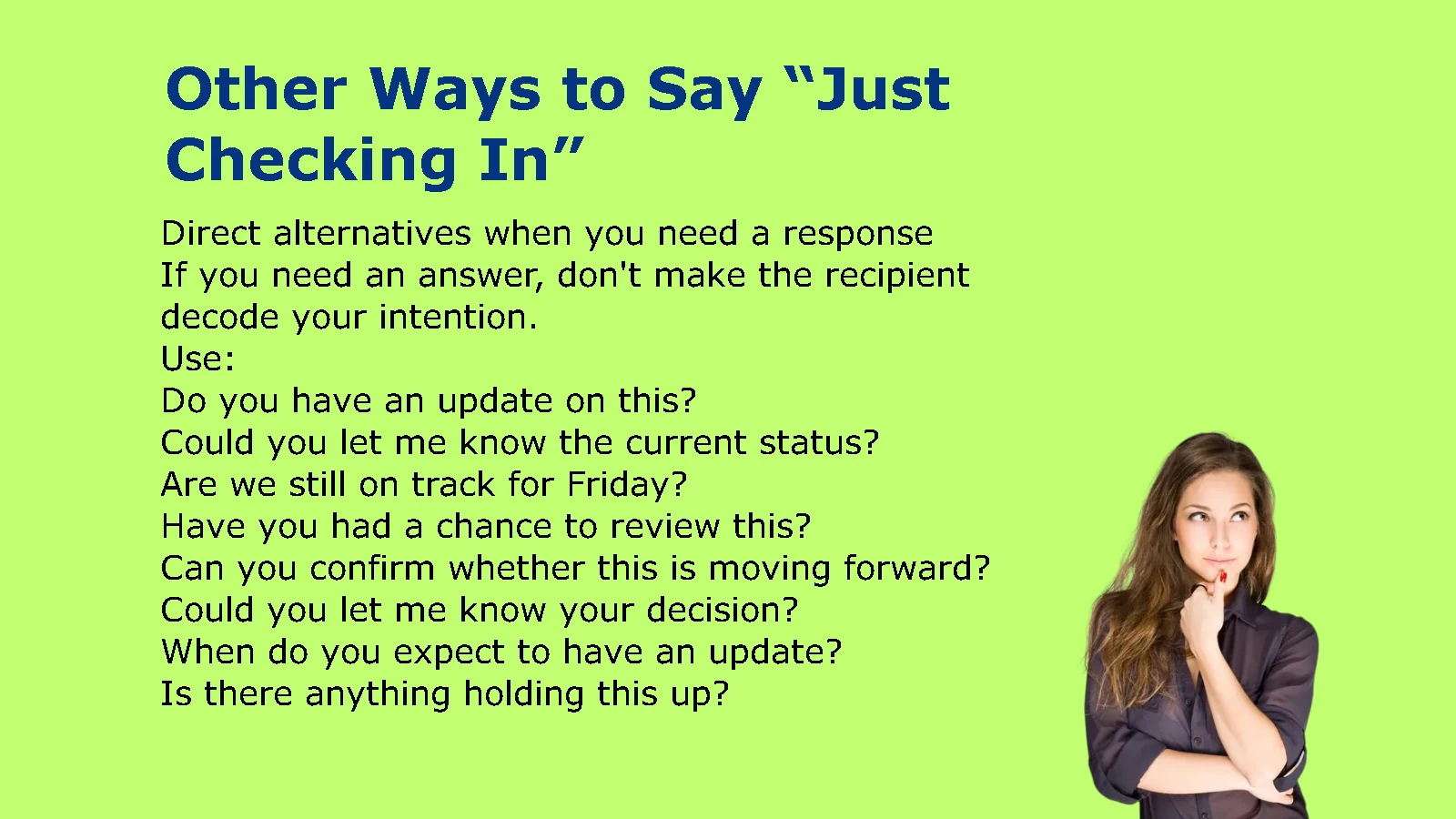
Direct alternatives when you need a response
If you need an answer, don’t make the recipient decode your intention.
Use:
- Do you have an update on this?
- Could you let me know the current status?
- Are we still on track for Friday?
- Have you had a chance to review this?
- Can you confirm whether this is moving forward?
- Could you let me know your decision?
- When do you expect to have an update?
- Is there anything holding this up?
Direct doesn’t mean aggressive.
Compare:
“Just checking in again about the report.”
with:
“Are we still on track to receive the report by Friday?”
The second message gives the recipient something concrete to answer.
Casual alternatives for friends and acquaintances
For personal conversations, professional phrases can sound strangely formal.
Instead, try:
- How’s everything going?
- How have you been?
- What’s new with you?
- How are things?
- How’s life treating you?
- How’s everything coming along?
- I was thinking about you. How are you doing?
- It’s been a while. How have you been?
For example:
“Hey! It’s been a while. How have you been?”
sounds much more natural than:
“I’m reaching out to check in regarding your current status.”
Save that one for a robot.
Short alternatives for texts and chat messages
Chat doesn’t need an email-style introduction.
Try:
- Any update?
- How’s it going?
- How are things?
- How’s that going?
- Where are we with this?
- Any news?
- How’s everything coming along?
- Need anything from me?
- Still on track?
- Did you get a chance to look at this?
The shorter the message, the more important the surrounding context becomes.
“Just Checking In” Alternatives for Professional Emails
Email follow-ups work best when the reader immediately understands what you’re following up about and what you need.
“I wanted to follow up on…”
This is one of the safest professional alternatives.
“I wanted to follow up on the proposal I sent last Thursday. Do you have any questions about the pricing or timeline?”
It works because the opening immediately identifies the subject.
“I’m following up regarding…”
This sounds slightly more formal.
“I’m following up regarding the invoice submitted on September 18. Could you confirm whether it has been processed?”
Use this style for administrative matters, vendors, clients, and formal business correspondence.
“I’d love to get an update on…”
This phrase softens the request without making it vague.
“I’d love to get an update on the website redesign when you have a chance.”
It’s particularly useful when the recipient isn’t necessarily late.
“Do you have an update on…?”
Use this when you genuinely need a status update.
“Do you have an update on the hiring timeline?”
There’s no need to hide the question behind several polite sentences.
“I wanted to see where things stand with…”
This phrase works well when a project or decision has been developing for some time.
“I wanted to see where things stand with the partnership agreement.”
It also leaves room for the recipient to explain delays, changes, or next steps.
“Could you let me know where we are with…?”
This works well with coworkers and project teams.
“Could you let me know where we are with the product images? We need them before Friday’s launch.”
Notice the second sentence. A deadline creates useful context.
Other Ways to Say “Just Checking In” at Work
Workplace follow-ups often fail because they focus on the act of following up rather than the work itself.
Instead of saying you’re checking in, identify the project, dependency, decision, or deadline.
When asking a coworker for an update
Try:
“How’s the client report coming along?”
or:
“Do you have an update on the client report?”
If you need the report by a certain time:
“Are we still on track to have the client report ready by Thursday?”
That question gives your coworker a clear target.
When checking on a project
Use language such as:
- How is the project progressing?
- Where do things stand with the project?
- Are we still on track for the launch?
- Has there been any movement on this?
- What’s the current status?
Avoid vague reminders when the project has several moving parts.
Instead of:
“Just checking in about the project.”
Try:
“I wanted to check whether the design review is still scheduled for Wednesday.”
When following up on a deadline
Deadlines call for precision.
“Are we still on track for Monday?”
“Can you confirm whether the report will be ready by 3 p.m.?”
“Do you anticipate any issues meeting Friday’s deadline?”
These questions are more actionable than “just checking in.”
When you need information from your manager
A manager may receive dozens of messages every day. Make yours easy to process.
“I wanted to follow up on the budget approval. Do you need any additional information from me?”
This combines context + request + offer of help.
When checking whether someone needs help
Don’t assume someone is behind.
Try:
“Is there anything you need from me to keep this moving?”
Or:
“Would it help if I handled the client follow-up?”
The second option is particularly strong because it offers a concrete action.
Other Ways to Say “Just Checking In” With a Client
Client communication requires a careful balance. You want to stay visible without sounding like you’re chasing them.
When you’re waiting for a client’s response
Instead of:
“Just checking in to see if you saw my email.”
Try:
“I wanted to follow up on the proposal I sent Tuesday. Do you have any questions I can answer?”
This gives the client a reason to respond.
When following up after a meeting
Mention the meeting and the next step.
“I wanted to follow up after our Tuesday meeting. Have you had a chance to review the revised timeline?”
This makes your email feel connected to an ongoing conversation rather than like an automated reminder.
When checking on a proposal
Try:
“I wanted to see where things stand with the proposal.”
Or:
“Have you had a chance to review the proposal? I’d be happy to walk through any questions.”
The second version works especially well because it combines a question with assistance.
When asking whether a project is still moving forward
Be direct but neutral:
“I wanted to check whether the project is still moving forward on the original timeline.”
This gives the client an easy opportunity to explain a change in priorities.
When you want to offer additional help
Lead with usefulness:
“I wanted to see whether you need anything else from our team before the next stage.”
That sounds less like a sales follow-up and more like project support.
Other Ways to Say “Just Checking In” With a Potential Customer
Sales follow-ups need more than persistence. A recipient has little reason to answer a message that adds nothing new.
When following up after a sales call
Instead of:
“Just checking in after our call.”
Try:
“I wanted to follow up on our conversation about reducing your reporting time. Would it be helpful to review the implementation options?”
The second version connects the follow-up to the prospect’s actual problem.
When following up after sending a proposal
“Have you had a chance to review the proposal? I’m happy to clarify the pricing or timeline.”
That’s much stronger than:
“Just checking in to see if you received the proposal.”
When a prospect has gone quiet
Avoid guilt-inducing language such as:
“I haven’t heard back from you.”
A more neutral approach:
“I wanted to see whether this project is still a priority for your team.”
That gives the prospect permission to say no, postpone the project, or continue the conversation.
When you have new information to share
This is one of the strongest reasons to follow up.
“I wanted to share an updated implementation timeline that may make the project easier to schedule.”
Now the email provides new value, not merely another reminder.
When you want to close the loop
If you’ve already followed up multiple times, make the next step clear:
“I’ll close the loop for now, but feel free to reach out if the project becomes a priority again.”
This is professional, respectful, and much less exhausting than another “just checking in” email.
Other Ways to Say “Just Checking In” After No Response
Following up after silence requires tact.
The goal isn’t to pressure someone into responding. It’s to make the next action obvious.
Polite ways to follow up without sounding pushy
Try:
- I wanted to follow up on my previous message.
- I wanted to see if you had a chance to review this.
- I’m following up in case my previous email got buried.
- I wanted to see whether this is still on your radar.
- I’d appreciate an update when you have a chance.
- Please let me know if you’d like to discuss this further.
The phrase “in case my previous email got buried” works particularly well because it doesn’t imply that the recipient deliberately ignored you.
Direct ways to ask for an answer
When the matter is time-sensitive:
“Could you confirm whether you’d like us to move forward?”
Or:
“Can you let me know by Thursday whether the proposed timeline works?”
A specific question is easier to answer than a general request for an update.
Low-pressure alternatives when there is no urgency
Use softer wording:
“Whenever you have a chance, I’d love to hear your thoughts.”
Or:
“No rush. I just wanted to see whether you’ve had a chance to review it.”
The phrase “no rush” should be genuine. Don’t write it when you actually need an answer today.
How to follow up when you’ve already sent several messages
At this point, repeating yourself rarely helps.
Change the purpose of your message.
You can:
- Add new information.
- Ask a specific question.
- Offer assistance.
- Give a clear deadline.
- Give the recipient an easy way to decline.
- Close the conversation temporarily.
For example:
“I wanted to close the loop on this. If the project is still planned for this quarter, I’m happy to update the proposal. Otherwise, I can reconnect later.”
That gives the recipient several easy paths forward.
“Just Checking In” Alternatives for Casual Conversations
Not every follow-up needs to sound polished.
Sometimes you’re simply thinking about someone.
Friendly ways to reconnect
- How have you been?
- It’s been a while! How are you doing?
- What’s new with you?
- How’s everything going?
- I was thinking about you. How have things been?
- How’s life treating you?
These phrases communicate genuine interest rather than administrative follow-up.
Ways to ask how someone is doing
If someone recently experienced a major event, be more specific.
Instead of:
“Just checking in.”
Try:
“How are you feeling after everything that happened?”
Or:
“How’s the new job going?”
Specific questions usually create better conversations.
Casual phrases for texting
Text messages benefit from brevity.
“Hey, how’s it going?”
“Any news?”
“How are things?”
“How’s the move going?”
“You doing okay?”
The last one can carry more emotional weight, so use it when the context supports it.
Ways to check on someone you haven’t spoken to recently
Acknowledge the gap without making it awkward:
“It’s been way too long. How have you been?”
Or:
“I realized we haven’t talked in ages. What’s new?”
That’s warmer than dropping a business-style “checking in” message into a personal conversation.
“Just Checking In” Alternatives by Tone
The right wording depends heavily on your relationship with the recipient.
| Situation | Recommended phrase | Why it works |
| Formal email | “I’m following up regarding…” | Clear and professional |
| Client update | “I wanted to see where things stand with…” | Polite but specific |
| Coworker | “How is this coming along?” | Natural workplace tone |
| Manager | “Could you let me know where we stand?” | Respectful and direct |
| Prospect | “Is this still a priority for your team?” | Addresses current intent |
| Friend | “How have you been?” | Personal and natural |
| Text | “Any update?” | Fast and conversational |
| Help offer | “Is there anything you need from me?” | Shifts focus to assistance |
| Deadline | “Are we still on track for Friday?” | Establishes a clear target |
| No response | “I wanted to follow up on my previous message.” | Neutral and non-accusatory |
Think of tone as a dial rather than an on/off switch.
You don’t have to choose between extremely formal and extremely casual. Most effective communication sits somewhere in the middle.
How to Choose the Right Alternative to “Just Checking In”
The best replacement isn’t necessarily the most sophisticated phrase. It’s the phrase that makes your purpose obvious.
Use the purpose of your message to choose the phrase
Ask yourself one question:
“What do I actually want from this message?”
If the answer is:
- An update → “Do you have an update on…?”
- A decision → “Could you confirm whether…?”
- Help → “Is there anything you need from me?”
- Progress information → “How is … coming along?”
- A deadline confirmation → “Are we still on track for…?”
- Reconnection → “How have you been?”
This simple approach eliminates most vague follow-ups.
Match the tone to your relationship
A message to your boss shouldn’t sound like a text to your best friend.
Likewise, a message to a long-term client can usually be warmer than a first-contact business email.
Think about:
- Your relationship
- Your relative level of authority
- The urgency
- The subject matter
- Your previous communication style
Consistency matters. If your usual communication is friendly and straightforward, suddenly writing like a legal department can feel unnatural.
Be specific about what you need
Compare:
“Just checking in about the presentation.”
with:
“Could you send me the final presentation by 2 p.m. so I can add it to the client deck?”
The second sentence tells the reader what, when, and why.
That’s a powerful formula for follow-up communication.
Give the recipient an easy way to respond
Good follow-ups reduce cognitive effort.
Instead of:
“Let me know your thoughts.”
Try:
“Does Tuesday or Wednesday work better for the review?”
Instead of:
“Any updates?”
Try:
“Are we still on track to launch Friday?”
The recipient can answer in seconds.
Add value instead of sending an empty reminder
A follow-up becomes more compelling when you bring something useful.
You could include:
- A revised document
- A new deadline
- A relevant data point
- A solution to a previously discussed problem
- An answer to a question
- A simplified next step
- A scheduling option
The strongest follow-up often doesn’t feel like a follow-up at all. It feels like progress.
How to Write a Better Follow-Up Email
A strong follow-up email doesn’t need to be long.
In many situations, four elements are enough:
Context → Purpose → Question → Next step
Start with context
Remind the recipient what you’re discussing.
“I’m following up on the proposal we discussed during Tuesday’s call.”
This prevents them from having to search through their inbox.
Explain why you’re reaching out now
Give the message a reason.
“We’re finalizing the implementation schedule this week.”
Now the recipient understands why you’re asking.
Ask one clear question
“Can you confirm whether your team would like to move forward with the May timeline?”
One clear question beats three vague ones.
Make the next step obvious
Tell the recipient what happens next.
“Once I have your confirmation, I’ll send the final schedule.”
This removes ambiguity.
Know when to stop following up
Persistence has diminishing returns.
If someone hasn’t responded after several useful, respectful attempts, sending the same message again probably won’t improve the situation.
A better final message might be:
“I’ll close the loop for now. If this becomes a priority later, feel free to reach out and I’ll be happy to pick it back up.”
You protect the relationship while keeping the door open.
“Just Checking In” Email Examples
The best alternative becomes easier to understand when you see it in context.
Example for a coworker
Subject: Client report
Hi Daniel,
I wanted to see how the client report is coming along. Are we still on track to have the final version ready by Thursday?
Thanks!
Example for a client
Subject: Project timeline
Hi Maria,
I’m following up on the revised project timeline we sent Tuesday. Have you had a chance to review it?
If you have any questions, I’d be happy to walk through the changes.
Best,
Example for a job application
Subject: Application follow-up
Hi Taylor,
I wanted to follow up on my application for the Marketing Manager position. I’m still very interested in the opportunity and wanted to see whether there are any updates on the hiring timeline.
Thank you for your time.
Example after a meeting
Subject: Next steps
Hi James,
I wanted to follow up after our meeting yesterday. Have you had a chance to review the proposed next steps?
Once you confirm the priorities, I can update the project schedule.
Example after sending a proposal
Subject: Proposal follow-up
Hi Alex,
I wanted to see whether you’ve had a chance to review the proposal. If helpful, I can answer questions about the pricing, timeline, or implementation process.
Would you like to schedule a quick call this week?
Example when someone hasn’t responded
Subject: Following up
Hi Chris,
I’m following up on my previous message regarding the website launch. Are you still planning to move forward with the original timeline?
If the schedule has changed, no problem. Just let me know what works best for your team.
Example for a friendly personal follow-up
Hey Mike! It’s been a while. How have you been? How’s the new job going?
Notice how none of these messages needs “just checking in.” They communicate the same underlying intent with more useful information.
Common Mistakes to Avoid When Replacing “Just Checking In”
Replacing the phrase isn’t enough. You can easily swap one vague expression for another.
Using vague phrases such as “touching base” without context
“Touching base” is another common workplace expression.
“Just touching base about the project.”
That’s not much clearer than “just checking in.”
Instead:
“I’m touching base about the launch date. Are we still on track for Friday?”
The phrase isn’t the problem. The lack of context is.
Sounding overly formal
Don’t turn a simple question into corporate poetry.
Instead of:
“I am writing to respectfully inquire as to the current status of the aforementioned matter.”
Say:
“Could you let me know where things stand?”
Clear writing almost always wins.
Asking multiple questions in one follow-up
A message like this creates unnecessary work:
“Did you review the proposal, speak with your team, decide on the budget, and look at the timeline?”
Break it down.
Identify the most important decision and ask about that first.
Following up without giving the recipient a reason to respond
A reminder isn’t automatically valuable.
If your previous email already contains everything the recipient needs, consider adding a useful update, a deadline, or a specific decision point.
Sending repeated messages with nothing new to add
Three versions of:
“Just checking in.”
don’t become stronger through repetition.
If you need to follow up again, change the message strategy rather than merely changing the wording.
Quick Guide: What to Say Instead of “Just Checking In”
Use this cheat sheet when you’re writing your next message.
If you want an update
- Do you have an update on this?
- I wanted to see where things stand.
- How is this coming along?
- Has there been any progress on this?
If you need a decision
- Could you confirm whether you’d like to move forward?
- Have you decided how you’d like to proceed?
- Can you let me know which option works best?
- Are you comfortable moving forward with the proposed plan?
If you want to offer help
- Is there anything you need from me?
- Can I help with anything on my end?
- Would it help if I handled the next step?
- Let me know if you’d like me to take care of this.
If you’re following up after a meeting
- I wanted to follow up on our conversation.
- Have you had a chance to review the next steps?
- I wanted to confirm what we discussed.
- Are we still aligned on the proposed timeline?
If you’re following up after no response
- I wanted to follow up on my previous message.
- I wanted to see whether you’ve had a chance to review this.
- Is this still on your radar?
- Please let me know if you’d like to revisit this later.
If you simply want to reconnect
- How have you been?
- How are things going?
- What’s new with you?
- It’s been a while. How have you been?
FAQ
What is a professional way to say “just checking in”?
A strong professional alternative is “I wanted to follow up on…” because it sounds natural while clearly connecting your message to an earlier conversation, request, or task. For a more direct approach, use “Do you have an update on…?”
What is a polite way to say “just checking in” in an email?
Try “I wanted to see where things stand” or “I’d love to get an update when you have a chance.” Both phrases keep the tone courteous while making your purpose clearer than a generic reminder.
What can I say instead of “just checking in” after no response?
You can say “I wanted to follow up on my previous message” or “I wanted to see whether you’ve had a chance to review this.” If the matter is urgent, ask a specific question and include the relevant deadline.
Is “just checking in” professional?
Yes. “Just checking in” is grammatically correct and can be professional, especially when the context is clear. However, it can sound vague or repetitive when you use it without explaining what you need. A more specific follow-up usually communicates your purpose better.
What is a better way to say “just checking in” with a client?
Try “I wanted to see where things stand with the project” or “I wanted to follow up on the proposal.” Client follow-ups work best when you connect the message to a project, decision, deadline, or useful next step.
What is the best alternative to “just checking in”?
There isn’t one universal replacement. The best alternative identifies your purpose. Use “I wanted to follow up on…” for professional emails, “Do you have an update on…?” for status requests, and “How have you been?” when you’re simply reconnecting with someone.
Final Takeaway
“Just checking in” isn’t a bad phrase. It’s simply too broad for many follow-up situations.
If you need an update, ask for an update. If you need a decision, ask for the decision. If you’re offering help, say so. And if you genuinely want to reconnect with someone, a simple “How have you been?” can sound far more natural.
The easiest formula to remember is:
Context + purpose + specific question + next step.
For example:
“I’m following up on the proposal we discussed Tuesday. Do you have any questions about the pricing? I’m happy to revise it if needed.”
That’s clear, courteous, and actionable.
Before you send your next follow-up, delete “just checking in” and ask yourself what you actually want the recipient to do. Then say that directly. Your emails will become shorter, clearer, and much easier to answer.
Meta Title: 40+ Other Ways to Say “Just Checking In”
Meta Description: Discover 40+ other ways to say “just checking in” for emails, work, clients, friends, follow-ups, and professional messages.













