Other ways to say “no way” are useful when you want to express strong disagreement, disbelief, refusal, surprise, or certainty that something is impossible. The exact alternative depends on the situation, because “no way” can sound casual, shocked, playful, or firmly resistant. Expressions such as absolutely not, not a chance, definitely not, you’re kidding, seriously?, impossible, I don’t think so, and there’s no way can communicate similar ideas in different contexts.
The phrase “no way” has several common meanings in everyday English. You might use it to strongly refuse a request, react with surprise or disbelief, or emphasize that something cannot possibly happen. For example, “No way am I going with you” shows refusal, while “No way! You won the competition?” expresses surprise. Because the meaning changes with context and tone, choosing the right alternative matters.
In this guide, you’ll learn the best ways to say “no way,” what each expression means, when to use it, and how formal or informal each alternative sounds. You’ll also see clear examples for conversations, texting, professional situations, and everyday speech.
By the end, you’ll know exactly which alternatives to “no way” sound natural in different situations and how to choose an expression that matches your intended tone.
What Does “No Way” Mean?
No way is an informal expression used to communicate strong refusal, disbelief, surprise, or the idea that something is impossible.
For example:
“Are you coming with us?”
“No way.”
Here, no way means “definitely not.”
But the same expression can have a completely different meaning:
“I won the contest!”
“No way!”
In this case, the speaker isn’t necessarily refusing anything. The expression shows surprise or disbelief.
It can also describe something that seems impossible:
“There’s no way we can finish this project tonight.”
Here, no way means that the speaker believes something cannot happen.
This flexibility explains why other ways to say no way aren’t interchangeable in every situation.
The Three Common Meanings of “No Way”
| Meaning | Example | Possible Alternative |
| Refusal | “No way am I doing that.” | “Absolutely not.” |
| Disbelief | “No way! You met her?” | “You’re kidding!” |
| Impossibility | “There’s no way we can finish today.” | “That’s impossible.” |
Understanding the intended meaning will help you choose the most natural replacement.
27 Other Ways to Say “No Way”
1. Absolutely Not
Meaning: A very strong and direct way to refuse something or disagree with a suggestion.
Best for: Clear refusals, boundaries, decisions, and strong disagreement.
Tone: Firm.
Example:
“Absolutely not. You’re not driving home if you’ve been drinking.”
This is one of the closest alternatives to no way when you’re using the expression as a firm refusal.
It works in both conversation and writing, although the context determines whether it sounds polite, firm, or confrontational.
2. Definitely Not
Meaning: A clear way to say that something is not true, acceptable, or likely.
Best for: Disagreement, refusal, and answering questions negatively.
Tone: Neutral to firm.
Example:
“Would you consider moving the deadline back another month?”
“Definitely not.”
Unlike some highly dramatic alternatives, definitely not can sound straightforward and controlled.
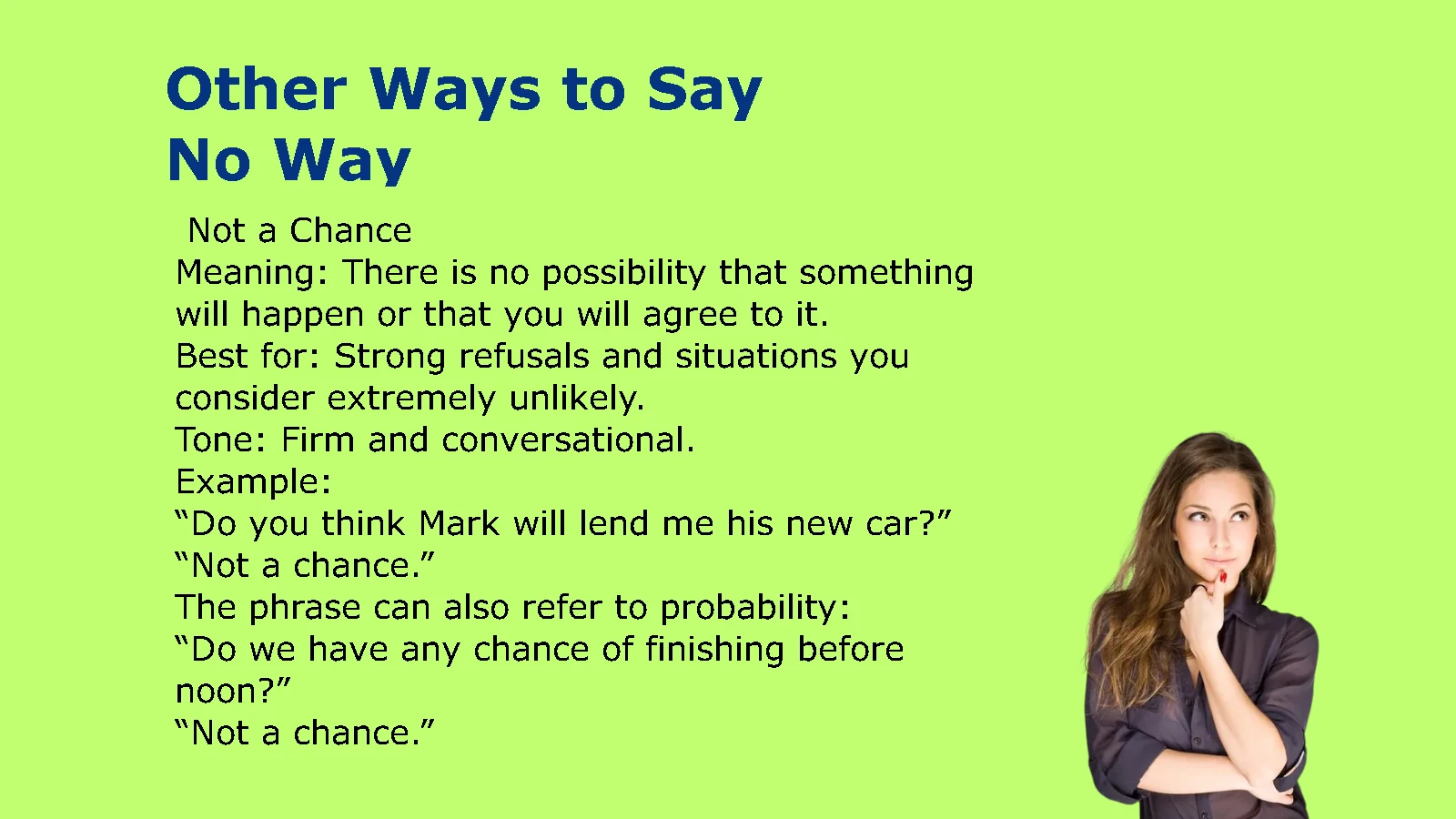
3. Not a Chance
Meaning: There is no possibility that something will happen or that you will agree to it.
Best for: Strong refusals and situations you consider extremely unlikely.
Tone: Firm and conversational.
Example:
“Do you think Mark will lend me his new car?”
“Not a chance.”
The phrase can also refer to probability:
“Do we have any chance of finishing before noon?”
“Not a chance.”
4. There’s No Way
Meaning: Something is impossible, extremely unlikely, or unacceptable.
Best for: Impossibility, disbelief, and strong disagreement.
Tone: Neutral and conversational.
Example:
“There’s no way we can fit all of this furniture into that room.”
This is especially useful when no way appears in a sentence rather than as a standalone response.
Compare:
“No way!”
with:
“There’s no way this will work.”
The second sentence explicitly describes something the speaker considers impossible.
5. No Chance
Meaning: Something is extremely unlikely or impossible.
Best for: Talking about possibility or probability.
Tone: Neutral and conversational.
Example:
“There’s no chance we’ll make the 6 p.m. train if we leave this late.”
No chance is particularly useful when you’re discussing whether something can happen.
It doesn’t always communicate the personal refusal that “no way” can express.
6. Not Happening
Meaning: Something will not be allowed to happen or will not happen.
Best for: Rejecting a plan, suggestion, request, or proposed action.
Tone: Casual and firm.
Example:
“You want to cancel the trip at the last minute? Not happening.”
This expression is common in casual American English and often sounds decisive.
7. I Don’t Think So
Meaning: A relatively indirect way to disagree, refuse, or say that something is unlikely.
Best for: Casual disagreement and less aggressive refusals.
Tone: Casual.
Example:
“Do you think I’m going to apologize for something I didn’t do?”
“I don’t think so.”
Compared with “absolutely not,” this can soften the response.
However, its meaning depends heavily on context and tone.
8. Nope
Meaning: An informal version of “no.”
Best for: Casual conversations, texting, friends, and relaxed situations.
Tone: Very casual.
Example:
“Are you going back there tonight?”
“Nope.”
Nope is not a formal substitute for “no way.” It’s simply an informal negative response that can carry some of the same force depending on how it’s delivered.
9. No, Thanks
Meaning: A polite way to decline an offer, invitation, or suggestion.
Best for: Social situations where you want to refuse without sounding harsh.
Tone: Polite and friendly.
Example:
“Would you like another piece of cake?”
“No, thanks. I’m full.”
If you’re looking for a polite alternative to “no way,” this is often much better than using a dramatic expression.
10. I’ll Pass
Meaning: A casual way to say that you don’t want to participate, accept something, or take an opportunity.
Best for: Invitations, offers, activities, and casual decisions.
Tone: Casual and polite.
Example:
“We’re going camping this weekend. Want to come?”
“I’ll pass this time.”
It usually sounds less confrontational than “no way.”
11. Forget It
Meaning: A way to reject an idea, request, or possibility, sometimes because you have decided that something isn’t worth pursuing.
Best for: Informal conversations and frustrated refusals.
Tone: Casual and sometimes dismissive.
Example:
“If they won’t fix the problem, forget it. I’ll find another company.”
Be careful with this phrase. Depending on your tone, it can sound irritated or rude.
12. Over My Dead Body
Meaning: An extremely strong and often dramatic way of saying that you will never allow something to happen.
Best for: Strong personal opposition, usually in humorous or exaggerated situations.
Tone: Dramatic and informal.
Example:
“You want to paint the living room neon green?”
“Over my dead body.”
This is not normally meant literally. It’s an exaggerated way to communicate strong opposition.
Because of its dramatic nature, it doesn’t belong in formal workplace communication.
13. Not in a Million Years
Meaning: Something is so unlikely or unacceptable that you cannot imagine it happening.
Best for: Strong refusal or disbelief.
Tone: Dramatic and conversational.
Example:
“Would you ever go skydiving?”
“Not in a million years.”
The phrase emphasizes how strongly you reject the possibility.
14. Under No Circumstances
Meaning: Something must not happen regardless of the situation.
Best for: Rules, serious instructions, policies, and strong formal refusals.
Tone: Formal and firm.
Example:
“Under no circumstances should confidential documents be shared outside the company.”
This is a useful formal way to say no way, but it isn’t appropriate for every casual conversation.
15. Out of the Question
Meaning: Something is completely unacceptable, impossible, or not available for consideration.
Best for: Rejecting a proposal, option, or possibility.
Tone: Firm and neutral.
Example:
“Buying another car right now is out of the question.”
This expression is especially useful when discussing decisions or options.
16. That’s Impossible
Meaning: Something cannot happen or cannot be true.
Best for: Rejecting the possibility of an event or questioning a claim.
Tone: Neutral and direct.
Example:
“That’s impossible. The store closed an hour ago.”
Unlike “absolutely not,” this expression focuses on impossibility rather than personal refusal.
That distinction makes it useful in factual discussions.
17. That Can’t Be Right
Meaning: You believe that information, a statement, or a result is incorrect.
Best for: Questioning surprising or apparently incorrect information.
Tone: Neutral.
Example:
“That can’t be right. My receipt says I paid $45.”
This is a better alternative to “no way” when you’re expressing doubt rather than refusing something.
18. You’re Kidding
Meaning: A casual way to express disbelief or surprise.
Best for: Unexpected news or surprising information.
Tone: Casual.
Example:
“You’re kidding! You got tickets to the final?”
The phrase can also be written as:
“You’re kidding.”
Your tone determines whether you’re genuinely asking or simply expressing surprise.
19. You’ve Got to Be Kidding Me
Meaning: A strong expression of disbelief, surprise, frustration, or annoyance.
Best for: Unexpected news or situations that seem unbelievable.
Tone: Very casual.
Example:
“You’ve got to be kidding me. They canceled the flight again?”
This is considerably more emotional than “I understand” or other neutral responses, so context matters.
20. Seriously?
Meaning: A short expression used to question whether something is really true or to show surprise or disbelief.
Best for: Unexpected statements, decisions, or news.
Tone: Casual.
Example:
“Seriously? You finished the entire project in one afternoon?”
The meaning changes with tone. It can express genuine curiosity, disbelief, annoyance, or amazement.
21. Are You Serious?
Meaning: A question used to show that something sounds surprising, unbelievable, or difficult to accept.
Best for: Unexpected news or claims.
Tone: Casual.
Example:
“Are you serious? They offered you the job?”
This is a natural choice when no way means “I can’t believe it.”
22. You Must Be Joking
Meaning: A way to say that you don’t believe what someone has just told you.
Best for: Surprising or unbelievable information.
Tone: Neutral to casual.
Example:
“You must be joking. The concert sold out in five minutes?”
It can sound slightly more restrained than “you’ve got to be kidding me.”
23. I Can’t Believe It
Meaning: An expression of strong surprise or disbelief.
Best for: Unexpected news, events, achievements, and shocking information.
Tone: Neutral and conversational.
Example:
“I can’t believe it. We actually won the competition!”
This phrase can express either positive or negative surprise.
For example:
“I can’t believe it! You met your favorite actor.”
and:
“I can’t believe it. They canceled the entire event.”
24. You’re Joking
Meaning: A way to express disbelief about something someone has said.
Best for: Surprising news and unexpected claims.
Tone: Casual.
Example:
“You’re joking. They really gave everyone the day off?”
It’s similar to “you’re kidding,” although the exact tone depends on the situation.
25. Not on Your Life
Meaning: A strong informal refusal meaning that you would never agree to or do something.
Best for: Strong personal refusals.
Tone: Informal and emphatic.
Example:
“Would you ever climb that mountain without a guide?”
“Not on your life.”
This is much stronger than a simple “no” and can sound dramatic.
26. No Way in Hell
Meaning: An extremely strong way to reject something or express disbelief.
Best for: Very informal conversations where strong language is acceptable.
Tone: Very informal and emphatic.
Example:
“No way in hell am I paying that much for a used car.”
This phrase can sound aggressive or vulgar because of hell, so it should generally be avoided in formal emails, professional communication, and polite situations.
27. Absolutely No Way
Meaning: A very emphatic refusal or expression of disbelief.
Best for: Strong reactions when you want to make your position unmistakable.
Tone: Firm and emphatic.
Example:
“Absolutely no way are we leaving without checking the weather first.”
This is close to the original expression and preserves much of its emotional force.
Professional Alternatives to “No Way”
If you’re writing a work email, business message, or professional response, no way can sound too casual or blunt.
The best replacement depends on what you’re trying to communicate.
When you need to refuse
Use:
- Absolutely not
- Definitely not
- Under no circumstances
- That isn’t possible
- That’s not something we can accommodate
- Unfortunately, we can’t do that
For example:
“Unfortunately, we can’t accommodate that request at this time.”
This communicates a refusal without sounding unnecessarily confrontational.
When you disagree
You could write:
“I don’t believe that’s the best approach.”
Or:
“I don’t think that would be feasible.”
These are more appropriate than “No way” when discussing a professional decision.
When something is impossible
Try:
“That isn’t feasible within the current timeline.”
Or:
“There isn’t a practical way to complete this by Friday.”
The important distinction is that you’re explaining why something cannot happen, rather than simply rejecting it.
Formal Ways to Say “No Way”
A formal alternative should usually avoid slang, dramatic expressions, and emotionally charged wording.
Good options include:
- Absolutely not
- Definitely not
- Under no circumstances
- Out of the question
- That isn’t possible
- That is not feasible
- That cannot be done
- I must respectfully decline
For example:
“Under no circumstances should these records be distributed externally.”
Or:
“I’m afraid that isn’t feasible within the current budget.”
The second example is particularly useful when you need to disagree without sounding unnecessarily harsh.
Casual Ways to Say “No Way”
Casual conversations give you much more flexibility.
Natural options include:
- Nope
- Not happening
- I don’t think so
- I’ll pass
- You’re kidding
- Seriously?
- Are you serious?
- You’ve got to be kidding me
- You’re joking
- No way in hell
For example:
“We’re getting up at 5 a.m. to go hiking.”
“Nope.”
Or:
“I just won two tickets to the game.”
“Seriously?”
The second response doesn’t mean “I refuse.” It means “I can’t believe that!”
Other Ways to Say “No Way” When You Mean “Absolutely Not”
Sometimes no way is simply a strong refusal.
In that situation, these expressions work particularly well:
| Phrase | Strength | Example |
| Absolutely not | Very strong | “Absolutely not. That’s too risky.” |
| Definitely not | Strong | “Definitely not. I already made other plans.” |
| Not a chance | Very strong | “Not a chance I’m paying that price.” |
| Not happening | Strong and casual | “Not happening. We’re staying home.” |
| Out of the question | Strong | “That option is out of the question.” |
| Under no circumstances | Very strong and formal | “Under no circumstances should you share the password.” |
| Over my dead body | Extreme and dramatic | “Over my dead body.” |
| Not on your life | Strong and informal | “Not on your life.” |
For everyday situations, absolutely not and definitely not are usually clearer than dramatic expressions.
Other Ways to Say “No Way” When You Mean “I Don’t Believe You”
The expression can also communicate disbelief.
For that meaning, consider:
- You’re kidding.
- You’re joking.
- You must be joking.
- Are you serious?
- Seriously?
- You’ve got to be kidding me.
- I can’t believe it.
- That can’t be right.
For example:
“I met Taylor Swift at the airport.”
Instead of:
“No way!”
you could say:
“You’re kidding!”
or:
“Seriously?”
or:
“I can’t believe it!”
These expressions preserve the feeling of surprise rather than turning the response into a refusal.
Other Ways to Say “No Way” When You Mean “Impossible”
When you mean that something cannot happen, use language that describes impossibility rather than disagreement.
Good choices include:
- There’s no way.
- No chance.
- That’s impossible.
- That isn’t possible.
- That can’t happen.
- That can’t be done.
- There’s no possible way.
- That’s not feasible.
- It’s out of the question.
For example:
“Can we finish all 500 orders before lunch?”
A natural response might be:
“There’s no way.”
In a professional context, you could say:
“That isn’t feasible within the current timeline.”
The second version sounds more measured and explains the issue without unnecessary emotion.
“No Way” vs. “Absolutely Not”
These expressions are close when you’re refusing something, but they don’t always sound identical.
No way is more conversational and can carry surprise or disbelief.
Absolutely not is more direct and specifically communicates refusal or disagreement.
Compare:
“No way! You actually met him?”
Here, “no way” expresses surprise.
But:
“Absolutely not. We’re not changing the agreement.”
Here, “absolutely not” clearly communicates refusal.
So if you’re replacing no way in a professional message, absolutely not may work when the original expression means a firm refusal. It won’t work when “no way” means “I can’t believe it.”
“No Way” vs. “There’s No Way”
These two expressions are related but can perform different grammatical jobs.
No way can stand alone:
“Are you going to do it?”
“No way.”
There’s no way usually introduces a statement about impossibility:
“There’s no way we’re going to finish this tonight.”
You can also use it for disbelief:
“There’s no way he said that.”
In the second example, the speaker is saying that they strongly doubt the statement is true.
“No Way” vs. “Not a Chance”
Not a chance usually communicates either strong refusal or the belief that something is extremely unlikely.
“Will you let him borrow your new car?”
“Not a chance.”
Here, it means “absolutely not.”
It can also describe probability:
“Do you think we’ll get there before the store closes?”
“Not a chance.”
Unlike “no way,” not a chance is particularly natural when discussing whether something is possible or likely.
“No Way” vs. “Out of the Question”
Out of the question means that something isn’t an acceptable option.
“Can we postpone the payment again?”
“That’s out of the question.”
This expression works well in discussions about decisions, plans, or options.
It generally sounds more deliberate than “no way,” making it useful in professional or serious conversations.
“No Way” vs. “I Don’t Think So”
These expressions can both reject an idea, but their strength differs.
“Want to go out tonight?”
“I don’t think so.”
This sounds relatively soft.
“Want to go out tonight?”
“Absolutely not.”
This sounds much stronger.
Therefore, I don’t think so is useful when you want to disagree or decline without making the response sound overly forceful.
What Is the Best Alternative to “No Way”?
There isn’t one universal best alternative because no way has several meanings.
Use this quick guide:
- Strong refusal: Absolutely not
- Polite refusal: No, thanks
- Casual refusal: Nope
- Professional refusal: Unfortunately, that’s not possible
- Impossible situation: There’s no way
- Extremely unlikely: Not a chance
- Strong disagreement: Definitely not
- Surprise: Seriously?
- Disbelief: You’re kidding
- Strong surprise: You’ve got to be kidding me
- Formal prohibition: Under no circumstances
- Rejected option: Out of the question
- Casual decline: I’ll pass
- Dramatic refusal: Over my dead body
How to Choose the Right Alternative
Before replacing “no way,” identify what you want your listener or reader to understand.
If you’re saying no
Choose absolutely not, definitely not, or not a chance.
If you’re declining politely
Choose no, thanks or I’ll pass.
If you’re talking about impossibility
Choose there’s no way, that’s impossible, or that’s not feasible.
If you’re expressing surprise
Choose seriously?, are you serious?, or I can’t believe it.
If you’re expressing disbelief
Choose you’re kidding, you’re joking, or you must be joking.
If you’re writing formally
Choose under no circumstances, out of the question, or that isn’t possible, depending on the context.
If you’re talking casually with friends
Choose nope, not happening, seriously?, you’re kidding, or I’ll pass.
The goal isn’t to find the most dramatic synonym. It’s to find the expression that communicates the same idea at the right level of intensity.
Common Mistakes When Replacing “No Way”
Using “Absolutely Not” for Surprise
If someone tells you:
“I just won a free trip to Hawaii!”
Responding with:
“Absolutely not.”
changes the meaning completely.
If you’re expressing surprise, say:
“No way!”
or:
“You’re kidding!”
Using “Under No Circumstances” in Casual Conversation
This phrase is grammatically correct, but it can sound unnecessarily formal among friends.
Instead of:
“Under no circumstances am I going to that party.”
you might naturally say:
“No way I’m going to that party.”
or:
“Not happening.”
Using “No Chance” When You Mean Refusal
“No chance” can mean that something is unlikely rather than that you personally refuse.
For example:
“There’s no chance we’ll finish by five.”
This describes probability.
If you’re personally rejecting a request, absolutely not or not a chance may be clearer.
Using Dramatic Expressions in Professional Emails
Phrases such as over my dead body and no way in hell may work with close friends, but they can sound hostile or inappropriate in professional communication.
Instead, try:
“I’m afraid that’s not possible.”
or:
“That isn’t something we can approve.”
Examples of “No Way” in Different Situations
Refusing an invitation
Original:
“Do you want to go camping in the middle of winter?”
Alternative:
“Not a chance.”
Declining politely
Original:
“Would you like another serving?”
Alternative:
“No, thanks. I’m full.”
Expressing surprise
Original:
“I got tickets to the championship game.”
Alternative:
“Seriously? That’s amazing!”
Expressing disbelief
Original:
“They finished the entire renovation in three days.”
Alternative:
“You’re kidding.”
Saying something is impossible
Original:
“Can we get there in ten minutes?”
Alternative:
“There’s no way.”
Rejecting a proposal
Original:
“Let’s cancel the contract without reviewing it.”
Alternative:
“That’s out of the question.”
Giving a formal refusal
Original:
“Can confidential information be shared with outside parties?”
Alternative:
“Under no circumstances should confidential information be shared externally.”
Frequently Asked Questions
What are some other ways to say “no way”?
Natural alternatives include absolutely not, definitely not, not a chance, there’s no way, no chance, not happening, I don’t think so, nope, no, thanks, I’ll pass, out of the question, seriously?, you’re kidding, and are you serious?
The best choice depends on whether you’re refusing, expressing disbelief, showing surprise, or describing something as impossible.
What is a polite way to say “no way”?
Try no, thanks, I’d rather not, I don’t think so, or I’ll pass when you want to decline without sounding overly forceful.
For professional communication, I’m afraid that’s not possible or unfortunately, we can’t accommodate that request may work better.
What is a professional way to say “no way”?
Depending on the meaning, use that’s not possible, that isn’t feasible, I don’t believe that’s possible, unfortunately, we can’t accommodate that, or under no circumstances.
The best choice depends on whether you’re declining a request, disagreeing with a proposal, or explaining an actual limitation.
What is a formal way to say “no way”?
Under no circumstances, that is not possible, that is not feasible, and out of the question can all work in formal situations when their meanings fit.
What can I say instead of “no way” in a text?
For casual texting, natural choices include nope, seriously?, you’re kidding, you’re joking, not happening, I don’t think so, and I’ll pass.
Choose based on what you mean. “Seriously?” shows surprise, while “not happening” communicates refusal.
Is “no way” rude?
Not necessarily. Its tone depends heavily on context.
“No way!” can express excitement or surprise:
“No way! You got the job?”
But:
“No way. I’m not doing that.”
is a firm refusal.
In professional situations, a more specific and measured phrase can prevent your response from sounding blunt.
Is “no way” formal or informal?
No way is generally conversational and informal. It can appear in many contexts, but formal writing often benefits from more precise alternatives such as that isn’t possible, under no circumstances, or out of the question.
What is another word for “no way” when expressing disbelief?
Try you’re kidding, you’re joking, you must be joking, seriously?, are you serious?, or I can’t believe it.
For example:
“I met my favorite actor at the airport.”
“You’re kidding!”
What is another way to say “no way” when refusing?
Good choices include absolutely not, definitely not, not a chance, not happening, out of the question, and under no circumstances.
The intensity varies, so choose according to how strong you want the refusal to sound.
What is a softer way to say “no way”?
I don’t think so, I’ll pass, and no, thanks are generally softer than absolutely not or no way in hell.
For example:
“Would you like to join us for dinner?”
“I’ll pass tonight, but thanks for asking.”
That response declines the invitation without sounding confrontational.
What is a stronger way to say “no way”?
Depending on context, absolutely not, not a chance, absolutely no way, over my dead body, and no way in hell are stronger choices.
The last two are highly informal or dramatic, so they aren’t suitable for every situation.
Final Thoughts
There are plenty of other ways to say no way, but the right choice depends on what you’re actually trying to communicate.
For a strong refusal, use absolutely not, definitely not, or not a chance. When something is impossible, there’s no way or that’s impossible is clearer. If you’re surprised by unexpected news, seriously?, you’re kidding, or I can’t believe it will sound more natural.
For polite situations, no, thanks and I’ll pass soften the response. In professional writing, expressions such as that’s not possible, that isn’t feasible, and under no circumstances can communicate the same basic idea with a more appropriate tone.
The most natural replacement isn’t always the phrase closest to “no way.” Match the alternative to the meaning, situation, and level of intensity you need. That small adjustment can make your English sound much more precise and natural.













